Kirjojen hintavertailu. Mukana 12 595 353 kirjaa ja 12 kauppaa.

Kirjailija

David Simpson

Kirjat ja teokset yhdessä paikassa: 72 kirjaa, julkaisuja vuosilta 1979-2024, suosituimpien joukossa A Discourse on Dreams and Night-Visions, with Numerous Examples Ancient and Modern. by the Revd. David Simpson, M.A.. Vertaile teosten hintoja ja tarkista saatavuus suomalaisista kirjakaupoista.

72 kirjaa

Kirjojen julkaisuhaarukka 1979-2024.

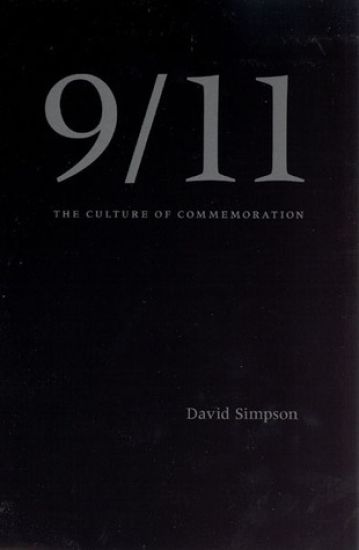
9/11

9/11

David Simpson

University of Chicago Press
2006
nidottu
After the terrorist attacks of September 11, 2001, a general sense that the world was different - that nothing would ever be the same - settled upon a grieving nation; and the events of that day were received as cataclysmic disruptions of an ordered world. Refuting this claim, David Simpson examines the complex and paradoxical character of American public discourse since that September morning, considering the ways the event has been aestheticized, exploited, and appropriated, while "Ground Zero" remains the contested site of an effort at adequate commemoration. In 9/11, Simpson argues that elements of the conventional culture of mourning and remembrance - grieving the dead, summarizing their lives in obituaries, and erecting monuments in their memory - have been co-opted for political advantage. He also confronts those who labeled the event an "apocalypse," condemning their exploitation of 9/11 for the defense of torture and war. In four elegant chapters - two of which expand on essays originally published in the "London Review of Books" to great acclaim - Simpson analyzes the response to 9/11: the nationally syndicated "Portraits of Grief" obituaries in the "New York Times"; the debates over the rebuilding of the World Trade Center towers and the memorial design; the representation of American and Iraqi dead after the invasion of March 2003, along with the worldwide circulation of the Abu Ghraib torture photographs; and the urgent and largely ignored critique of homeland rhetoric from the domain of critical theory. Calling for a sustained cultural and theoretical analysis, "9/11" is the first book of its kind to consider the events of that tragic day with a perspective so firmly grounded in the humanities and so persuasive about the contribution they can make to our understanding of its consequences.

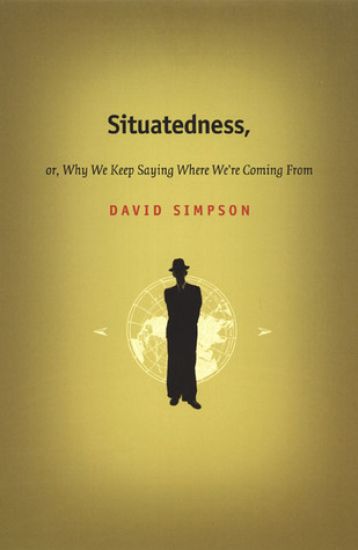
Situatedness, or, Why We Keep Saying Where We're Coming from
“Let me tell you where I'm coming from . . .”-so begins many a discussion in contemporary U.S. culture. Pressed by an almost compulsive desire to situate ourselves within a definite matrix of reference points (for example, “as a parent of two children” or “as an engineer” or “as a college graduate”) in both scholarly inquiry and everyday parlance, we seem to reject adamantly the idea of a universal human subject. Yet what does this rhetoric of self-affiliation tell us? What is its history? David Simpson’s Situatedness casts a critical eye on this currently popular form of identification, suggesting that, far from being a simple turn of phrase, it demarcates a whole structure of thinking.Simpson traces the rhetorical syndrome through its truly interdisciplinary genealogy. Discussing its roles within the fields of legal theory, social science, fiction, philosophy, and ethics, he argues that the discourse of situatedness consists of a volatile fusion of modesty and aggressiveness. It oscillates, in other words, between accepting complete causal predetermination and advocating personal agency and responsibility. Simpson’s study neither fully rejects nor endorses the present-day language of self-specification. Rather it calls attention to the limitations and opportunities of situatedness-a notion whose ideological slippage it ultimately sees as allowing late-capitalist liberal democracies to function. Given its wide scope and lively rendering, Situatedness will attract a range of scholars in the humanities and legal studies. It will also interest all those for whom the politics of subjectivity pose real problems of authority, identity, and belief.
Situatedness, or, Why We Keep Saying Where We're Coming from
“Let me tell you where I'm coming from . . .”-so begins many a discussion in contemporary U.S. culture. Pressed by an almost compulsive desire to situate ourselves within a definite matrix of reference points (for example, “as a parent of two children” or “as an engineer” or “as a college graduate”) in both scholarly inquiry and everyday parlance, we seem to reject adamantly the idea of a universal human subject. Yet what does this rhetoric of self-affiliation tell us? What is its history? David Simpson’s Situatedness casts a critical eye on this currently popular form of identification, suggesting that, far from being a simple turn of phrase, it demarcates a whole structure of thinking.Simpson traces the rhetorical syndrome through its truly interdisciplinary genealogy. Discussing its roles within the fields of legal theory, social science, fiction, philosophy, and ethics, he argues that the discourse of situatedness consists of a volatile fusion of modesty and aggressiveness. It oscillates, in other words, between accepting complete causal predetermination and advocating personal agency and responsibility. Simpson’s study neither fully rejects nor endorses the present-day language of self-specification. Rather it calls attention to the limitations and opportunities of situatedness-a notion whose ideological slippage it ultimately sees as allowing late-capitalist liberal democracies to function. Given its wide scope and lively rendering, Situatedness will attract a range of scholars in the humanities and legal studies. It will also interest all those for whom the politics of subjectivity pose real problems of authority, identity, and belief.
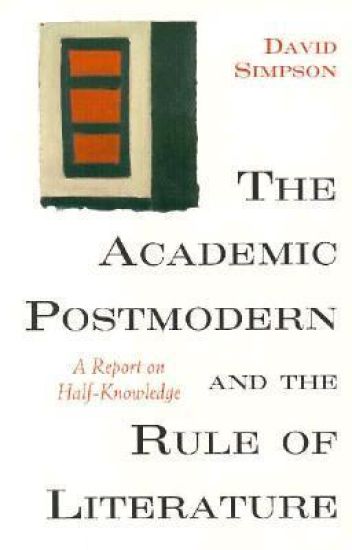
The Academic Postmodern and the Rule of Literature

The Academic Postmodern and the Rule of Literature

David Simpson

University of Chicago Press
1995
sidottu
This critique of the postmodern turn discusses the distinctive aspects of postmodern scholarship: the pervasiveness of the literary and the flight from grand theory to local knowledge. Simpson examines defining features of postmodern thought - storytelling, autobiography, anecdote and localism - and traces their unacknowledged roots in literature and literary criticism. Considering such examples as the conversational turn in philosophy led by Richard Rorty and the anecdotal qualities of the New Historicism, he argues that much of contemporary scholarship is literary in its terms, methods, and assumptions about knowledge; in their often unconscious adoption of literary approaches, scholars have a limited way of looking at the world. He warns scholars against mistaking the migration of ideas from one discipline to another for a radically new response to the postmodern age. In his assessment of the academic postmodern enterprise, Simpson recognizes that both the literary turn and the emphasis on local, subjective voices have done much to enrich knowledge. But he also identifies the danger in abandoning synthetic knowledge to particular truths, cautioning that "we would be foolish to pretend that little narratives are true alternatives to grand ones, rather than chips off a larger block whose shape we can no longer see because we are not looking."
The Academic Postmodern and the Rule of Literature

The Academic Postmodern and the Rule of Literature

David Simpson

University of Chicago Press
1995
nidottu
This critique of the postmodern turn discusses the distinctive aspects of postmodern scholarship: the pervasiveness of the literary and the flight from grand theory to local knowledge. Simpson examines defining features of postmodern thought - storytelling, autobiography, anecdote and localism - and traces their unacknowledged roots in literature and literary criticism. Considering such examples as the conversational turn in philosophy led by Richard Rorty and the anecdotal qualities of the New Historicism, he argues that much of contemporary scholarship is literary in its terms, methods, and assumptions about knowledge; in their often unconscious adoption of literary approaches, scholars have a limited way of looking at the world. He warns scholars against mistaking the migration of ideas from one discipline to another for a radically new response to the postmodern age. In his assessment of the academic postmodern enterprise, Simpson recognizes that both the literary turn and the emphasis on local, subjective voices have done much to enrich knowledge. But he also identifies the danger in abandoning synthetic knowledge to particular truths, cautioning that "we would be foolish to pretend that little narratives are true alternatives to grand ones, rather than chips off a larger block whose shape we can no longer see because we are not looking."
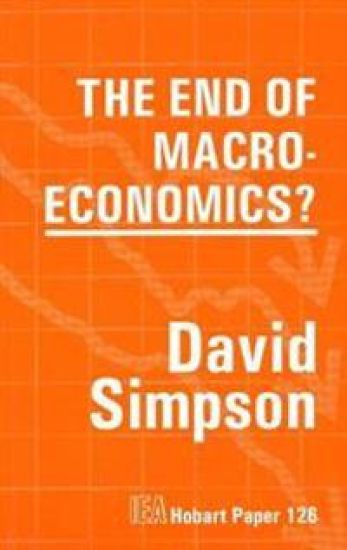
The End of Macroeconomics

The End of Macroeconomics

David Simpson

Institute of Economic Affairs
1994
nidottu
CONTENTS: Introduction; What is Macro-Economics?; The Failure of Macro-Economic Policy; The failure of Macro-Economic Theory; The Classical Alternative; Implications of the Alternative Approach; Summary & Conclusions.
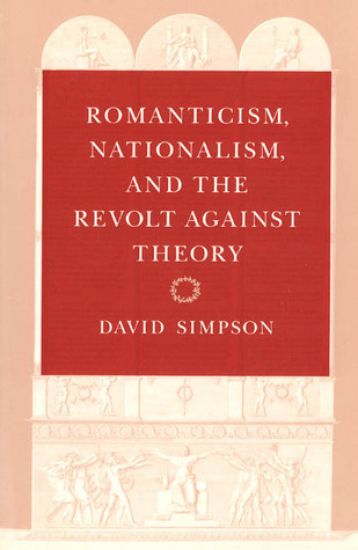
Romanticism, Nationalism, and the Revolt against Theory

Romanticism, Nationalism, and the Revolt against Theory

David Simpson

University of Chicago Press
1993
nidottu
Why has Anglo-American culture for so long regarded "theory" with intense suspicion? In this important contribution to the history of critical theory, David Simpson argues that a nationalist myth underlies contemporary attacks on theory. Theory's antagonists, Simpson shows, invoke the same criteria of common sense and national solidarity as did the British intellectuals who rebelled against "theory" and "method" during the French Revolution. Simpson demonstrates the close association between "theory" and "method" and shows that by the mid-eighteenth century, "method" had acquired distinctly subversive associations in England. Attributed increasingly to the French and the Germans, "method" paradoxically evoked images both of inhuman rationality and unbridled sentimentality; in either incarnation, it was seen as a threat to what was claimed to be authentically British. Simpson develops these paradigms in relation to feminism, the gendering of Anglo-American culture, and the emergence of literature and literary criticism as antitheoretical discourses. He then looks at the Romantic poets' response to this confining ideology of the cultural role of literature. Finally, Simpson considers postmodern theory's claims for the radical energy of nonrational or antirationalist positions. This is an essential book not only for students of the Romantic period and intellectual historians concerned with the idea of "method," but for anyone interested in the historical background of today's debates over the excesses and possibilities of "theory."
Wordsworth and the Figurings of the Real

Wordsworth and the Figurings of the Real

David Simpson

Palgrave Macmillan
1982
sidottu
Perhaps the most powerful feature of the Romantic imagination is its ability to dissolve existing form and order and create it anew. The Romantic investigation of the functions of the imagination also leads to important insights concerning its problems and dangers. Because it separates the person experiencing it from others around him, the imagination introduces ways of seeing which cannot be assumed to be simply communicable or easily shared, and which have as their objects different forms or 'things'. These forms, or figures, risk becoming for their originators both vehicles of power, in so far as they do convince others of their reality, and limiting constructs of prefigured order, inhibiting their users from the perception of new relations and alternative meanings. When the figured becomes the real, there thus arise difficulties in both individual and social perceptions. Arguing from the stance that all perception takes place by a creative (and hence potentially divisive) assembly of images or qualities into things, David Simpson shows that the analysis of figurative representation in Wordsworth's writing is of central importance to his idea of the human mind, and the way in which it is affected or allowed to function by its environment, both human and physical. In this way Wordsworth's ideas about the function of literature in society are seen to be more fully worked out than readers have often assumed them to be. Simpson pays particular attention to the ethical consequences of different ways of figuring the real, offering an explanation of Wordsworth's distinction between life in the town and life among the mountains and lakes of north-west England. In relating Wordsworth's poetry to important contemporary debates in political economy such as those concerning the division of labour and the evaluation of the advantages and disadvantages of commerce and luxury, he suggests that Wordsworth is a notable precursor of that nineteenth-century tradition which sees themind as open to critical determination by social and environmental factors.
Wordsworth and the Figurings of the Real

Wordsworth and the Figurings of the Real

David Simpson

Palgrave Macmillan
1982
nidottu
Perhaps the most powerful feature of the Romantic imagination is its ability to dissolve existing form and order and create it anew. The Romantic investigation of the functions of the imagination also leads to important insights concerning its problems and dangers. Because it separates the person experiencing it from others around him, the imagination introduces ways of seeing which cannot be assumed to be simply communicable or easily shared, and which have as their objects different forms or 'things'. These forms, or figures, risk becoming for their originators both vehicles of power, in so far as they do convince others of their reality, and limiting constructs of prefigured order, inhibiting their users from the perception of new relations and alternative meanings. When the figured becomes the real, there thus arise difficulties in both individual and social perceptions. Arguing from the stance that all perception takes place by a creative (and hence potentially divisive) assembly of images or qualities into things, David Simpson shows that the analysis of figurative representation in Wordsworth's writing is of central importance to his idea of the human mind, and the way in which it is affected or allowed to function by its environment, both human and physical. In this way Wordsworth's ideas about the function of literature in society are seen to be more fully worked out than readers have often assumed them to be. Simpson pays particular attention to the ethical consequences of different ways of figuring the real, offering an explanation of Wordsworth's distinction between life in the town and life among the mountains and lakes of north-west England. In relating Wordsworth's poetry to important contemporary debates in political economy such as those concerning the division of labour and the evaluation of the advantages and disadvantages of commerce and luxury, he suggests that Wordsworth is a notable precursor of that nineteenth-century tradition which sees themind as open to critical determination by social and environmental factors.