Kirjojen hintavertailu. Mukana 12 595 353 kirjaa ja 12 kauppaa.

Kirjailija

David Singleton

Kirjat ja teokset yhdessä paikassa: 11 kirjaa, julkaisuja vuosilta 1999-2023, suosituimpien joukossa Language Acquisition. Vertaile teosten hintoja ja tarkista saatavuus suomalaisista kirjakaupoista.

11 kirjaa

Kirjojen julkaisuhaarukka 1999-2023.

Second Language Acquisition and Lifelong Learning

Second Language Acquisition and Lifelong Learning

Simone E. Pfenninger; Julia Festman; David Singleton

TAYLOR FRANCIS LTD
2023
nidottu
Language fundamentally defines and distinguishes us as humans, as members of society, and as individuals. As we go through life, our relationship with language and with learning shifts and changes, but it remains significant. This book is an up-to-date resource for graduate students and researchers in second language (L2) acquisition who are interested in language learning across the lifespan. The main goal is to survey and evaluate what is known about the linguistic-cognition-affect associations that occur in L2 learning from birth through senescence (passing through the stages of childhood, adolescence, adulthood, and third age), the extent to which L2 acquisition may be seen as contributing to healthy and active aging, the impact of the development of personalized, technology-enhanced communicative L2 environments, and how these phenomena are to be approached scientifically and methodologically. The effects of certain specific variables, such as gender, socio-economic background, and bilingualism are also analyzed, as we argue that chronological age does not determine the positioning of L2 learners across the lifespan: age is part of a complex web of social distinctions such as psychological and individual factors that intersect in the construction of a learner’s relative status and opportunities.

Second Language Acquisition and Lifelong Learning

Second Language Acquisition and Lifelong Learning

Simone E. Pfenninger; Julia Festman; David Singleton

TAYLOR FRANCIS LTD
2023
sidottu
Language fundamentally defines and distinguishes us as humans, as members of society, and as individuals. As we go through life, our relationship with language and with learning shifts and changes, but it remains significant. This book is an up-to-date resource for graduate students and researchers in second language (L2) acquisition who are interested in language learning across the lifespan. The main goal is to survey and evaluate what is known about the linguistic-cognition-affect associations that occur in L2 learning from birth through senescence (passing through the stages of childhood, adolescence, adulthood, and third age), the extent to which L2 acquisition may be seen as contributing to healthy and active aging, the impact of the development of personalized, technology-enhanced communicative L2 environments, and how these phenomena are to be approached scientifically and methodologically. The effects of certain specific variables, such as gender, socio-economic background, and bilingualism are also analyzed, as we argue that chronological age does not determine the positioning of L2 learners across the lifespan: age is part of a complex web of social distinctions such as psychological and individual factors that intersect in the construction of a learner’s relative status and opportunities.
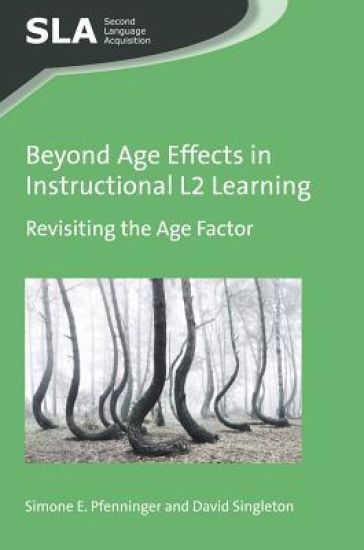
Beyond Age Effects in Instructional L2 Learning

Beyond Age Effects in Instructional L2 Learning

Simone E. Pfenninger; David Singleton

Multilingual Matters
2017
sidottu
This book constitutes a holistic study of how and why late starters surpass early starters in comparable instructional settings. Combining advanced quantitative methods with individual-level qualitative data, it examines the role of age of onset in the context of the Swiss multilingual educational system and focuses on performance at the beginning and end of secondary school, thereby offering a long-term view of the teenage experience of foreign language learning. The study scrutinised factors that seem to prevent young starters from profiting from their extended learning period and investigated the mechanisms that enable late beginners to catch up with early beginners relatively quickly. Taking account of contextual factors, individual socio-affective factors and instructional factors within a single longitudinal study, the book makes a convincing case that age of onset is not only of minimal relevance for many aspects of instructed language acquisition, but that in this context, for a number of reasons, a later onset can be beneficial.
Beyond Age Effects in Instructional L2 Learning

Beyond Age Effects in Instructional L2 Learning

Simone E. Pfenninger; David Singleton

Multilingual Matters
2017
nidottu
This book constitutes a holistic study of how and why late starters surpass early starters in comparable instructional settings. Combining advanced quantitative methods with individual-level qualitative data, it examines the role of age of onset in the context of the Swiss multilingual educational system and focuses on performance at the beginning and end of secondary school, thereby offering a long-term view of the teenage experience of foreign language learning. The study scrutinised factors that seem to prevent young starters from profiting from their extended learning period and investigated the mechanisms that enable late beginners to catch up with early beginners relatively quickly. Taking account of contextual factors, individual socio-affective factors and instructional factors within a single longitudinal study, the book makes a convincing case that age of onset is not only of minimal relevance for many aspects of instructed language acquisition, but that in this context, for a number of reasons, a later onset can be beneficial.
Key Topics in Second Language Acquisition

Key Topics in Second Language Acquisition

Vivian Cook; David Singleton

Multilingual Matters
2014
sidottu
This textbook offers an introductory overview of eight hotly-debated topics in second language acquisition research. It offers a glimpse of how SLA researchers have tried to answer common questions about second language acquisition rather than being a comprehensive introduction to SLA research. Each chapter comprises an introductory discussion of the issues involved and suggestions for further reading and study. The reader is asked to consider the issues based on their own experiences, thus allowing them to compare their own intuitions and experiences with established research findings and gain an understanding of methodology. The topics are treated independently so that they can be read in any order that interests the reader. The topics in question are: • how different languages connect in the mind; • whether there is a best age for learning a second language; • the importance of grammar in acquiring and using a second language; • how the words of a second language are acquired; • how people learn to write in a second language; • how attitude and motivation help in learning a second language; • the usefulness of second language acquisition research for language teaching; • the goals of language teaching.
Key Topics in Second Language Acquisition

Key Topics in Second Language Acquisition

Vivian Cook; David Singleton

Multilingual Matters
2014
nidottu
This textbook offers an introductory overview of eight hotly-debated topics in second language acquisition research. It offers a glimpse of how SLA researchers have tried to answer common questions about second language acquisition rather than being a comprehensive introduction to SLA research. Each chapter comprises an introductory discussion of the issues involved and suggestions for further reading and study. The reader is asked to consider the issues based on their own experiences, thus allowing them to compare their own intuitions and experiences with established research findings and gain an understanding of methodology. The topics are treated independently so that they can be read in any order that interests the reader. The topics in question are: • how different languages connect in the mind; • whether there is a best age for learning a second language; • the importance of grammar in acquiring and using a second language; • how the words of a second language are acquired; • how people learn to write in a second language; • how attitude and motivation help in learning a second language; • the usefulness of second language acquisition research for language teaching; • the goals of language teaching.
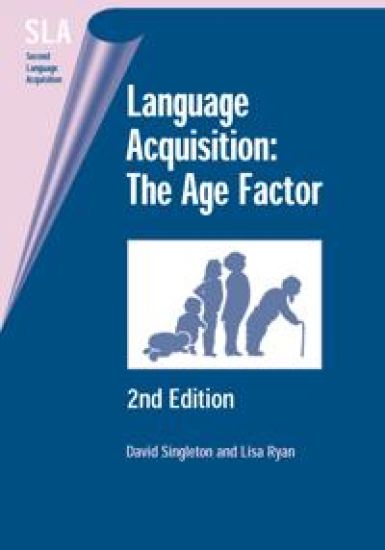
Language Acquisition

Language Acquisition

David Singleton; Lisa Ryan

Multilingual Matters
2004
nidottu
This book examines the evidence relative to the idea that there is an age factor in first and second language acquisition, evidence that has sources ranging from studies of feral children to evaluations of language programmes in primary schools. It goes on to explore the various explanations that have been advanced to account for such evidence. Finally, it looks at the educational ramifications of the age question, with particular regard to formal second language teaching in the early school years and in ‘third age’ contexts.
Language and the Lexicon

Language and the Lexicon

David Singleton

Hodder Arnold
2000
nidottu
The lexicon represents the building blocks of language: words and vocabulary. Most of us think of language in terms of words, and words are also integral to the way in which linguists approach language as an object of study. The lexicon and lexical issues must be taken in consideration in every domain of language study and, conversely, the lexicon cannot be viewed in isolation from other aspects of language.'Language and the Lexicon' provides a comprehensive yet accessible overview of lexicology, introducing the reader to the lexicon by exploring the lexical aspects of a range of different areas of language: syntax, morphology, semantics, phonology, language variation, language change, language acquisition and language processing. Assuming no prior knowledge of linguistics, the book introduces the key concepts employing examples from a wide variety of languages in order to illustrate the points made.This book is ideally suited to those approaching lexicology for the first time. With its wide breadth of focus and diverse topics, it can equally serve as a first introduction to linguistics.
Exploring the Second Language Mental Lexicon

Exploring the Second Language Mental Lexicon

David Singleton

Cambridge University Press
1999
pokkari
Unlike many recent books on L2 vocabulary and processing, this volume does not set out to offer a complex perspective of the L2 lexicon, but rather represents a sustained attempt to come to grips with some very basic questions clustered around the relationship between the L2 mental lexicon and the L1 mental lexicon. It provides a substantial review of L1 and L2 lexical research issues such as similarities and differences between the conditions of L1 and L2 acquisition, the respective roles of form and meaning in L1 and L2 processing, and the degree of separation/integration between L1 and the L2 lexical operations. New research into the L2 lexicon from the Trinity College Dublin Modern Languages Project is considered in the latter part of the volume.