Kirjojen hintavertailu. Mukana 12 390 323 kirjaa ja 12 kauppaa.

Kirjailija

David Sloan Wilson

Kirjat ja teokset yhdessä paikassa: 10 kirjaa, julkaisuja vuosilta 1999-2023, suosituimpien joukossa Finnes altruisme?. Vertaile teosten hintoja ja tarkista saatavuus suomalaisista kirjakaupoista.

10 kirjaa

Kirjojen julkaisuhaarukka 1999-2023.

Atlas Hugged

Atlas Hugged

David Sloan Wilson

Vidlit
2023
pokkari
"Atlas Hugged signals a revolution in the way we see the world and our rightful place within it. Not a violent revolution, thankfully, but an intellectual revolution."With these words, David Sloan Wilson invites readers into a fictional world that mirrors events taking place in the real world-the rapid evolution of worldwide cooperation. Wilson is uniquely positioned to tell this story. As a scientist, he helped to lay the theoretical foundation for the intellectual revolution with books such as Unto Others (with philosopher Elliott Sober), Darwin's Cathedral, and Does Altruism Exist? As a nonfiction writer, his books Evolution for Everyone, The Neighborhood Project, and This View of Life already reach a wide audience. With Atlas Hugged, Wilson returns to his familial roots as the son of novelist Sloan Wilson, who helped to define the 1950s with his novels The Man in the Grey Flannel Suit and A Summer Place. There is nothing like a story for conveying a moral worldview. Atlas Hugged is many things, but above all it is a story of two young people trying to tell right from wrong without needing to peer through a tissue of lies.
This View of Life

This View of Life

David Sloan Wilson

Vintage Books
2020
nidottu
It is widely understood that Charles Darwin's theory of evolution completely revolutionized the study of biology. Yet, according to David Sloan Wilson, the Darwinian revolution won't be truly complete until it is applied more broadly--to everything associated with the words human, culture, and policy. In a series of engaging and insightful examples--from the breeding of hens to the timing of cataract surgeries to the organization of an automobile plant--Wilson shows how an evolutionary worldview provides a practical tool kit for understanding not only genetic evolution but also the fast-paced changes that are having an impact on our world and ourselves. What emerges is an incredibly empowering argument: If we can become wise managers of evolutionary processes, we can solve the problems of our age at all scales--from the efficacy of our groups to our well-being as individuals to our stewardship of the planet Earth
Does Altruism Exist?

Does Altruism Exist?

David Sloan Wilson

Yale University Press
2016
pokkari
A powerful treatise that demonstrates the existence of altruism in nature, with surprising implications for human society Does altruism exist? Or is human nature entirely selfish? In this eloquent and accessible book, famed biologist David Sloan Wilson provides new answers to this age-old question based on the latest developments in evolutionary science. From an evolutionary viewpoint, Wilson argues, altruism is inextricably linked to the functional organization of groups. “Groups that work” undeniably exist in nature and human society, although special conditions are required for their evolution. Humans are one of the most groupish species on earth, in some ways comparable to social insect colonies and multi-cellular organisms. The case that altruism evolves in all social species is surprisingly simple to make. Yet the implications for human society are far from obvious. Some of the most venerable criteria for defining altruism aren’t worth caring much about, any more than we care much whether we are paid by cash or check. Altruism defined in terms of thoughts and feelings is notably absent from religion, even though altruism defined in terms of action is notably present. The economic case for selfishness can be decisively rejected. The quality of everyday life depends critically on people who overtly care about the welfare of others. Yet, like any other adaptation, altruism can have pathological manifestations. Wilson concludes by showing how a social theory that goes beyond altruism by focusing on group function can help to improve the human condition.Co-published with Templeton Press
Finnes altruisme?

Finnes altruisme?

David Sloan Wilson

Cappelen Damm akademisk
2015
nidottu
Finnes den ekte, uselviske altruismen? Eller har den naturlige utvelgelsen gjort oss umedgjørlige og egoistiske i vår streben etter overlevelse? David Sloan Wilsons «kortfattede bok om et stort spørsmål» er ikke bare en invitasjon til å delta på en utfordrende reise gjennom evolusjonsbiologien, men også et ambisiøst og entusiastisk vitenskapelig forsvarsskrift for betydningen av altruisme – ikke bare for menneskeartens overlevelse, men også for fremtiden til global politikk, forretningsutvikling og utformingen av politiske retningslinjer. Uten å la seg avskrekke av den kompleksiteten som tidligere kjennetegnet biologivitenskapen gjennom dens legitimering av rasediskriminering, totalitær undertrykkelse og rå kapitalisme, foreslår Wilson et modig, vitenskapelig fundert paradigmeskifte: en overgang fra en verden preget av den konkurranselystne arten homo economicus til en verden hvor samarbeid og altruisme er garantister for menneskets overlevelse på jorda.Fra Nina Witoszeks etterord til Finnes altruisme?
The Neighborhood Project

The Neighborhood Project

David Sloan Wilson

Little, Brown Company
2011
sidottu
After decades of studying animals in their habitats, evolutionary biologist David Sloan Wilson had a radical idea-apply evolutionary science to the study of a city. Cities are like organisms, so why not study them as such?Inspired to become an agent of change in his post-industrial hometown, Wilson descended on its neighborhoods with a scientist's eye. What does bullying feed on? How can we give kids the best start in life? Is spirituality expanding into new areas, or shrinking? How does neighborhood quality affect test scores? After learning how these traits 'live' throughout a city, how can we improve the lives of its citizens?Populated with original research and the latest science and written in an appealing, personal narrative, THE NEIGHBORHOOD PROJECT is a significant book that strives to define how places define us.
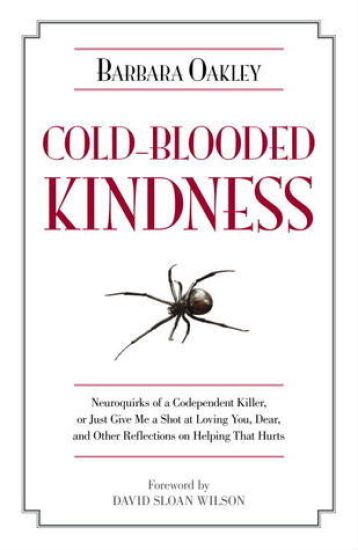
Cold-Blooded Kindness

Cold-Blooded Kindness

Barbara Oakley; David Sloan Wilson

Prometheus Books
2011
sidottu
In this searing exploration of deadly codependency, the author takes the reader on a spellbinding voyage of discovery that examines the questions: Are some people naturally too caring? Is caring sometimes a mask for darker motives? Can science help us understand how our concerns for others can hurt everything we hold dear? This gripping story brings extraordinary insight to our deepest questions. Is kindness always the right answer? Is kindness always what it seems?
Unto Others

Unto Others

Elliott Sober; David Sloan Wilson

Harvard University Press
1999
nidottu
No matter what we do, however kind or generous our deeds may seem, a hidden motive of selfishness lurks--or so science has claimed for years. This book, whose publication promises to be a major scientific event, tells us differently. In Unto Others philosopher Elliott Sober and biologist David Sloan Wilson demonstrate once and for all that unselfish behavior is in fact an important feature of both biological and human nature. Their book provides a panoramic view of altruism throughout the animal kingdom--from self-sacrificing parasites to insects that subsume themselves in the superorganism of a colony to the human capacity for selflessness--even as it explains the evolutionary sense of such behavior.Explaining how altruistic behavior can evolve by natural selection, this book finally gives credence to the idea of group selection that was originally proposed by Darwin but denounced as heretical in the 1960s. With their account of this controversy, Sober and Wilson offer a detailed case study of scientific change as well as an indisputable argument for group selection as a legitimate theory in evolutionary biology.Unto Others also takes a novel evolutionary approach in explaining the ultimate psychological motives behind unselfish human behavior. Developing a theory of the proximate mechanisms that most likely evolved to motivate adaptive helping behavior, Sober and Wilson show how people and perhaps other species evolved the capacity to care for others as a goal in itself.A truly interdisciplinary work that blends biology, philosophy, psychology, and anthropology, this book will permanently change not just our view of selfless behavior but also our understanding of many issues in evolutionary biology and the social sciences.