Kirjojen hintavertailu. Mukana 12 390 323 kirjaa ja 12 kauppaa.

Kirjailija

David Strachan

Kirjat ja teokset yhdessä paikassa: 4 kirjaa, julkaisuja vuosilta 2010-2025, suosituimpien joukossa King's Seat, Dunkeld: Excavations of a Royal Centre of the Southern Picts, 2017-21. Vertaile teosten hintoja ja tarkista saatavuus suomalaisista kirjakaupoista.

4 kirjaa

Kirjojen julkaisuhaarukka 2010-2025.

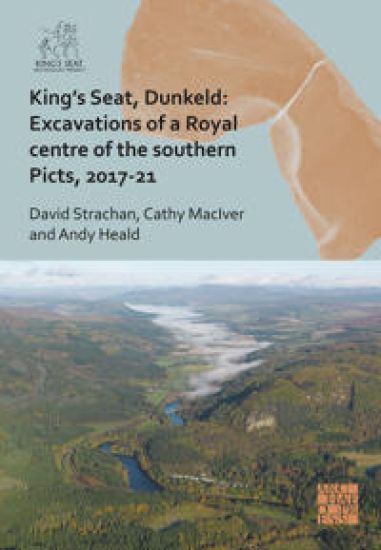
King's Seat, Dunkeld: Excavations of a Royal Centre of the Southern Picts, 2017-21
It is remarkable, given Dunkeld’s importance in medieval Scotland, that so little was known of King’s Seat fort until the 1950s. While proposed as a royal Pictish ‘nuclear’ fort in the 1980s, it was so heavily overgrown as to be effectively lost to archaeology until 2015, when the local history society instigated a programme of community archaeology to explore its story. Led by Perth and Kinross Heritage Trust, working with AOC Archaeology Group, this included excavation that revealed a high-status Pictish fort complex. Like the classic sites Dundurn and Clatchard Craig, it had a high-status summit citadel surrounded by a hierarchy of connected out-works on lower terraces. LiDAR data revealed a previously unknown south enclosure, more than doubling its total footprint and raising questions about the role of such sites and the nature of Pictish settlement. Controlling important routes from the north and west into the lower Tay region, King’s Seat was a Pictish ‘royal’ stronghold, estate, and production centre which was to attract an important early monastic foundation. While relatively short-lived, it produced evidence of elite metalworking and trade and was the venue for feasting that saw the consumption of exotic luxuries such as Continental imports and glass vessels from Anglo-Saxon England. It was abandoned, rather than destroyed, perhaps as power passed to a lower site in a new architectural form, associated with the increasing power of the church and as larger polities developed. The relics of Columba were brought to Dunkeld in the 9th century, probably as much a result of tensions between Pictish royalty and the Gaelic church as the threat of Viking raids, before its ecclesiastical importance was eclipsed by St Andrews. Dunkeld takes its name from the Gaelic dùn Cailleann or ‘fort of the Caledonians’ which undoubtedly refers to King’s Seat fort. It is apt that retention of this pre-Pictish name celebrates the link between later prehistory and medieval Scotland that is so well represented by the site itself.
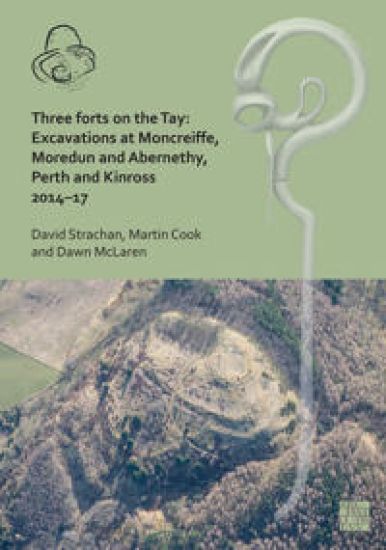
Three Forts on the Tay

Three Forts on the Tay

David Strachan; Martin Cook; Dawn McLaren

Archaeopress
2023
sidottu
Despite a resurgence in Scottish fort studies, few sites have been investigated, and fewer still at the scale reported in this volume. Over 2014-17, Perth and Kinross Heritage Trust, working with AOC Archaeology Group, excavated three hilltop forts on the Tay estuary to explore both their enclosing works and internal buildings, and uncovered an impressive assemblage of small finds. At Moredun fort on Moncreiffe Hill, a previously unknown monumental roundhouse, a rare La Tène bird-head brooch, and evidence of shale bangle industry were uncovered. At Castle Law, Abernethy, excavated in the 1890s and the type-site of Childe’s ‘Abernethy complex’, re-excavation prompted reassessment of the artefacts from original excavations to reveal new evidence of the deposition of artefacts and animal bones within its cistern. Excavation of the enclosing works of these sites, and Moncreiffe fort, suggest an evolution of fort defences from simple earth and stone ramparts to massive timber-laced walls – the murus Gallicus described by Caesar – reflecting high status sites with restricted access for a social elite. Hillforts of The Tay was part of the Tay Landscape Partnership Scheme, a community heritage initiative and the results of this citizen science project make a significant contribution to establishing Tayside as a well-studied area for the site type both within Scotland, and further afield.
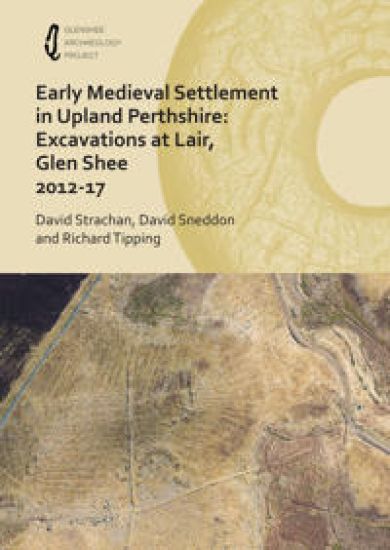
Early Medieval Settlement in Upland Perthshire: Excavations at Lair, Glen Shee 2012-17

Early Medieval Settlement in Upland Perthshire: Excavations at Lair, Glen Shee 2012-17

David Strachan; David Sneddon; Richard Tipping

Archaeopress
2019
sidottu
Archaeological evidence for settlement and land use in early medieval Scottish upland landscapes remains largely undiscovered. This study records only the second excavation of one important and distinctive house form, the Pitcarmicktype building, in the hills of north-east Perth and Kinross. Excavation of seven turf buildings at Lair in Glen Shee has confirmed the introduction of Pitcarmick buildings in the early 7th century AD. Clusters of these at Lair, and elsewhere in the hills, are interpreted as integrated, spatially organised farm complexes comprising byre-houses and outbuildings. Their form has more to do with contemporary traditions across the North Sea than with local styles. There is a close link between 7th-century climatic amelioration and their spread across the hills, and it is argued that this was a purposeful re-occupation of a neglected landscape. Pitcarmick buildings were constructed and lived in by precocious, knowledgeable, and prosperous farming communities. Pollen analysis has shown the upland economy to have been arable as well as pastoral, and comparable contemporary economic ‘recovery’ is suggested from similar analyses across Scotland. The farms at Lair were stable and productive until the 11th century when changes, poorly understood, saw their demise.