Kirjojen hintavertailu. Mukana 12 290 406 kirjaa ja 12 kauppaa.

Kirjailija

David T Hardy

Kirjat ja teokset yhdessä paikassa: 4 kirjaa, julkaisuja vuosilta 2001-2019, suosituimpien joukossa Mass Killings: Myth, Reality, and Solutions. Vertaile teosten hintoja ja tarkista saatavuus suomalaisista kirjakaupoista.

Mukana myös kirjoitusasut: David T. Hardy

4 kirjaa

Kirjojen julkaisuhaarukka 2001-2019.

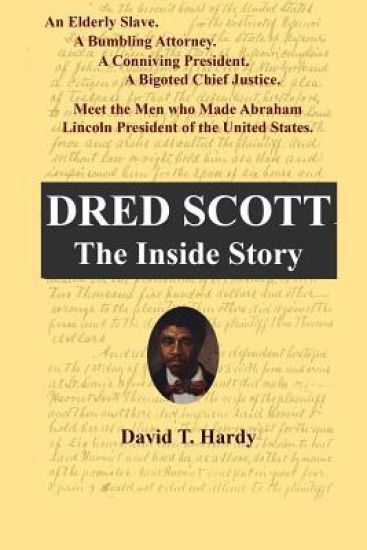
Dred Scott: The Inside Story

Dred Scott: The Inside Story

David T. Hardy

Independently Published
2019
nidottu
Gold Medal for historical nonfiction, 2019 African American Historical and Genealogical Society Book Awards Much has been written about Dred Scott, the historic Supreme Court ruling that did so much to elect Abraham Lincoln and bring on the Civil War. Yet many mysteries have remained. Why did Dred Scott's attorneys sue a New York City businessman, who had no apparent claim to holding him in slavery? Why did the businessman claim in court that he owned the Scott family? Was the case a coincidence, or a pro-slavery set-up that backfired? Did Chief Justice Taney secretly tip off President-elect Buchanan as to the outcome?Dred Scott: The Inside Story answers these questions once and for all. Relying upon 19th century newspaper articles, presidential archives, and a key unpublished autobiography of an eyewitness to the most critical event, it rewrites the history of this pivotal court case. The case was based on collusion, and engineered by powerful pro-slavery attorney Reverdy Johnson. The New York City businessman posed as the Scott family's owner to protect the real slaveholder: his sister Irene. Irene did not want to be named as the slaveholder, because she had married a prominent anti-slavery congressman. Abolitionists who accused the Chief Justice of whispering a tip in President Buchanan's ear had no idea how right they were. But Buchanan didn't need a whispered tip, members of the Supreme Court had secretly written him to disclose the ruling, and he had successfully lobbied one of them into changing his vote.Imagine a reality in which people can own other people, or a person can buy himself, and become free. A reality where slaves can sue their masters, and have a jury decide whether they are really free. Into this not-alternate reality came a remarkable cast of Americans: Dred and Harriet Scott - the slaves whose suit for freedom sparked a battle in the Supreme Court and in the White House. John F. A. Sanford - the mountain man turned New York millionaire, who agreed to pose as the Scott's owner. Rep. Calvin Chaffee - the prominent Massachusetts abolitionist, who was shocked to discover that he and his wife owned slaves. Roger Taney - Chief Justice of the Supreme Court, who tried to preserve the Union by protecting slavery, and instead brought on the Civil War and slavery's abolition. Abraham Lincoln - the failed frontier politician who awoke one morning to realize that Taney and Buchanan had given him the roadmap to the White House. David T. Hardy, attorney and N.Y. Times best-selling author, explores the side of Dred Scott not explored in the history books, a side that involved mistakes, trickery, and skulduggery at the highest levels.
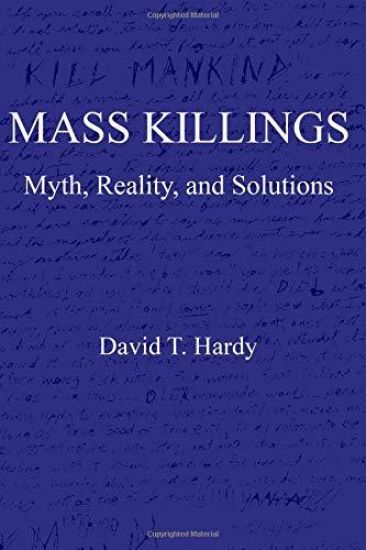
Mass Killings: Myth, Reality, and Solutions

Mass Killings: Myth, Reality, and Solutions

David T. Hardy

Independently Published
2018
nidottu
Mass killings, and especially school shootings, are terrifying crimes that seize the nation's attention. After each, many instinctively ask "why did he do this?" and "what can we do to stop it?" Best-selling author and attorney David T. Hardy here concisely answers these and other questions, based upon careful study of specific cases. He probes the mental states that make mass killers willing to kill (and usually to die), establishes what the killers are after, and outlines what we should do (or not do) to frustrate them.Hardy begins by dispelling a number of myths about mass killings. Mass killers were not bullied: they were more likely the bullies. They didn't just "snap," they planned carefully for months. Mass killings are not a uniquely American problem. The most lethal mass killing (102 dead) came in China, the most lethal mass shooting (67 dead) occurred in Norway. The most deadly mass killing in America involved arson; the most lethal school killing involved explosives.What drives most mass killers? They are extreme cases of narcissistic personality disorder: they are willing to kill and die in order to gain the publicity they crave. That the publicity comes as infamy rather than fame makes no difference to them: "Screw fame, I'll take infamy," as one wrote.A major problem is that killers and the mass media have established a symbiotic relationship, where each gives the other what it needs. Mass killer give the media what it wants: an enormous audience, and thus ratings and advertising income. The media gives the mass killers what they want: instant celebrity status, their pictures on the evening news and the cover of Time, their manifestos publicized and debated, their names made into household words.What is to be done? Hardy analyses many proposals, good and bad. What will work is media self-restraint. After the first 48 hours, do not show the killers' pictures, nor give their names, nor publish their manifestos. Focus on the victims instead. If mass killers become "non-persons," their motive will vanish. Something very like this was done in the wake of the attempted killing of Rep. Steve Scalise, and the media were not hindered in their reporting. To protect schools, arm selected teachers. Mass killers will single out or avoid uniformed security, but have no way to know where the armed teachers are. It's not necessary for a system to be perfect. Raising the risk of failure is sufficient, because narcissists hate the idea of failure as much as they love the idea of celebrity status. Becoming a failure, a laughingstock, is their nightmare. Hardy outlines these and other proposals that might have merit.What won't work? Hardy evaluated several. The most obvious failure is a measure that is always proposed in the wake of a mass killing: gun control. It simply cannot work. Broader background checks? All mass killers either passed them or would have passed them. Waiting periods? The killers plan for months or years. Limiting magazine size? Almost all carry two or more guns. Banning AR-15? Mass killers don't often use them.Mass Killings: Myth, Reality, and Solutions is an indispensable book for anyone interested in this problem, and in assessing ways to reduce it.
This is Not an Assault

This is Not an Assault

David T Hardy; Rex Kimball

Xlibris Corporation
2001
pokkari
In February, 1993, a gun battle erupted outside Waco, Texas, as federal agents attempted to search the communal residence of a religion known as the "Branch Davidians." The battle, and the following siege, was the greatest law enforcement debacle in American history, costing nearly a hundred lives. After a criminal trial, two Cabinet-level studies, and three sets of Congressional hearings, the truth appeared to be firmly settled. A cult led by a madman had shot at federal agents and had then set themselves aflame. The issue was settled. Then in 1999, the Waco issue exploded, with proof that the Federal agencies had lied to their own leadership, to Congress, and to the courts. "This Is Not An Assault" explores this remarkable turnabout. It is authored by someone who saw it from the inside, a former government attorney whose lawsuit forced ATF and FBI to divulge the incriminating documents and tapes. Author Biography: David T. Hardy is an attorney and a legal scholar. He holds a B.A. and Juris Doctorate from the University of Arizona, where he served as Associate Editor of the Arizona Law Review, a fellow of the Instiute for Humane Studies, and was given the ABA's Lewis M. Powell medallion for excellence in appellate advocacy. Mr. Hardy is the author of three books, portions of six anthologies, and thirteen law review articles. His writings on Federal firearms laws have been cited as authority by the U.S. Supreme Court and ten of the thirteen U.S. Courts of Appeals. He has testified before two Senate committees conducting oversight of the Bureau of Alcohol, Tobacco, and Firearms. Mr. Hardy spent eight years as a Federal agency attorney, representing the U.S. Department of theInterior and the Federal Deposit Insurance Corporation. Before and after his federal service, he practiced law in Tucson, Arizona.
This is Not an Assault

This is Not an Assault

David T Hardy

Xlibris Corporation
2001
sidottu
In February, 1993, a gun battle erupted outside Waco, Texas, as federal agents attempted to search the communal residence of a religion known as the "Branch Davidians." The battle, and the following siege, was the greatest law enforcement debacle in American history, costing nearly a hundred lives. After a criminal trial, two Cabinet-level studies, and three sets of Congressional hearings, the truth appeared to be firmly settled. A cult led by a madman had shot at federal agents and had then set themselves aflame. The issue was settled. Then in 1999, the Waco issue exploded, with proof that the Federal agencies had lied to their own leadership, to Congress, and to the courts. "This Is Not An Assault" explores this remarkable turnabout. It is authored by someone who saw it from the inside, a former government attorney whose lawsuit forced ATF and FBI to divulge the incriminating documents and tapes. Author Biography: David T. Hardy is an attorney and a legal scholar. He holds a B.A. and Juris Doctorate from the University of Arizona, where he served as Associate Editor of the Arizona Law Review, a fellow of the Instiute for Humane Studies, and was given the ABA's Lewis M. Powell medallion for excellence in appellate advocacy. Mr. Hardy is the author of three books, portions of six anthologies, and thirteen law review articles. His writings on Federal firearms laws have been cited as authority by the U.S. Supreme Court and ten of the thirteen U.S. Courts of Appeals. He has testified before two Senate committees conducting oversight of the Bureau of Alcohol, Tobacco, and Firearms. Mr. Hardy spent eight years as a Federal agency attorney, representing the U.S. Department of theInterior and the Federal Deposit Insurance Corporation. Before and after his federal service, he practiced law in Tucson, Arizona.