Kirjojen hintavertailu. Mukana 12 595 353 kirjaa ja 12 kauppaa.

Kirjailija

David Tucker

Kirjat ja teokset yhdessä paikassa: 24 kirjaa, julkaisuja vuosilta 1997-2026, suosituimpien joukossa Augusta Arsenal. Vertaile teosten hintoja ja tarkista saatavuus suomalaisista kirjakaupoista.

24 kirjaa

Kirjojen julkaisuhaarukka 1997-2026.

Local Heroes

Local Heroes

David Tucker

Regal House Publishing
2026
nidottu
" David Tucker celebrates the incandescence of the every day, and raises the ordinary to art-- a telephone as quiet as an heirloom, the stillness tended like wheat-- even as he mourns the quickness of time passing. There are gems on every page, in every line, in poems full of pathos and humor and longing. And always, the last words linger, still shimmering with a reverence for life amidst all the losses." -- Amy Nutt, Pulitzer Prize winning author
Augusta Arsenal

Augusta Arsenal

Stacey Thompson; David Tucker

Arcadia Publishing (SC)
2026
nidottu
Augusta, Georgia was home to the Augusta Arsenal for more than 125 years. In this compilation of images, familiar places meld together with historic characters to paint the picture of one of Augusta's longest-standing federal outposts. In 1791, US president George Washington visited Augusta and later proposed that the arsenal be built along the banks of the Savannah River. The arsenal was completed in 1819 and moved up the hill to Summerville in 1827. Part of the US Army Ordnance Department, the Augusta Arsenal service members and civilian employees were charged with making and repairing small firearms for the military. World War II-era images show the breadth of operations at the arsenal during its busiest time. Community members came together to support the expanded arsenal operations during the war when more than 2,000 employees worked at the Summerville site. Now home to Augusta University's Summerville campus, many original buildings, sites, and historic objects are preserved for future generations. The historic quadrangle, commandant's home, and stable are just a few of the many structures preserved by Augusta University. Stacey Thompson is director of the Guard House Museum and the Museum Studies Certificate program in the Katherine Reese Pamplin College of Arts, Humanities, and Social Sciences at Augusta University. David Tucker, a seasoned writer and editor, is retired from the Medical College of Georgia.
A Reply to Hate: Forgiving My Attacker

A Reply to Hate: Forgiving My Attacker

Nasser Kurdy; David Tucker

Ibidem Press
2021
nidottu
In September 2017, Dr Nasser Kurdy was stabbed in the neck while entering the grounds of his local mosque. This book tells the story of that attack and how Dr Kurdy came to forgive his attacker. It lays out the international historical events that brought Dr Kurdy to be in that place at that time and it follows events after the attack, combining his surgical knowledge with his experience of the UK criminal justice system as well as a series of reflective enquiries into the nature of forgiveness. The book is the timely and inspiring story of the optimism that can emerge from violence. It also includes contributions from a number of friends, family, and colleagues of Dr Kurdy, which illustrate the impact such an attack can have beyond that on a single individual.
United States Special Operations Forces

United States Special Operations Forces

Christopher Lamb; David Tucker

Columbia University Press
2019
sidottu
In this book, two national-security experts put the exploits of America’s special operation forces in historical and strategic context. David Tucker and Christopher J. Lamb offer an incisive overview of America’s turbulent experience with special operations. Starting with in-depth interviews with special operators, the authors illustrate the diversity of modern special operations forces and the strategic value of their unique attributes.Despite longstanding and growing public fascination with special operators, these forces and their contribution to national security are poorly understood. With this book, Tucker and Lamb dispel common misconceptions and offer a penetrating analysis of how these unique and valuable forces can be employed to even better effect in the future. The book builds toward a comprehensive assessment of the strategic utility of special operations forces, which it then considers in light of the demands of future warfare. This second edition of United States Special Operations Forces, revised throughout to account for lessons learned in the twelve years since its first publication, includes two new case studies, one on High Value Target Teams and another on Village Stability Operations, and two new appendixes charting the evolution of special operation missions and the best literature on all aspects of U.S. special operation forces.
United States Special Operations Forces

United States Special Operations Forces

Christopher Lamb; David Tucker

Columbia University Press
2019
pokkari
In this book, two national-security experts put the exploits of America’s special operation forces in historical and strategic context. David Tucker and Christopher J. Lamb offer an incisive overview of America’s turbulent experience with special operations. Starting with in-depth interviews with special operators, the authors illustrate the diversity of modern special operations forces and the strategic value of their unique attributes.Despite longstanding and growing public fascination with special operators, these forces and their contribution to national security are poorly understood. With this book, Tucker and Lamb dispel common misconceptions and offer a penetrating analysis of how these unique and valuable forces can be employed to even better effect in the future. The book builds toward a comprehensive assessment of the strategic utility of special operations forces, which it then considers in light of the demands of future warfare. This second edition of United States Special Operations Forces, revised throughout to account for lessons learned in the twelve years since its first publication, includes two new case studies, one on High Value Target Teams and another on Village Stability Operations, and two new appendixes charting the evolution of special operation missions and the best literature on all aspects of U.S. special operation forces.
Of sweat and other joys

Of sweat and other joys

David Tucker

Independently Published
2019
nidottu
David knew the one great thing that came from the sudden death of his father was that it gave him a healthy sense of his own mortality. He knew that life was for living to the full every day and was not going to wait until he retired or had enough money to see the world. Instead of holidays to Spain or Cornwall, David decided to take his wife and three young children to Asia for fun and adventure. Sometimes, though, his family saw things differently. This is a story of a young family and their travels through a landscape of coconut trees, paddy fields beaches, ancient temples, rich jungles and fast-paced cities. Along the way they experience some of the kindest people on earth and witness the cruelty and horror of genocide. Join this family on their adventure in Vietnam, Sri Lanka and Cambodia, as they discover a broken and beautiful world.
Revolution and Resistance

Revolution and Resistance

David Tucker

Johns Hopkins University Press
2016
pokkari
In this provocative history, David Tucker argues that "irregular warfare"-including terrorism, guerrilla warfare, and other insurgency tactics-is intimately linked to the rise and decline of Euro-American empire around the globe. Tracing the evolution of resistance warfare from the age of the conquistadors through the United States' recent ventures in Afghanistan and Iraq, Revolution and Resistance demonstrates that contemporary conflicts in the Middle East, Africa, and Asia are simply the final stages in the unraveling of Euro-American imperialism. Tucker explores why it was so difficult for indigenous people and states to resist imperial power, which possessed superior military technology and was driven by a curious moral imperative to conquer. He also explains how native populations eventually learned to fight back by successfully combining guerrilla warfare with political warfare. By exploiting certain Euro-American weaknesses-above all, the instability created by the fading rationale for empire-insurgents were able to subvert imperialism by using its own ideologies against it. Tucker also examines how the development of free trade and world finance began to undermine the need for direct political control of foreign territory. Touching on Pontiac's Rebellion of 1763, Abd el-Kader's jihad in nineteenth-century Algeria, the national liberation movements that arose in twentieth-century Palestine, Vietnam, and Ireland, and contemporary terrorist activity, Revolution and Resistance shows how changing means have been used to wage the same struggle. Emphasizing moral rather than economic or technological explanations for the rise and fall of Euro-American imperialism, this concise, comprehensive book is required reading for anyone seeking to understand the character of contemporary conflict.
The End of Intelligence

The End of Intelligence

David Tucker

Stanford University Press
2014
pokkari
Using espionage as a test case, The End of Intelligence criticizes claims that the recent information revolution has weakened the state, revolutionized warfare, and changed the balance of power between states and non-state actors—and it assesses the potential for realizing any hopes we might have for reforming intelligence and espionage. Examining espionage, counterintelligence, and covert action, the book argues that, contrary to prevailing views, the information revolution is increasing the power of states relative to non-state actors and threatening privacy more than secrecy. Arguing that intelligence organizations may be taken as the paradigmatic organizations of the information age, author David Tucker shows the limits of information gathering and analysis even in these organizations, where failures at self-knowledge point to broader limits on human knowledge—even in our supposed age of transparency. He argues that, in this complex context, both intuitive judgment and morality remain as important as ever and undervalued by those arguing for the transformative effects of information. This book will challenge what we think we know about the power of information and the state, and about the likely twenty-first century fate of secrecy and privacy.
The End of Intelligence

The End of Intelligence

David Tucker

Stanford University Press
2014
sidottu
Using espionage as a test case, The End of Intelligence criticizes claims that the recent information revolution has weakened the state, revolutionized warfare, and changed the balance of power between states and non-state actors—and it assesses the potential for realizing any hopes we might have for reforming intelligence and espionage. Examining espionage, counterintelligence, and covert action, the book argues that, contrary to prevailing views, the information revolution is increasing the power of states relative to non-state actors and threatening privacy more than secrecy. Arguing that intelligence organizations may be taken as the paradigmatic organizations of the information age, author David Tucker shows the limits of information gathering and analysis even in these organizations, where failures at self-knowledge point to broader limits on human knowledge—even in our supposed age of transparency. He argues that, in this complex context, both intuitive judgment and morality remain as important as ever and undervalued by those arguing for the transformative effects of information. This book will challenge what we think we know about the power of information and the state, and about the likely twenty-first century fate of secrecy and privacy.
Confronting the Unconventional: Innovation and Transformation in Military Affairs
The Department of Defense (DoD) is committed to transforming its conventional warfare capabilities. At the same time, DoD must increase its emphasis on irregular warfare. This ambitious agenda raises some questions. Are there limits to military transformation? Or, if it seems obvious that there must be limits to transformation, what are they exactly, why do they arise, and how can we identify them so that we may better accomplish the transformation that the U.S. military is capable of? If limits to military change and transformation exist, what are the broader implications for national policy and strategy? Professor David Tucker offers some answers to these questions in this Letort Paper by analyzing the efforts of the French, British, and Americans to deal with irregular threats after World War II. He concludes that there are limits to transformation and offers an analysis of the effects of these limits on policy and strategy for the war on terrorism.
Samuel Beckett and Arnold Geulincx

Samuel Beckett and Arnold Geulincx

David Tucker

Bloomsbury Academic
2014
nidottu
amuel Beckett once wrote that were he in the ‘unfortunate position' of a critic studying his work, one of his points of departure would be the ideas of the 17th-century philosopher, Arnold Geulincx. Samuel Beckett and Arnold Geulincx: Tracing ‘a literary fantasia' is the first full-length study to document the extent of the influence Geulincx's philosophy had on Beckett's prose and late drama. Establishing itself as a reference point for Beckett's published and unpublished writings, David Tucker's study presents a clear, chronological exploration of Beckett's engagement with Geulincx, and of how this engagement marks, and is marked by, broader changes in Beckett's aesthetic thinking. By positioning close, interpretative philosophical readings alongside analyses of archival materials, Tucker sets out an affirmative and reconciliatory approach to divergent strands in contemporary Beckett Studies.
Samuel Beckett and Arnold Geulincx

Samuel Beckett and Arnold Geulincx

David Tucker

Continuum Publishing Corporation
2012
sidottu
"Samuel Beckett once wrote that were he in the unfortunate position of a critic studying his work, one of his points of departure would be the ideas of the seventeenth-century philosopher, Arnold Geulincx. Samuel Beckett and Arnold Geulincx: Tracing a literary fantasia is the first full-length study to document the extent of the influence Geulincxs philosophy had on Becketts prose and late drama. Establishing itself as a reference point for Becketts published and unpublished writings, David Tuckers study presents a clear, chronological exploration of Becketts engagement with Geulincx, and of how this engagement marks, and is marked by, broader changes in Becketts aesthetic thinking. By positioning close, interpretative philosophical readings alongside analyses of archival materials, Tucker sets out an affirmative and reconciliatory approach to divergent strands in contemporary Beckett Studies."
Out of London Walks

Out of London Walks

Stephen Barnett; David Tucker

Virgin Books
2012
pokkari
Enjoy all that out of London has to offer, and discover the heritage and history behind the scenes in some of England's most picturesque places, such as Bath, Canterbury, Royal Winchester and Stratford. With stories and advice drawn from the expertise and knowledge of the famous London Walks Company and its small army of guides, this book is perfect for tourists who want to experience English life beyond Trafalgar Square, as well as for Londoners keen to step off the Circle Line and discover the secrets just beyond their own doorstep. With photos, maps and illustrations, Out of London Walks contains all the best day trips from the capital city – the ideal companion of the out of London rambler.
Illuminating the Dark Arts of War

Illuminating the Dark Arts of War

David Tucker

Continuum Publishing Corporation
2012
sidottu
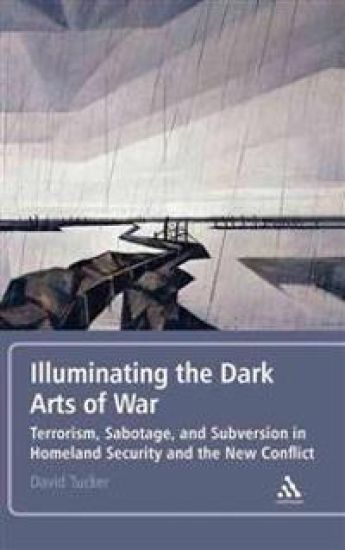
In this title, terrorism, sabotage, and subversion are analyzed to challenge the dominant views that a 'new conflict' is now posing unprecedented threats to U.S. homeland security. Since 9/11, the dominant view is that we have entered an era of 'new conflict' in which technology has empowered non-state actors who now pose unprecedented and unmanageable threats to U.S. national security. This unique work studies a range of threats, from homegrown and foreign terrorism to the possibility of cyber- or Chinese sabotage and fears of religious subversion to challenge every aspects of this 'new conflict' argument and expose its underlying exaggerations and misunderstandings. Examining such issues as political violence, the role of religion in terrorism, the impact of technology, and the political aspects of homeland security, this unique survey demonstrates how such activities as terrorism are limited by their clandestine nature. It also addresses why we need to switch our strategic focus and increase the role citizens have in dealing with such threats. This historically informed and critical analysis fills a void in the debates on the threats and conflicts that the U.S. confronts at home and abroad and will appeal to anyone interested in national security and terrorism.
Illuminating the Dark Arts of War

Illuminating the Dark Arts of War

David Tucker

Continuum Publishing Corporation
2012
nidottu
In this title, terrorism, sabotage, and subversion are analyzed to challenge the dominant views that a 'new conflict' is now posing unprecedented threats to U.S. homeland security. Since 9/11, the dominant view is that we have entered an era of 'new conflict' in which technology has empowered non-state actors who now pose unprecedented and unmanageable threats to U.S. national security. This unique work studies a range of threats, from homegrown and foreign terrorism to the possibility of cyber- or Chinese sabotage and fears of religious subversion to challenge every aspects of this 'new conflict' argument and expose its underlying exaggerations and misunderstandings. Examining such issues as political violence, the role of religion in terrorism, the impact of technology, and the political aspects of homeland security, this unique survey demonstrates how such activities as terrorism are limited by their clandestine nature. It also addresses why we need to switch our strategic focus and increase the role citizens have in dealing with such threats. This historically informed and critical analysis fills a void in the debates on the threats and conflicts that the U.S. confronts at home and abroad and will appeal to anyone interested in national security and terrorism.
London Walks: London Stories

London Walks: London Stories

David Tucker

Virgin Books
2009
pokkari
London Walks is the award-winning original walking tour company. Written by the expert and knowledgeable guides who lead the walks, London Stories is the perfect way to discover the rich history of London and its hidden gems, including:Sinister London - haunted London and Jack the Ripper.Literary London - from Shakespeare to Dickens.Public Houses - the old pubs of Soho. Mystery and Secrets - the city's hidden past.A Tale of Two Cities - Westminster and the Square Mile.Perfect for tourists who want to experience London life beyond Trafalgar Square as well as for Londoners keen to step off the Circle Line and discover the secrets on their own doorstep, London Stories offers a fascinating glimpse into the capital's rich history. With photos, maps and illustrations to bring the stories to life, London Stories is for those who love London, written by those who know it best.
Enlightened Republicanism

Enlightened Republicanism

David Tucker

Lexington Books
2008
sidottu
Enlightened Republicanism is the first book-length study of Thomas Jefferson's Notes on the State of Virginia, which has often been used as a treasury of quotations from which historians, political scientists, and literary scholars have borrowed in order to prove one point or another about America or Jefferson himself. David Tucker examines Jefferson's work as a whole, arguing that the it was carefully structured. He proceeds to demonstrate that only a deeper understanding of this structure as an integral part of Jefferson's argument can give the reader a true comprehension of Notes on the State of Virginia. Enlightened republicanism, as Jefferson defined it, was revolutionary, as it fundamentally changed the goals of government and the practice of politics to bring them into accord as much as possible with the complex and varied demands of nature.