Kirjojen hintavertailu. Mukana 12 595 353 kirjaa ja 12 kauppaa.

Kirjailija

David Vines

Kirjat ja teokset yhdessä paikassa: 7 kirjaa, julkaisuja vuosilta 1995-2017, suosituimpien joukossa Macroeconomic Policy. Vertaile teosten hintoja ja tarkista saatavuus suomalaisista kirjakaupoista.

7 kirjaa

Kirjojen julkaisuhaarukka 1995-2017.

Macroeconomic Policy

Macroeconomic Policy

Martin Weale; Andrew Blake; Nicos Christodoulakis; James Meade; David Vines

Routledge
2017
nidottu
This analysis of macroeconomic policy, originally published in 1989, argues that key government objectives, such as reduced inflation, decreased unemployment and an adequate level of national saving can be achieved only by employing both monetary and fiscal policies, in conjunction with supply-side policies expressly designed to improve the workings of the labour market. Part 1 is a comparative analysis showing the effects of monetary and fiscal policy on the economy. Real-wage rigidity in the labour market is shown to have important consequences for the working of both types of policy, because it conditions the economy’s response to tax changes. Part 2 presents an econometric model which combines consistent stock-flow accounts with a full range of expectational effects. Part 3 presents an innovative technique for solving rational expectations models with the need for arbitary terminal conditions.
Macroeconomic Policy

Macroeconomic Policy

Martin Weale; Andrew Blake; Nicos Christodoulakis; James Meade; David Vines

Routledge
2015
sidottu
This analysis of macroeconomic policy, originally published in 1989, argues that key government objectives, such as reduced inflation, decreased unemployment and an adequate level of national saving can be achieved only by employing both monetary and fiscal policies, in conjunction with supply-side policies expressly designed to improve the workings of the labour market. Part 1 is a comparative analysis showing the effects of monetary and fiscal policy on the economy. Real-wage rigidity in the labour market is shown to have important consequences for the working of both types of policy, because it conditions the economy’s response to tax changes. Part 2 presents an econometric model which combines consistent stock-flow accounts with a full range of expectational effects. Part 3 presents an innovative technique for solving rational expectations models with the need for arbitary terminal conditions.
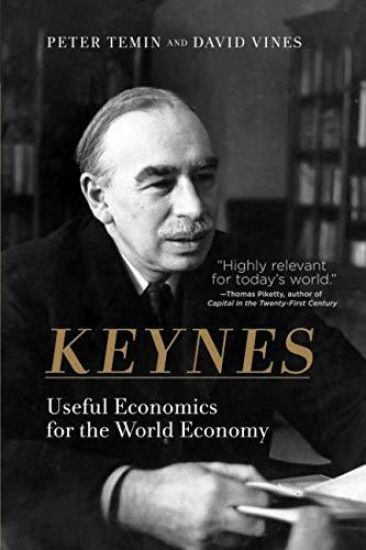
Keynes

Keynes

Peter Temin; David Vines

MIT Press
2016
pokkari
Why Keynes is relevant to today's global economic crisis, and how Keynesian ideas can point the way to renewed economic growth.As the global economic crisis continues to cause damage, some policy makers have called for a more Keynesian approach to current economic problems. In this book, the economists Peter Temin and David Vines provide an accessible introduction to Keynesian ideas that connects Keynes's insights to today's global economy and offers readers a way to understand current policy debates. They survey economic thinking before Keynes and explain how difficult it was for Keynes to escape from conventional wisdom. They also set out the Keynesian analysis of a closed economy and expand the analysis to the international economy, using a few simple graphs to present Keynes's formal analyses in an accessible way. Finally, they discuss problems of today's world economy, showcasing the usefulness of a simple Keynesian approach to current economic policy choices. Keynesian ideas, they argue, can lay the basis for a return to economic growth.
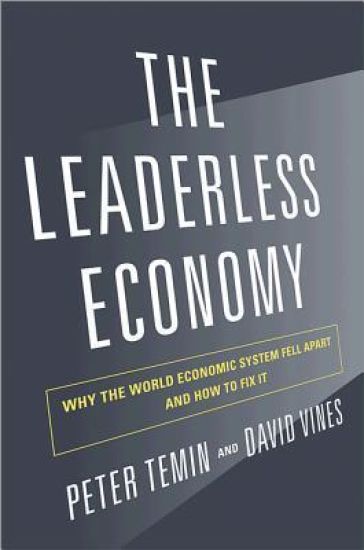
The Leaderless Economy

The Leaderless Economy

Peter Temin; David Vines

Princeton University Press
2013
sidottu
The Leaderless Economy reveals why international financial cooperation is the only solution to today's global economic crisis. In this timely and important book, Peter Temin and David Vines argue that our current predicament is a catastrophe rivaled only by the Great Depression. Taking an in-depth look at the history of both, they explain what went wrong and why, and demonstrate why international leadership is needed to restore prosperity and prevent future crises. Temin and Vines argue that the financial collapse of the 1930s was an "end-of-regime crisis" in which the economic leader of the nineteenth century, Great Britain, found itself unable to stem international panic as countries abandoned the gold standard. They trace how John Maynard Keynes struggled for years to identify the causes of the Great Depression, and draw valuable lessons from his intellectual journey. Today we are in the midst of a similar crisis, one in which the regime that led the world economy in the twentieth century--that of the United States--is ending. Temin and Vines show how America emerged from World War II as an economic and military powerhouse, but how deregulation and a lax attitude toward international monetary flows left the nation incapable of reining in an overleveraged financial sector and powerless to contain the 2008 financial panic. Fixed exchange rates in Europe and Asia have exacerbated the problem. The Leaderless Economy provides a blueprint for how renewed international leadership can bring today's industrial nations back into financial balance--domestically and between each other.
Stagflation (2 Volumes) (Routledge Revivals)

Stagflation (2 Volumes) (Routledge Revivals)

David Vines; Jan Maciejowski; James E. Meade

Routledge
2011
muu
Comprising Wage-Fixing (first published 1982), and Demand Management (first published 1983) this two volume reissued set is a vital and stimulating analysis of the causes and consequences of stagflation – a paralysing combination of mass unemployment and rapid inflation which affected a variety of economies across the developed world in the 1970s and early 1980s.Wage-Fixing, written by James Meade, deals primarily with the needed reform of wage-fixing institutions, contrasting the Great Depression of the 1930s with the Great Stagflation of the 1970s. Meanwhile Demand Management is devoted to the design of fiscal, monetary and foreign exchange-rate policies for the control of the money demand for the products of labour. This volume deals with the theory of demand management, feedback control and the creation of a dynamic model of the UK economy.Written in clear and accessible language, this reissue will appeal to the general reader as well as students of economics and professional economists. It should be required reading for all those who wish to learn the lessons of the Great Stagflation of the 1970s to avoid a repetition in the current economic climate.
North–South Linkages and International Macroeconomic Policy

North–South Linkages and International Macroeconomic Policy

David Vines; David Currie

Cambridge University Press
2010
pokkari
Researchers have begun to apply economic techniques initially developed to analyse the industrialised countries to analyse North-South interactions in the world economy. This volume, derived from a CEPR conference, brings together theoretical and empirical papers on fiscal, monetary and trade linkages between the North and South. The papers use the advances in the use of the major macroeconomic models to simulate global and inter-regional interactions, and to analyse the implications for the South of macroeconomic developments in the North. They also examine international policy questions in a genuinely global context, and consider the design of policy packages for the Third World (aid versus trade, growth-oriented adjustment) in an empirical context. This volume provides a useful overview of the flourishing research area relating to interactions between North and South, and highlights areas where future research is needed.
North–South Linkages and International Macroeconomic Policy

North–South Linkages and International Macroeconomic Policy

David Vines; David Currie

Cambridge University Press
1995
sidottu
Researchers have begun to apply economic techniques initially developed to analyse the industrialised countries to analyse North-South interactions in the world economy. This volume, derived from a CEPR conference, brings together theoretical and empirical papers on fiscal, monetary and trade linkages between the North and South. The papers use the advances in the use of the major macroeconomic models to simulate global and inter-regional interactions, and to analyse the implications for the South of macroeconomic developments in the North. They also examine international policy questions in a genuinely global context, and consider the design of policy packages for the Third World (aid versus trade, growth-oriented adjustment) in an empirical context. This volume provides a useful overview of the flourishing research area relating to interactions between North and South, and highlights areas where future research is needed.