Kirjojen hintavertailu. Mukana 12 595 353 kirjaa ja 12 kauppaa.

Kirjailija

David W. Brooks

Kirjat ja teokset yhdessä paikassa: 6 kirjaa, julkaisuja vuosilta 1997-2015, suosituimpien joukossa The Unified Learning Model. Vertaile teosten hintoja ja tarkista saatavuus suomalaisista kirjakaupoista.

Mukana myös kirjoitusasut: David W Brooks

6 kirjaa

Kirjojen julkaisuhaarukka 1997-2015.

The Unified Learning Model

The Unified Learning Model

Duane F. Shell; David W. Brooks; Guy Trainin; Kathleen M. Wilson; Douglas F. Kauffman; Lynne M. Herr

Springer
2014
nidottu
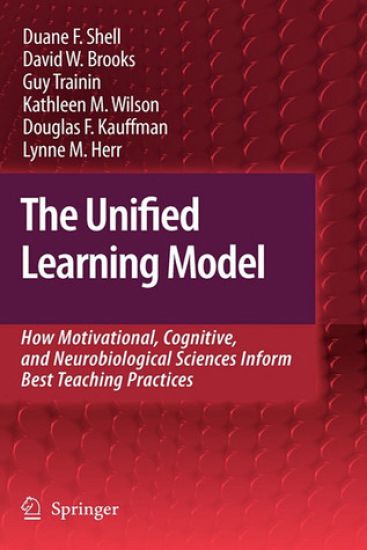
This is a book about how humans learn. Our focus is on classroom learning although the principles are, as the name of this book indicates, universal. We are concerned with learning from pre-school to post-graduate. We are concerned with most bu- ness, industrial and military training. We do not address how infants learn how to speak or walk, or how grown-ups improve their tennis swing. We do address all learning described by the word “thought”, as well as anything we might try to teach, or instruct in formal educational settings. In education, the words theory and model imply conjecture. In science, these same words imply something that is a testable explanation of phenomena able to predict outcomes of experiments. This book presents a model of learning that the authors offer in the sense of scientists rather than educators. Conjecture implies that information is incomplete, and so it surely is with human learning. On the other hand, we assert that more than enough is known to sustaina “scienti?c” model of learning. This book is not a review of the literature. Instead, it is a synthesis. Scholars and many teachers likely have heard much if not most or even all of the information we use to develop the uni?ed learning model. What you have not read before is a model putting the information together in just this way; this is the ?rst one.
The Unified Learning Model

The Unified Learning Model

Duane F. Shell; David W. Brooks; Guy Trainin; Kathleen M. Wilson; Douglas F. Kauffman; Lynne M. Herr

Springer
2009
sidottu
This is a book about how humans learn. Our focus is on classroom learning although the principles are, as the name of this book indicates, universal. We are concerned with learning from pre-school to post-graduate. We are concerned with most bu- ness, industrial and military training. We do not address how infants learn how to speak or walk, or how grown-ups improve their tennis swing. We do address all learning described by the word “thought”, as well as anything we might try to teach, or instruct in formal educational settings. In education, the words theory and model imply conjecture. In science, these same words imply something that is a testable explanation of phenomena able to predict outcomes of experiments. This book presents a model of learning that the authors offer in the sense of scientists rather than educators. Conjecture implies that information is incomplete, and so it surely is with human learning. On the other hand, we assert that more than enough is known to sustaina “scienti?c” model of learning. This book is not a review of the literature. Instead, it is a synthesis. Scholars and many teachers likely have heard much if not most or even all of the information we use to develop the uni?ed learning model. What you have not read before is a model putting the information together in just this way; this is the ?rst one.

How to Lead a Successful Life

How to Lead a Successful Life

David W Brooks

Lulu Publishing Services
2014
pokkari
There are many lessons in Texas Holdem poker that apply generally to life. The life lessons are universal, it's just fun to use situations in poker to make the point. Holdem players will get the analogies instantly, at least the good ones who know more than what beats what. I have written this book to share some lessons I learned across my life. I trust these principles will help you to deal with every-day life more effectively and will enable you to more fully enjoy every day you are granted. If the tone gets a little preachy sometimes, well, tough. You need to hear it. My sincere hope is that you will take time to physically write a few things down about your life after reading this book and then enjoy seeing that writing evolve across time. The analogies to Texas Holdem are fun. If you play Holdem you will get the connections easily. And if you don't, maybe you should try something new, and begin.
Web-Teaching

Web-Teaching

David W. Brooks; Diane E. Nolan; Susan M. Gallagher

Kluwer Academic/Plenum Publishers
2001
nidottu
Beginning with a brief history of the Internet, this book delves into a review of current research, active learning strategies, Web courseware, metacognition, strategies for Web discussions, promoting student self-regulation, building interactive Web pages, basic HTML coding, managing Web sites, using databases, automated testing, and security and legal issues. Experience shows that Web teaching may be used in an extremely wide range of subject areas. Modern course management software has demystified the use of the Web for teaching, allowing instructors to focus on instructional design and improving student experiences instead of only the technical skills of building Web sites. Web-Teaching helps readers pick and choose what aspects of the Web to employ to achieve the greatest student learning gains.
Web-Teaching

Web-Teaching

David W. Brooks

Kluwer Academic/Plenum Publishers
1997
nidottu
Based on the author's experience using computers and multimedia in teaching large, multisection courses, this groundbreaking text demonstrates how teaching professionals at all levels of instruction can use `paperless' electronic dialoguing to dramatically improve classroom instruction. The book explains how to employ such tools as: hypertext, animation, morphs, CAD, and virtual reality interactive strategies using of e-mail `self-regulation', a means of enhancing students'independence and efficiency and `intranets', networks that are off the Web but operate on the same basic principle.