Kirjojen hintavertailu. Mukana 12 595 353 kirjaa ja 12 kauppaa.

Kirjailija

David W. Lightfoot

Kirjat ja teokset yhdessä paikassa: 4 kirjaa, julkaisuja vuosilta 1993-2020, suosituimpien joukossa How to Set Parameters. Vertaile teosten hintoja ja tarkista saatavuus suomalaisista kirjakaupoista.

4 kirjaa

Kirjojen julkaisuhaarukka 1993-2020.

Born to Parse

Born to Parse

David W. Lightfoot

MIT Press
2020
sidottu
In this book, David Lightfoot argues that just as some birds are born to chirp, humans are born to parse-predisposed to assign linguistic structures to their ambient external language. This approach to language acquisition makes two contributions to the development of Minimalist thinking. First, it minimizes grammatical theory, dispensing with three major entities- parameters; an evaluation metric for the selection of grammars; and any independent parsing mechanism. Instead, Lightfoot argues, children parse their ambient external language using their internal language. Universal Grammar is "open," consistent with what children learn through parsing with their internal language system. Second, this understanding of language acquisition yields a new view of variable properties in language-properties that occur only in certain languages. Under the open UG vision, very specific language particularities arise in response to new parses. Both external and internal languages play crucial, interacting roles- unstructured, amorphous external language is parsed and an internal language system results.Lightfoot explores case studies that show such innovative parses of external language in the history of English- development of modal verbs, loss of verb movement, and nineteenth-century changes in the syntax of the verb to be. He then discusses how children learn through parsing; the role of parsing at the syntactic structure's interface with the externalization system and logical form; language change; and variable properties seen through the lens of an open UG.
The Language Organ

The Language Organ

Stephen R. Anderson; David W. Lightfoot

Cambridge University Press
2002
pokkari
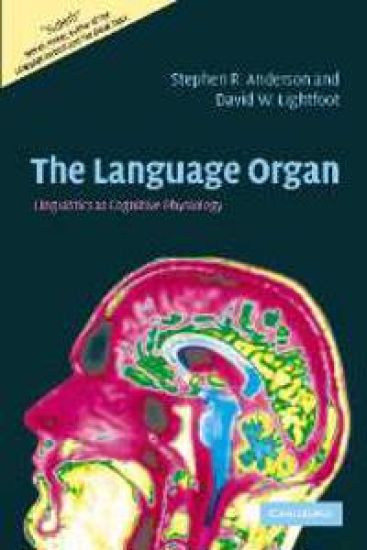
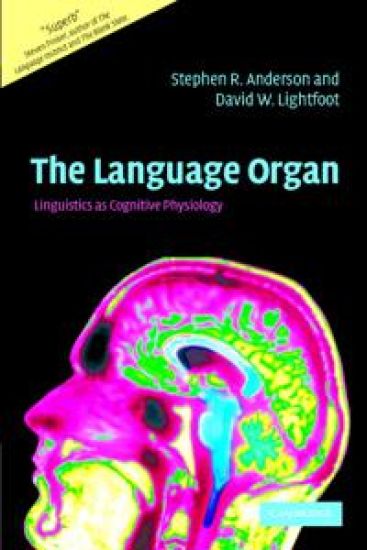
The Language Organ treats human language as the manifestation of a faculty of the mind, a mental organ whose nature is determined by human biology and whose functional properties should be explored just as physiology explores the functional properties of physical organs. It surveys the nature of the language faculty in its various aspects: the systems of sounds, words, and syntax, the development of language in the child and historically, and what is known about its relation to the brain. It discusses the kinds of work that can be carried out in these areas that will contribute to an understanding of the human language organ. This book will appeal to students and researchers in linguistics, and is written to be accessible to colleagues in other disciplines dealing with language as well as to readers with an interest in general science and the nature of the human mind.
The Language Organ

The Language Organ

Stephen R. Anderson; David W. Lightfoot

Cambridge University Press
2002
sidottu
The Language Organ treats human language as the manifestation of a faculty of the mind, a mental organ whose nature is determined by human biology and whose functional properties should be explored just as physiology explores the functional properties of physical organs. It surveys the nature of the language faculty in its various aspects: the systems of sounds, words, and syntax, the development of language in the child and historically, and what is known about its relation to the brain. It discusses the kinds of work that can be carried out in these areas that will contribute to an understanding of the human language organ. This book will appeal to students and researchers in linguistics, and is written to be accessible to colleagues in other disciplines dealing with language as well as to readers with an interest in general science and the nature of the human mind.
How to Set Parameters

How to Set Parameters

David W. Lightfoot

Bradford Books
1993
pokkari
Over the past decade, generative grammarians have viewed language acquisition as a process of fixing option points or parameters defined in Universal Grammar. Here David Lightfoot addresses the crucial question of what it takes to set a parameter - of what kind of experience is needed to trigger the emergence of a natural kind of grammar. Lightfoot asserts that parameter setting is not sensitive to embedded material, and that it is triggered only by robust elements that are structurally simple. He observes that morphological properties play a significant role in setting parameters which have widespread syntactic effects. Using evidence from data on diachronic changes and from current work in syntactic theory, Lightfoot makes precise claims about the triggering experience that can explain a number of historical puzzles. He argues that the changes could have taken place in the way they did only if language acquisition proceeds on the basis of simple, unembedded experiences.