Kirjojen hintavertailu. Mukana 12 595 353 kirjaa ja 12 kauppaa.

Kirjailija

David Weisburd

Kirjat ja teokset yhdessä paikassa: 20 kirjaa, julkaisuja vuosilta 1989-2026, suosituimpien joukossa White-Collar Crime and Criminal Careers. Vertaile teosten hintoja ja tarkista saatavuus suomalaisista kirjakaupoista.

20 kirjaa

Kirjojen julkaisuhaarukka 1989-2026.

Place Matters

Place Matters

David Weisburd; John E. Eck; Anthony A. Braga; Cody W. Telep; Breanne Cave; Kate Bowers; Gerben Bruinsma; Charlotte Gill; Elizabeth R. Groff; Julie Hibdon; Joshua C. Hinkle; Shane D. Johnson; Brian Lawton; Cynthia Lum; Jerry H. Ratcliffe; George Rengert; Travis Taniguchi; Sue-Ming Yang

Cambridge University Press
2016
sidottu
Over the last two decades, there has been increased interest in the distribution of crime and other antisocial behavior at lower levels of geography. The focus on micro geography and its contribution to the understanding and prevention of crime has been called the 'criminology of place'. It pushes scholars to examine small geographic areas within cities, often as small as addresses or street segments, for their contribution to crime. Here, the authors describe what is known about crime and place, providing the most up-to-date and comprehensive review available. Place Matters shows that the study of criminology of place should be a central focus of criminology in the twenty-first century. It creates a tremendous opportunity for advancing our understanding of crime, and for addressing it. The book brings together eighteen top scholars in criminology and place to provide comprehensive research expanding across different themes.
White-Collar Crime and Criminal Careers

White-Collar Crime and Criminal Careers

David Weisburd; Elin Waring; Ellen F. Chayet

Cambridge University Press
2001
sidottu
Studies of the criminal career to date have focused on common criminals and street crime; criminologists have overlooked the careers of white-collar offenders. David Weisburd and Elin Waring offer here the first detailed examination of the criminal careers of people convicted of white-collar crimes. Weisburd and Waring uncover some surprising findings, which upset common wisdom about white-collar criminals. Many scholars have assumed that white-collar criminals are unlikely to have multiple or long records or repeat offenses. As the authors demonstrate, a significant number of white-collar criminals have numerous brushes with the law and their careers show marked similarities to the circumstances and life patterns of street criminals. Their findings illustrate the misplaced emphasis of previous scholarship in focusing on the categorical distinctions between criminals and non-criminals. Rather, their data suggest the importance of the immediate context of crime and its role in leading otherwise conventional people to violate the law.
Hot Spots of Crime

Hot Spots of Crime

David Weisburd; Clair V. Uding; Beidi Dong; Kiseong Kuen

Cambridge University Press
2026
sidottu
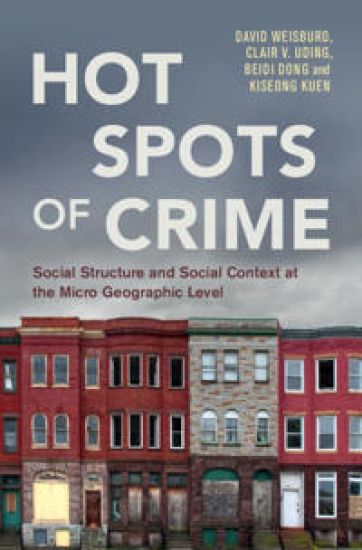
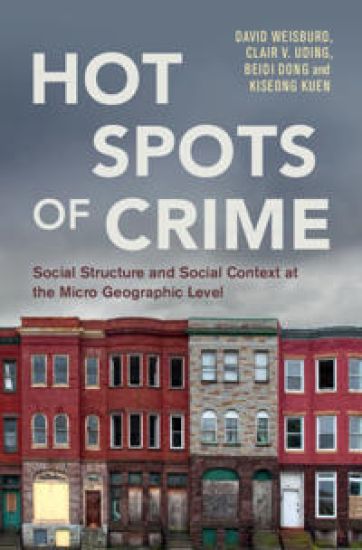
While hot spots of crime have become an important focus of study in criminology and an important focus of crime prevention in programs like hot spots policing, to date we know little about these places. Who lives in hot spots of crime? What factors lead to these places becoming crime hot spots? What other social and health problems are found in these places? The book draws on more than 7,000 surveys of people living on crime hot spot and non-hot spot streets, systematic physical and social observations, and structured qualitative data collection. The results of this study illustrate that hot spots of crime are not just hot spots for crime, but also many other social ills. By shedding light on the social features of hot spots of crime, the book recognizes the importance of informal social controls in understanding and preventing crime at crime hot spots. This title is also available as open access on Cambridge Core.
Hot Spots of Crime

Hot Spots of Crime

David Weisburd; Clair V. Uding; Beidi Dong; Kiseong Kuen

Cambridge University Press
2026
pokkari
While hot spots of crime have become an important focus of study in criminology and an important focus of crime prevention in programs like hot spots policing, to date we know little about these places. Who lives in hot spots of crime? What factors lead to these places becoming crime hot spots? What other social and health problems are found in these places? The book draws on more than 7,000 surveys of people living on crime hot spot and non-hot spot streets, systematic physical and social observations, and structured qualitative data collection. The results of this study illustrate that hot spots of crime are not just hot spots for crime, but also many other social ills. By shedding light on the social features of hot spots of crime, the book recognizes the importance of informal social controls in understanding and preventing crime at crime hot spots. This title is also available as open access on Cambridge Core.
The Future of the Criminology of Place

The Future of the Criminology of Place

David Weisburd; Barak Ariel; Anthony A. Braga; John Eck; Charlotte Gill; Elizabeth Groff; Clair V. Uding; Amarat Zaatut

Cambridge University Press
2025
pokkari
Microgeographic units of analysis have moved to the center of criminological inquiry. This Element brings together leading crime-and-place scholars to identify promising areas for future study. Section 1 introduces the Element and the importance of focusing on the future of studies of crime and place. Section 2 examines the development of hot-spots policing and the importance of focusing on its impact on communities. It also looks at how 'pracademics' can advance the science and practice of place-based policing. Section 3 focuses on place managers as prevention agents and examines how city government can influence crime at place. It further contends that rural communities need to become a key focus of crime-and-place scholarship. Section 4 emphasizes the importance of the connection of health, crime, and place. It also argues for the importance of expanding the methodological tools of crime and place to include careful ethnographic and qualitative research.
The Future of the Criminology of Place

The Future of the Criminology of Place

David Weisburd; Barak Ariel; Anthony A. Braga; John Eck; Charlotte Gill; Elizabeth Groff; Clair V. Uding; Amarat Zaatut

Cambridge University Press
2025
sidottu
Microgeographic units of analysis have moved to the center of criminological inquiry. This Element brings together leading crime-and-place scholars to identify promising areas for future study. Section 1 introduces the Element and the importance of focusing on the future of studies of crime and place. Section 2 examines the development of hot-spots policing and the importance of focusing on its impact on communities. It also looks at how 'pracademics' can advance the science and practice of place-based policing. Section 3 focuses on place managers as prevention agents and examines how city government can influence crime at place. It further contends that rural communities need to become a key focus of crime-and-place scholarship. Section 4 emphasizes the importance of the connection of health, crime, and place. It also argues for the importance of expanding the methodological tools of crime and place to include careful ethnographic and qualitative research.
Advanced Statistics in Criminology and Criminal Justice

Advanced Statistics in Criminology and Criminal Justice

David Weisburd; David B. Wilson; Alese Wooditch; Chester Britt

Springer Nature Switzerland AG
2022
nidottu
This book provides the student, researcher or practitioner with the tools to understand many of the most commonly used advanced statistical analysis tools in criminology and criminal justice, and also to apply them to research problems. The volume is structured around two main topics, giving the user flexibility to find what they need quickly. The first is “the general linear model” which is the main analytic approach used to understand what influences outcomes in crime and justice. It presents a series of approaches from OLS multivariate regression, through logistic regression and multi-nomial regression, hierarchical regression, to count regression. The volume also examines alternative methods for estimating unbiased outcomes that are becoming more common in criminology and criminal justice, including analyses of randomized experiments and propensity score matching. It also examines the problem of statistical power, and how it can be used to better designstudies. Finally, it discusses meta analysis, which is used to summarize studies; and geographic statistical analysis, which allows us to take into account the ways in which geographies may influence our statistical conclusions.
Basic Statistics in Criminology and Criminal Justice

Basic Statistics in Criminology and Criminal Justice

David Weisburd; Chester Britt; David B. Wilson; Alese Wooditch

Springer Nature Switzerland AG
2022
nidottu
This introductory textbook takes a building-block approach that emphasizes the application and interpretation of statistics in research in crime and justice. This text is meant for both students and professionals who want to gain a basic understanding of common statistical methods used in criminology and criminal justice before advancing to more complex statistical analyses in future volumes. This book emphasizes comprehension and interpretation. As the statistical methods discussed become more complex and demanding to compute, it integrates statistical software. It provides readers with an accessible understanding of popular statistical programs used to examine real-life crime and justice problems (including SPSS, Stata, and R). In addition, the book includes supplemental resources such as a glossary of key terms, practice questions, and sample data. Basic Statistics in Criminology and Criminal Justice aims to give students and researchers a core understanding of statistical concepts and methods that will leave them with the confidence and tools to tackle the statistical problems in their own research work.
Advanced Statistics in Criminology and Criminal Justice

Advanced Statistics in Criminology and Criminal Justice

David Weisburd; David B. Wilson; Alese Wooditch; Chester Britt

Springer Nature Switzerland AG
2021
sidottu
This book provides the student, researcher or practitioner with the tools to understand many of the most commonly used advanced statistical analysis tools in criminology and criminal justice, and also to apply them to research problems. The volume is structured around two main topics, giving the user flexibility to find what they need quickly. The first is “the general linear model” which is the main analytic approach used to understand what influences outcomes in crime and justice. It presents a series of approaches from OLS multivariate regression, through logistic regression and multi-nomial regression, hierarchical regression, to count regression. The volume also examines alternative methods for estimating unbiased outcomes that are becoming more common in criminology and criminal justice, including analyses of randomized experiments and propensity score matching. It also examines the problem of statistical power, and how it can be used to better designstudies. Finally, it discusses meta analysis, which is used to summarize studies; and geographic statistical analysis, which allows us to take into account the ways in which geographies may influence our statistical conclusions.
Basic Statistics in Criminology and Criminal Justice

Basic Statistics in Criminology and Criminal Justice

David Weisburd; Chester Britt; David B. Wilson; Alese Wooditch

Springer Nature Switzerland AG
2021
sidottu
This introductory textbook takes a building-block approach that emphasizes the application and interpretation of statistics in research in crime and justice. This text is meant for both students and professionals who want to gain a basic understanding of common statistical methods used in criminology and criminal justice before advancing to more complex statistical analyses in future volumes. This book emphasizes comprehension and interpretation. As the statistical methods discussed become more complex and demanding to compute, it integrates statistical software. It provides readers with an accessible understanding of popular statistical programs used to examine real-life crime and justice problems (including SPSS, Stata, and R). In addition, the book includes supplemental resources such as a glossary of key terms, practice questions, and sample data. Basic Statistics in Criminology and Criminal Justice aims to give students and researchers a core understanding of statistical concepts and methods that will leave them with the confidence and tools to tackle the statistical problems in their own research work.
Statistics in Criminal Justice

Statistics in Criminal Justice

David Weisburd; Chester Britt

Springer-Verlag New York Inc.
2017
nidottu
Statistics in Criminal Justice takes an approach that emphasizes the application and interpretation of statistics in research in crime and justice. This text is meant for both students and researchers who want to gain a basic understanding of common statistical methods used in this field. In general, the text relies on a building-block approach, meaning that each chapter helps to prepare the student for the chapters that follow. It also means that the level of sophistication of the text increases as the text progresses. Throughout the text there is an emphasis on comprehension and interpretation, rather than computation. However, as the statistical methods discussed become more complex and demanding to compute, there is increasing use and integration of statistical software. This approach is meant to provide the reader with an accessible, yet sophisticated understanding of statistics that can be used to examine real-life criminal justice problems with popular statistical software programs. The primary goal of the text is to give students and researchers a basic understanding of statistical concepts and methods that will leave them with the confidence and the tools for tackling more complex problems on their own.New to the 4th Edition· New chapter on experimental design and the analysis of experimental data.· New chapter on multi-level models, including growth-curve models.· New computer exercises throughout the text to illustrate the use of both SPSS and Stata.· Revision of exercises at the end of each chapter that places greater emphasis on using statistical software.· Additional resources on the text’s web site for instructors and students, including answers to selected problems, syntax for replicating text examples in SPSS and Stata, and other materials that can be used to supplement the use of the text.
Statistics in Criminal Justice

Statistics in Criminal Justice

David Weisburd; Chester Britt

Springer-Verlag New York Inc.
2013
sidottu
Statistics in Criminal Justice takes an approach that emphasizes the application and interpretation of statistics in research in crime and justice. This text is meant for both students and researchers who want to gain a basic understanding of common statistical methods used in this field. In general, the text relies on a building-block approach, meaning that each chapter helps to prepare the student for the chapters that follow. It also means that the level of sophistication of the text increases as the text progresses. Throughout the text there is an emphasis on comprehension and interpretation, rather than computation. However, as the statistical methods discussed become more complex and demanding to compute, there is increasing use and integration of statistical software. This approach is meant to provide the reader with an accessible, yet sophisticated understanding of statistics that can be used to examine real-life criminal justice problems with popular statistical software programs. The primary goal of the text is to give students and researchers a basic understanding of statistical concepts and methods that will leave them with the confidence and the tools for tackling more complex problems on their own.New to the 4th Edition· New chapter on experimental design and the analysis of experimental data.· New chapter on multi-level models, including growth-curve models.· New computer exercises throughout the text to illustrate the use of both SPSS and Stata.· Revision of exercises at the end of each chapter that places greater emphasis on using statistical software.· Additional resources on the text’s web site for instructors and students, including answers to selected problems, syntax for replicating text examples in SPSS and Stata, and other materials that can be used to supplement the use of the text.
Statistics in Criminal Justice

Statistics in Criminal Justice

David Weisburd; Chester Britt

Springer-Verlag New York Inc.
2010
nidottu
Statistics in Criminal Justice takes an approach that emphasizes the uses of statistics in research in crime and justice. This text is meant for students and professionals who want to gain a basic understanding of statistics in this field. The text takes a building-block approach, meaning that each chapter helps to prepare the student for the chapters that follow. It also means that the level of sophistication of the text increases as the text progresses. Throughout the text there is an emphasis on comprehension and interpretation, rather than computation. However, it takes a serious approach to statistics, which is relevant to the real world of research in crime and justice. This approach is meant to provide the reader with an accessible but sophisticated understanding of statistics that can be used to examine real-life criminal justice problems. The goal of the text is to give the student a basic understanding of statistics and statistical concepts that will leave the student with the confidence and the tools for tackling more complex problems on their own. Statistics in Criminal Justice is meant not only as an introduction for students but as a reference for researchers. A number of changes have been made to the 3rd edition, including the following: - Additional exercises at the end of each chapter - Expanded computer exercises that can be performed in the Student Version of SPSS - Extended discussion of multivariate regression models, including interaction and non-linear effects - A new chapter on multinomial and ordinal logistic regression models, examined in a way that highlights comprehension and interpretation - With the additional material on multivariate regression models, the text is appropriate for both undergraduate and beginning graduate statistics courses in criminal justice
Statistics in Criminal Justice

Statistics in Criminal Justice

David Weisburd; Chester Britt

Springer-Verlag New York Inc.
2007
sidottu
Statistics in Criminal Justice takes an approach that emphasizes the uses of statistics in research in crime and justice. This text is meant for students and professionals who want to gain a basic understanding of statistics in this field. The text takes a building-block approach, meaning that each chapter helps to prepare the student for the chapters that follow. It also means that the level of sophistication of the text increases as the text progresses. Throughout the text there is an emphasis on comprehension and interpretation, rather than computation. However, it takes a serious approach to statistics, which is relevant to the real world of research in crime and justice. This approach is meant to provide the reader with an accessible but sophisticated understanding of statistics that can be used to examine real-life criminal justice problems. The goal of the text is to give the student a basic understanding of statistics and statistical concepts that will leave the student with the confidence and the tools for tackling more complex problems on their own. Statistics in Criminal Justice is meant not only as an introduction for students but as a reference for researchers. A number of changes have been made to the 3rd edition, including the following: - Additional exercises at the end of each chapter - Expanded computer exercises that can be performed in the Student Version of SPSS - Extended discussion of multivariate regression models, including interaction and non-linear effects - A new chapter on multinomial and ordinal logistic regression models, examined in a way that highlights comprehension and interpretation - With the additional material on multivariate regression models, the text is appropriate for both undergraduate and beginning graduate statistics courses in criminal justice
White-Collar Crime and Criminal Careers

White-Collar Crime and Criminal Careers

David Weisburd; Elin Waring; Ellen F. Chayet

Cambridge University Press
2001
pokkari
Studies of the criminal career to date have focused on common criminals and street crime; criminologists have overlooked the careers of white-collar offenders. David Weisburd and Elin Waring offer here the first detailed examination of the criminal careers of people convicted of white-collar crimes. Weisburd and Waring uncover some surprising findings, which upset common wisdom about white-collar criminals. Many scholars have assumed that white-collar criminals are unlikely to have multiple or long records or repeat offenses. As the authors demonstrate, a significant number of white-collar criminals have numerous brushes with the law and their careers show marked similarities to the circumstances and life patterns of street criminals. Their findings illustrate the misplaced emphasis of previous scholarship in focusing on the categorical distinctions between criminals and non-criminals. Rather, their data suggest the importance of the immediate context of crime and its role in leading otherwise conventional people to violate the law.
Crimes of the Middle Classes

Crimes of the Middle Classes

David Weisburd; Stanton Wheeler; Elin Waring; Nancy Bode

Yale University Press
1994
pokkari
White-collar criminals are often assumed to be wealthy and powerful individuals who receive lenient treatment from the courts. This book—a major study of convicted white-collar offenders in America—provides a radically different portrait of these criminals and their punishments. Weisburd, Wheeler, Waring, and bode argue that the majority of white-collar criminals come from the middle classes and that judges often punish wrongdoers of higher status more harshly than less socially privileged criminals. Drawing from a large research project that had special access to confidential federal pre-sentence investigations, the authors are able to give a particularly rich and detailed view of white-collar crime—from securities fraud and anti-trust violations to embezzlement and tax fraud. Following offenders from their crimes through conviction and sentencing, their book provides a fresh look at a number of questions that have become central research and policy concerns. Fro example, they find that the most important factor that makes it possible to commit costly and damaging white-collar crimes is use of organizational resources. They state that, when sentencing white-collar criminals, judges consider the blameworthiness of defendants and the harm they inflict upon the community. The authors argue that the vast middle of our increasingly bureaucratic society has both more opportunities for financial wrongdoing and more susceptibility to it. They predict that white-collar crimes committed by these Americans will grow in significance as the nation approaches the twenty-first century.
Jewish Settler Violence

Jewish Settler Violence

David Weisburd

Pennsylvania State University Press
1989
pokkari
Between 1949 and 1967 few Israelis had questioned the boundaries established during Israel's war for independence. Zionist and religious ideologies that advocated Jewish control over all the "Land of Israel"—the areas of Jewish settlement in biblical times—lay dormant. The 1967 victory, which brought the bulk of these territories under Israeli control, rekindled traditional sentiments for the reestablishment of Jewish sovereignty in all these territories. These sentiments became a powerful political force within Israel and provide a growing potential for violence. This book examines those Israelis who have become most identified with this violence. Its focus is upon the development of vigilantism and political deviance in the Gush Emunim settlements.This book examines the similarities between deviant behavior and society's reactions to deviance. It examines the deviance of Jewish settlers who themselves advocate or participate in law-violating actions. It describes and explains the social organization of deviant social controls. Rather than centering our view of the normative process in the general society, it focuses upon Jewish settlers who evade and resist the rules and laws of that society in the name of "higher" laws.A detailed examination of settler rationalizations of vigilante violence against Arabs provides an unusual glimpse of community support for law violations in these areas. Unique quantitative data allow for the first major multivariate analysis of vigilante attitudes and behaviors.Jewish Settler Violence provides an innovative and thought-provoking approach to violence that is rationalized and legitimized with reference to norms and values. It illustrates the importance of broadening concerns with crime and deviance to include "altruistic" law violations that have more in common with the complex decision-making processes of societal reactions than the routine character of most deviant behavior. It also provides a set of sobering implications for the future of Jewish settler violence. This research suggests that vigilantism and antigovernment violence will increase at the same time that the Israeli government will find it increasingly difficulty to respond to and control settler deviance.