
Kirjailija
Deanna Kuhn
Kirjat ja teokset yhdessä paikassa: 16 kirjaa, julkaisuja vuosilta 2000-2022, suosituimpien joukossa Construir nuestro mejor futuro. Vertaile teosten hintoja ja tarkista saatavuus suomalaisista kirjakaupoista.
16 kirjaa
Kirjojen julkaisuhaarukka 2000-2022.





Let's Discuss: Second-language Learners Share Ideas - Teacher's Edition
Deanna Kuhn
Wessex, Inc.
2021
sidottu
We all wonder what our future holds. Some people are satisfied just to wait and see what happens. Others understand that they can play a major role in shaping their own future - they don't need to just wait and let it happen to them. Building your own future means making lots of decisions - many small ones and some big ones. Some decisions are just about your own life. Others involve the community you live in, your country, and even the whole world. In history classes, you learn about the decisions individuals and countries have made in the past and the consequences of those decisions. In other social studies classes you also learn about the decisions that have become laws and affect how people live today in your local area and in your country. But you often lack time in these classes to think about decisions regarding the future. How might the choices and decisions that we live with today be different? How could we make them better?
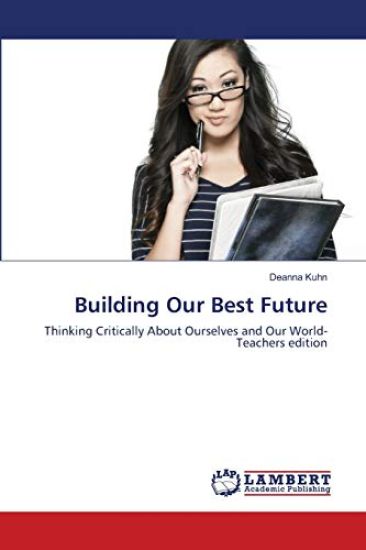
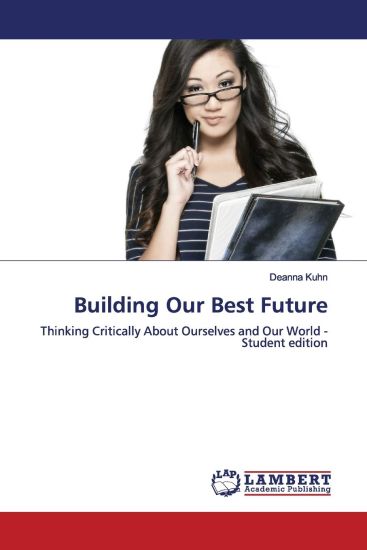
Building Our Best Future by Deanna Kuhn (author of Education for Thinking, Harvard University Press) offers a text written directly to middle and secondary students. It engages them in a method of well-documented effectiveness, using peer dialog to develop verbal and written skills of argument and critical thinking. Simultaneously it engages them in evidence-based decision making regarding 44 topics about their personal futures, the futures of their communities, of their nation, and their world. Provided for each topic is a comprehensive body of factual knowledge, in simple Q&A format, all with further sources. A Teachers Edition, providing further resources including assessment of student skill gains, is complimentary with 10 or more student copies.
Building Our Best Future by Deanna Kuhn (author of Education for Thinking, Harvard University Press) offers a text written directly to middle and secondary students. It engages them in a method of well-documented effectiveness, using peer dialog to develop verbal and written skills of argument and critical thinking. Simultaneously it engages them in evidence-based decision making regarding 44 topics about their personal futures, the futures of their communities, of their nation, and their world. Provided for each topic is a comprehensive body of factual knowledge, in simple Q&A format, all with further sources. A Teachers Edition, providing further resources including assessment of student skill gains, is complimentary with 10 or more student copies.

It is essential that middle- and high-school students develop argument skills. This rich resource provides a clear, step-by-step approach that achieves this goal. The method is rooted in peer dialog and makes use of readily available technology. The authors document impressive gains in students’ skills in producing and interpreting both dialogic and written arguments. The method can be used in English or content-area classes, or even be implemented as a stand-alone class or as part of a debate program. This curriculum helps students become critical thinkers prepared for the demands of college, careers, and citizenship. Book Features: Background on why students should develop argument skills and what these skills consist of The nuts and bolts of how to implement the curriculum in your own classroom Alignments to the Common Core State Standards and Next Generation Science Standards Accessible video material showing both teacher’s instructions and students’ activities Samples of students’ written work Assessment tools that you can use or modify to fit your own needs An appendix with additional guides, examples, suggested topics, and classroom-ready reproducibles.New to the second edition is a chapter on how you can incorporate this approach into an existing curriculum if you are unable to implement the full program.The techniques are designed to be flexible and adaptable, and work with students of all ability levels—especially with those who are less motivated and engaged in school.This enhanced edition is also accompanied by free bonus eResources, such as suggested readings on different topics and full lesson plans, which you can download and print from our website, www.routledge.com/9781138911406.
It is essential that middle- and high-school students develop argument skills. This rich resource provides a clear, step-by-step approach that achieves this goal. The method is rooted in peer dialog and makes use of readily available technology. The authors document impressive gains in students’ skills in producing and interpreting both dialogic and written arguments. The method can be used in English or content-area classes, or even be implemented as a stand-alone class or as part of a debate program. This curriculum helps students become critical thinkers prepared for the demands of college, careers, and citizenship. Book Features: Background on why students should develop argument skills and what these skills consist of The nuts and bolts of how to implement the curriculum in your own classroom Alignments to the Common Core State Standards and Next Generation Science Standards Accessible video material showing both teacher’s instructions and students’ activities Samples of students’ written work Assessment tools that you can use or modify to fit your own needs An appendix with additional guides, examples, suggested topics, and classroom-ready reproducibles.New to the second edition is a chapter on how you can incorporate this approach into an existing curriculum if you are unable to implement the full program.The techniques are designed to be flexible and adaptable, and work with students of all ability levels—especially with those who are less motivated and engaged in school.This enhanced edition is also accompanied by free bonus eResources, such as suggested readings on different topics and full lesson plans, which you can download and print from our website, www.routledge.com/9781138911406.
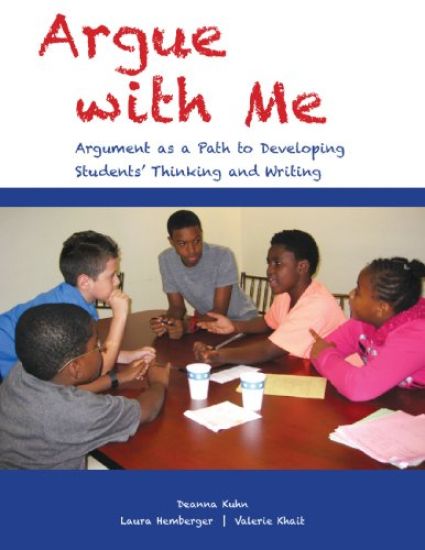
It is essential that middle- and high-school students develop argument skills. This rich resource provides a clear, step-by-step approach that achieves this goal. The method is rooted in peer dialog and makes use of readily available technology. The authors document impressive gains in students' skills in producing and interpreting both dialogic and written arguments. The method can be used in English or content-area classes, or even be implemented as a stand-alone class or as part of a debate program. This curriculum helps students become critical thinkers prepared for the demands of college, careers, and citizenship. Book Features: Background on why students should develop argument skills and what these skills consist of The nuts and bolts of how to implement the curriculum in your own classroom Alignments to the Common Core State Standards and Next Generation Science Standards Accessible video material showing both teacher's instructions and students' activities Samples of students' written work Assessment tools that you can use or modify to fit your own needs An appendix with additional guides, examples, suggested topics, and classroom-ready reproducibles. New to the second edition is a chapter on how you can incorporate this approach into an existing curriculum if you are unable to implement the full program.The techniques are designed to be flexible and adaptable, and work with students of all ability levels-especially with those who are less motivated and engaged in school. This enhanced edition is also accompanied by free bonus eResources, such as suggested readings on different topics and full lesson plans, which you can download and print from our website, www.routledge.com/9781138911406.
What do we want schools to accomplish? The only defensible answer, Deanna Kuhn argues, is that they should teach students to use their minds well, in school and beyond.Bringing insights from research in developmental psychology to pedagogy, Kuhn maintains that inquiry and argument should be at the center of a “thinking curriculum”—a curriculum that makes sense to students as well as to teachers and develops the skills and values needed for lifelong learning. We have only a brief window of opportunity in children’s lives to gain (or lose) their trust that the things we ask them to do in school are worth doing. Activities centered on inquiry and argument—such as identifying features that affect the success of a music club catalog or discussing difficult issues like capital punishment—allow students to appreciate their power and utility as they engage in them.Most of what students do in schools today simply does not have this quality. Inquiry and argument do. They are education for life, not simply more school, and they offer a unifying purpose for compulsory schooling as it serves an ever more diverse and challenging population.
In this Monograph, knowledge acquisition is examined as a process involving the coordination of existing theories with new evidence. Central to the present work is the claim that strategies of knowledge acquisition may vary significantly across (as well as within) individuals and can be conceptualized within a developmental framework.