Kirjojen hintavertailu. Mukana 12 657 676 kirjaa ja 12 kauppaa.
Kirjailija
Deborah Dixon
Kirjat ja teokset yhdessä paikassa: 7 kirjaa, julkaisuja vuosilta 2013-2026, suosituimpien joukossa An Introduction to Political Geography. Vertaile teosten hintoja ja tarkista saatavuus suomalaisista kirjakaupoista.
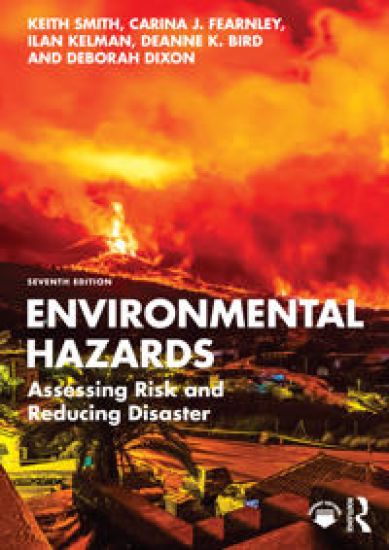
The seventh edition of Environmental Hazards provides a much expanded and fully up-to-date overview of all the extreme environmental events that threaten people and what they value in the 21st century globally. It integrates cutting-edge materials to provide an interdisciplinary approach to environmental hazards and their management, illustrating how natural and human systems interact to place communities of all sizes, and at all stages of economic development, at risk. Part 1 defines basic concepts of hazard, risk, vulnerability and disaster and explores the evolution of hazards theory. Part 2 employs a consistent chapter structure to demonstrate how individual hazards occur, their impacts and how the risks can be assessed and managed.This extensively revised edition includes:Fresh perspectives on the reliability of disaster data, disaster risk reduction, risk and disaster perception and communication, and new technologies available to assist with environmental hazard managementThe addition of several new environmental hazards including landslide and avalanches, cryospheric hazards, karst and subsidence hazards, and hazards of the AnthropoceneMore boxed sections with a focus on both generic issues and the lessons to be learned from a carefully selected range of up-to-date extreme eventsAn annotated list of key resources, including further reading and relevant websites, for all chaptersMore colour diagrams and photographs, and more than 1,000 references to some of the most significant and recent published materialNew exercises to assist teaching in the classroom, or self-learningThis carefully structured and balanced textbook captures the complexity and dynamism of environmental hazards and is essential reading for students across many disciplines including geography, environmental science, environmental studies and natural resources.
The seventh edition of Environmental Hazards provides a much expanded and fully up-to-date overview of all the extreme environmental events that threaten people and what they value in the 21st century globally. It integrates cutting-edge materials to provide an interdisciplinary approach to environmental hazards and their management, illustrating how natural and human systems interact to place communities of all sizes, and at all stages of economic development, at risk. Part 1 defines basic concepts of hazard, risk, vulnerability and disaster and explores the evolution of hazards theory. Part 2 employs a consistent chapter structure to demonstrate how individual hazards occur, their impacts and how the risks can be assessed and managed.This extensively revised edition includes:Fresh perspectives on the reliability of disaster data, disaster risk reduction, risk and disaster perception and communication, and new technologies available to assist with environmental hazard managementThe addition of several new environmental hazards including landslide and avalanches, cryospheric hazards, karst and subsidence hazards, and hazards of the AnthropoceneMore boxed sections with a focus on both generic issues and the lessons to be learned from a carefully selected range of up-to-date extreme eventsAn annotated list of key resources, including further reading and relevant websites, for all chaptersMore colour diagrams and photographs, and more than 1,000 references to some of the most significant and recent published materialNew exercises to assist teaching in the classroom, or self-learningThis carefully structured and balanced textbook captures the complexity and dynamism of environmental hazards and is essential reading for students across many disciplines including geography, environmental science, environmental studies and natural resources.
An Introduction to Political Geography continues to provide a broad-based introduction to contemporary political geography for students following undergraduate degree courses in geography and related subjects. The text explores the full breadth of contemporary political geography, covering not only traditional concerns such as the state, geopolitics, electoral geography and nationalism; but also increasing important areas at the cutting-edge of political geography research including globalization, the geographies of regulation and governance, geographies of policy formulation and delivery, and themes at the intersection of political and cultural geography, including the politics of place consumption, landscapes of power, citizenship, identity politics and geographies of mobilization and resistance.This second edition builds on the strengths of the first. The main changes and enhancements are: four new chapters on: political geographies of globalization, geographies of empire, political geography and the environment and geopolitics and critical geopoliticssignificant updating and revision of the existing chapters to discuss key developments, drawing on recent academic contributions and political eventsnew case studies, drawing on an increasing number of international and global examplesadditional boxes for key concepts and an enlarged glossary. As with the first edition, extensive use is made of case study examples, illustrations, explanatory boxes, guides to further reading and a glossary of key terms to present the material in an easily accessible manner. Through employment of these techniques this book introduces students to contributions from a range of social and political theories in the context of empirical case study examples. By providing a basic introduction to such concepts and pointing to pathways into more specialist material, this book serves both as a core text for first- and second- year courses in political geography, and as a resource alongside supplementary textbooks for more specialist third year courses.
An Introduction to Political Geography continues to provide a broad-based introduction to contemporary political geography for students following undergraduate degree courses in geography and related subjects. The text explores the full breadth of contemporary political geography, covering not only traditional concerns such as the state, geopolitics, electoral geography and nationalism; but also increasing important areas at the cutting-edge of political geography research including globalization, the geographies of regulation and governance, geographies of policy formulation and delivery, and themes at the intersection of political and cultural geography, including the politics of place consumption, landscapes of power, citizenship, identity politics and geographies of mobilization and resistance.This second edition builds on the strengths of the first. The main changes and enhancements are: four new chapters on: political geographies of globalization, geographies of empire, political geography and the environment and geopolitics and critical geopoliticssignificant updating and revision of the existing chapters to discuss key developments, drawing on recent academic contributions and political eventsnew case studies, drawing on an increasing number of international and global examplesadditional boxes for key concepts and an enlarged glossary. As with the first edition, extensive use is made of case study examples, illustrations, explanatory boxes, guides to further reading and a glossary of key terms to present the material in an easily accessible manner. Through employment of these techniques this book introduces students to contributions from a range of social and political theories in the context of empirical case study examples. By providing a basic introduction to such concepts and pointing to pathways into more specialist material, this book serves both as a core text for first- and second- year courses in political geography, and as a resource alongside supplementary textbooks for more specialist third year courses.