Kirjojen hintavertailu. Mukana 12 390 323 kirjaa ja 12 kauppaa.

Kirjailija

Debrupa Lahiri

Kirjat ja teokset yhdessä paikassa: 3 kirjaa, julkaisuja vuosilta 2021-2025, suosituimpien joukossa Carbon Nanotubes. Vertaile teosten hintoja ja tarkista saatavuus suomalaisista kirjakaupoista.

3 kirjaa

Kirjojen julkaisuhaarukka 2021-2025.

Boron Nitride Nanostructures

Boron Nitride Nanostructures

Indranil Lahiri; Amrita De Adhikari; Souvik Ghosh; Rita Joshi; Satish Jaiswal; Debrupa Lahiri

TAYLOR FRANCIS LTD
2025
sidottu
This book gives a focused view of boron nitride (BN) nanostructures including structure, synthesis, properties and various energy and healthcare related applications. It covers varied dimensional structures of BN, along with other crystalline phases, and important properties of all these structures. It also covers different synthesis routes for all types of BN nanostructures, functional groups, defect engineering etc. Further sections cover energy storage and conversion, biomedical, piezoelectric and, sensing applications including challenges and opportunities.Provides exhaustive coverage of nanostructures of Boron NitrideDiscusses pertinent structure, synthesis, functionalization, and properties in detailEmphasizes on applications in energy and healthcare sectorContains individual chapters on chapters on zero-dimensional, one-dimensional, two-dimensional, and three-dimensional structures of Boron NitrideIncludes patentability, market potential and actual product informationThis book is aimed at Researchers and graduate students in Chemical Engineering, Materials Science, Physics, and Chemistry.

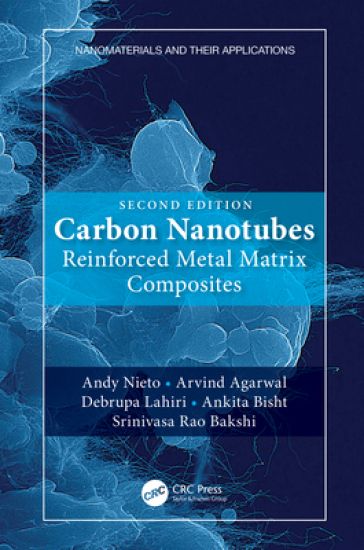
Carbon Nanotubes

Carbon Nanotubes

Andy Nieto; Arvind Agarwal; Debrupa Lahiri; Ankita Bisht; Srinivasa Rao Bakshi

TAYLOR FRANCIS LTD
2024
nidottu
This discovery of carbon nanotubes (CNT) three decades ago ushered in the technological era of nanotechnology. Among the most widely studied areas of CNT research is their use as structural reinforcements in composites. This book describes the development of CNT reinforced metal matrix composites (CNT-MMCs) over the last two decades. The field of CNT-MMCs is abundant in fundamental science, rich in engineering challenges and innovations and ripe for technological maturation and commercialization. The authors have sought to present the current state of the-art in CNT-MMC technology from their synthesis to their myriad potential end-use applications. Specifically, topics explored include:• Advantages, limitations, and evolution of processing techniques used to synthesize and fabricate CNT-MMCs• Emphasizes dispersion techniques of CNTs in metallic systems, a key challenge to the successful and widespread implementation of CNT-MMCs. Methods for quantification and improved control of CNT distributions are presented• Methods for quantification and improved control of CNT distributions are presented• Characterization techniques uniquely suited for charactering these nanoscale materials and their many chemical and physical interactions with the metal matrix, including real-time in-situ characterization of deformation mechanisms• Electron microscope images from premier studies enrich discussions on micro-mechanical modeling, interfacial design, mechanical behavior, and functional properties• A chapter is dedicated to the emergence of dual reinforcement composites that seek to enhance the efficacy of CNTs and lead to material properties by designThis book highlights seminal findings in CNT-MMC research and includes several tables listing processing methods, associated CNT states, and resulting properties in order to aid the next generation of researchers in advancing the science and engineering of CNT-MMCs. In addition, a survey of the patent literature is presented in order to shed light on what the first wave of CNT-MMC commercialization may look like and the challenges that will have to be overcome, both technologically and commercially.
Carbon Nanotubes

Carbon Nanotubes

Andy Nieto; Arvind Agarwal; Debrupa Lahiri; Ankita Bisht; Srinivasa Rao Bakshi

CRC Press
2021
sidottu
This discovery of carbon nanotubes (CNT) three decades ago ushered in the technological era of nanotechnology. Among the most widely studied areas of CNT research is their use as structural reinforcements in composites. This book describes the development of CNT reinforced metal matrix composites (CNT-MMCs) over the last two decades. The field of CNT-MMCs is abundant in fundamental science, rich in engineering challenges and innovations and ripe for technological maturation and commercialization. The authors have sought to present the current state of the-art in CNT-MMC technology from their synthesis to their myriad potential end-use applications. Specifically, topics explored include:• Advantages, limitations, and evolution of processing techniques used to synthesize and fabricate CNT-MMCs• Emphasizes dispersion techniques of CNTs in metallic systems, a key challenge to the successful and widespread implementation of CNT-MMCs. Methods for quantification and improved control of CNT distributions are presented• Methods for quantification and improved control of CNT distributions are presented• Characterization techniques uniquely suited for charactering these nanoscale materials and their many chemical and physical interactions with the metal matrix, including real-time in-situ characterization of deformation mechanisms• Electron microscope images from premier studies enrich discussions on micro-mechanical modeling, interfacial design, mechanical behavior, and functional properties• A chapter is dedicated to the emergence of dual reinforcement composites that seek to enhance the efficacy of CNTs and lead to material properties by designThis book highlights seminal findings in CNT-MMC research and includes several tables listing processing methods, associated CNT states, and resulting properties in order to aid the next generation of researchers in advancing the science and engineering of CNT-MMCs. In addition, a survey of the patent literature is presented in order to shed light on what the first wave of CNT-MMC commercialization may look like and the challenges that will have to be overcome, both technologically and commercially.