Kirjojen hintavertailu. Mukana 12 595 353 kirjaa ja 12 kauppaa.

Kirjailija

Denis Donoghue

Kirjat ja teokset yhdessä paikassa: 15 kirjaa, julkaisuja vuosilta 1969-2025, suosituimpien joukossa Jonathan Swift. Vertaile teosten hintoja ja tarkista saatavuus suomalaisista kirjakaupoista.

15 kirjaa

Kirjojen julkaisuhaarukka 1969-2025.

Jonathan Swift

Jonathan Swift

Denis Donoghue

Cambridge University Press
2010
pokkari
In this concise critical survey, Professor Donoghue looks at Swift's whole output, and expresses a fresh sense of his literary character. In particular, he questions the widespread view that Swift is to be understood in terms of irony, persona or mask. He points out, for instance, that Swift's irony is not continuous, and that his sense of form is not ours. We should not see him as producing elaborate artistic structures, but as meeting particular needs which forced themselves upon him. We need also to identify the 'gestures' through which Swift revealed his characteristic mental attitudes, and behind them to sense his general life-stance; to understand his devices - such as the choice and change of perspective; his deeper pre-occupations - such as the relationship between the body, the mind and the soul; his attitude to and use of language; his conception of the nature of humanity; the characteristics of his verse.
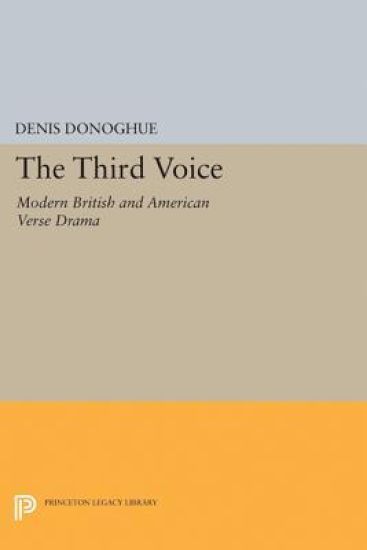
Third Voice

Third Voice

Denis Donoghue

Princeton University Press
2016
sidottu
In this stimulating survey of the entire field of modern English verse drama, William Butler Yeats and T.S. Eliot are regarded as the key figures. Shorter studies are included of Christopher Fry, E.E. Cummings, W.H. Auden, Archibald MacLeish, Ezra Pound, Wallace Stevens, and Richard Eberhart. Differing from some contemporary critics, Mr. Donoghue believes that verse drama is a major creative art-form of our literature, with a vigorous present and promise of a vital future. In a persuasive and perceptive exposition of this belief, he considers such questions as the nature of dramatic verse, the mood play, the relation between dramatic verse and the behavior of speech, the necessity of distinguishing between "verse drama" and "poetic drama" or "theatre poetry." Originally published in 1963. The Princeton Legacy Library uses the latest print-on-demand technology to again make available previously out-of-print books from the distinguished backlist of Princeton University Press. These editions preserve the original texts of these important books while presenting them in durable paperback and hardcover editions. The goal of the Princeton Legacy Library is to vastly increase access to the rich scholarly heritage found in the thousands of books published by Princeton University Press since its founding in 1905.
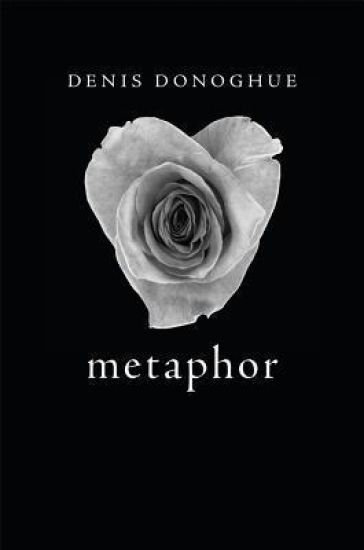
Metaphor

Metaphor

Denis Donoghue

Harvard University Press
2014
sidottu
Denis Donoghue turns his attention to the practice of metaphor and to its lesser cousins, simile, metonym, and synecdoche. Metaphor (“a carrying or bearing across”) supposes that an ordinary word could have been used in a statement but hasn’t been. Instead, something else, something unexpected, appears. The point of a metaphor is to enrich the reader’s experience by bringing different associations to mind. The force of a good metaphor is to give something a different life, a new life. The essential character of metaphor, Donoghue says, is prophetic. Metaphors intend to change the world by changing our sense of it.At the center of Donoghue’s study is the idea that metaphor permits the greatest freedom in the use of language because it exempts language from the local duties of reference and denotation. Metaphors conspire with the mind in its enjoyment of freedom. Metaphor celebrates imaginative life par excellence, from Donoghue’s musings on Aquinas’ Latin hymns, interspersed with autobiographical reflection, to his agile and perceptive readings of Wallace Stevens.When Donoghue surveys the history of metaphor and resistance to it, going back to Aristotle and forward to George Lakoff, he is a sly, cogent, and persuasive companion. He also addresses the question of whether or not metaphors can ever truly die. Reflected on every page of Metaphor are the accumulated wisdom of decades of reading and a sheer love of language and life.
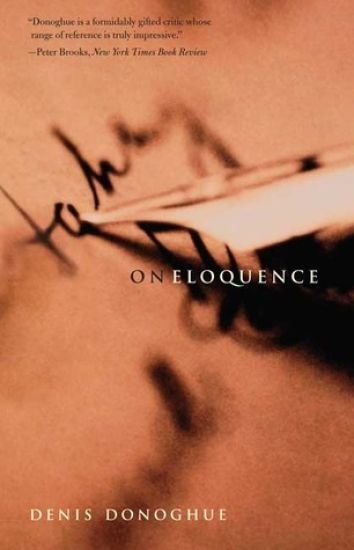
On Eloquence

On Eloquence

Denis Donoghue

Yale University Press
2010
pokkari
An eloquent reminder of why we should care about—and revel in—eloquence in literature and speechOn Eloquence questions the common assumption that eloquence is merely a subset of rhetoric, a means toward a rhetorical end. Denis Donoghue, an eminent and prolific critic of the English language, holds that this assumption is erroneous. While rhetoric is the use of language to persuade people to do one thing rather than another, Donoghue maintains that eloquence is “gratuitous, ideally autonomous, in speech and writing an upsurge of creative vitality for its own sake.” He offers many instances of eloquence in words, and suggests the forms our appreciation of them should take. Donoghue argues persuasively that eloquence matters, that we should indeed care about it. “Because we should care about any instances of freedom, independence, creative force, sprezzatura,” he says, “especially when we live—perhaps this is increasingly the case—in a culture of the same, featuring official attitudes, stereotypes of the officially enforced values, sedated language, a politics of pacification.” A noteworthy addition to Donoghue’s long-term project to reclaim a disinterested appreciation of literature as literature, this volume is a wise and pleasurable meditation on eloquence, its unique ability to move or give pleasure, and its intrinsic value.
Jonathan Swift Critical Introduction

Jonathan Swift Critical Introduction

Denis Donoghue

Cambridge University Press
1969
sidottu
In this concise critical survey, Professor Donoghue looks at Swift's whole output, and expresses a fresh sense of his literary character. In particular, he questions the widespread view that Swift is to be understood in terms of irony, persona or mask. He points out, for instance, that Swift's irony is not continuous, and that his sense of form is not ours. We should not see him as producing elaborate artistic structures, but as meeting particular needs which forced themselves upon him. We need also to identify the 'gestures' through which Swift revealed his characteristic mental attitudes, and behind them to sense his general life-stance; to understand his devices - such as the choice and change of perspective; his deeper pre-occupations - such as the relationship between the body, the mind and the soul; his attitude to and use of language; his conception of the nature of humanity; the characteristics of his verse.
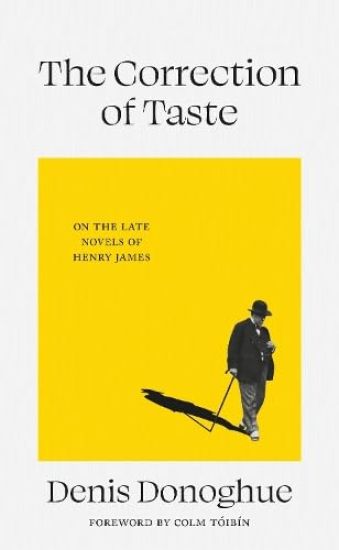
The Correction of Taste

The Correction of Taste

Denis Donoghue; Colm Toibín

THE LILLIPUT PRESS LTD
2025
sidottu
‘Donoghue was alert to the idea of the unsayable, as he circled around the idea of language itself as pliable material, all the more beautiful for that and worthy of our full consideration, but yielding at times to further levels of mystery...’ from foreword by Colm Tóibín In this last written work, the internationally renowned Irish literary critic Denis Donoghue brings an acute critical intelligence to bear on the late novels of Henry James. One of the greatest novelists in the English language, Henry James (1843-1916) was an American-British author who is regarded as a key transitional figure between literary realism and literary modernism. James’s The Portrait of a Lady (1881) was the central achievement of his early period. The Turn of the Screw (1898) was a high-point of Gothic literature. In The Correction of Taste, Denis Donoghue offers a close reading of James’s final novels, taking as his starting point an observation by T.S. Eliot about the function of literary criticism. Exploring a succession of works such as The Ambassadors (1903), The Wings of the Dove (1902) and The Golden Bowl (1905), Donoghue brings into sharp focus the complex layers of James’s literary genius.
Third Voice

Third Voice

Denis Donoghue

Princeton University Press
2015
pokkari
In this stimulating survey of the entire field of modern English verse drama, William Butler Yeats and T.S. Eliot are regarded as the key figures. Shorter studies are included of Christopher Fry, E.E. Cummings, W.H. Auden, Archibald MacLeish, Ezra Pound, Wallace Stevens, and Richard Eberhart. Differing from some contemporary critics, Mr. Donoghue believes that verse drama is a major creative art-form of our literature, with a vigorous present and promise of a vital future. In a persuasive and perceptive exposition of this belief, he considers such questions as the nature of dramatic verse, the mood play, the relation between dramatic verse and the behavior of speech, the necessity of distinguishing between "verse drama" and "poetic drama" or "theatre poetry." Originally published in 1963. The Princeton Legacy Library uses the latest print-on-demand technology to again make available previously out-of-print books from the distinguished backlist of Princeton University Press. These editions preserve the original texts of these important books while presenting them in durable paperback and hardcover editions. The goal of the Princeton Legacy Library is to vastly increase access to the rich scholarly heritage found in the thousands of books published by Princeton University Press since its founding in 1905.
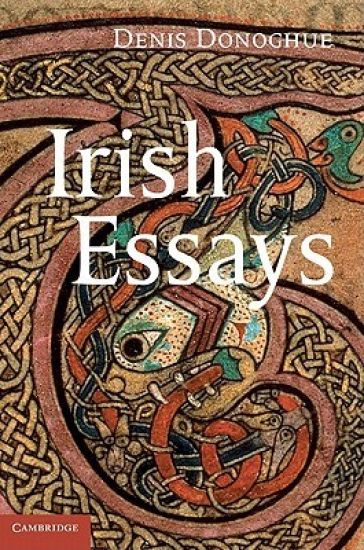
Irish Essays

Irish Essays

Denis Donoghue

Cambridge University Press
2011
sidottu
Denis Donoghue has been a key figure in Irish studies and an important public intellectual in Ireland, the UK and US throughout his career. These essays represent the best of his writing and operate in conversation with one another. He probes the questions of Irish national and cultural identity that underlie the finest achievements of Irish writing in all genres. Together, the essays form an unusually lively and far-reaching study of three crucial Irish writers – Swift, Yeats and Joyce – together with other voices including Mangan, Beckett, Trevor, McGahern and Doyle. Donoghue's forceful arguments, deep engagement with the critical tradition, buoyant prose and extensive learning are all exemplified in this collection. This book is essential reading for all those interested in Irish literature and culture and its far-reaching effects on the world.
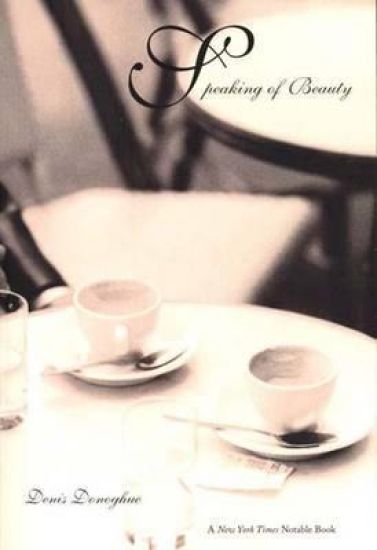
Speaking of Beauty

Speaking of Beauty

Denis Donoghue

Yale University Press
2004
pokkari
A foremost critic of the English language here reflects on beauty and the language that it inspires in authors from Kant to Keats, Hawthorne to Housman. “An excellent and eloquent book.”—James Wood, New York Times Book Review“A beautiful book about beauty. Enormously learned, allusive, recuperative, and citational, it is a passionate meditation on what has been said about beauty in the West from the Greeks to the present day.”—J. Hillis Miller“Donoghue talks . . . with a delightful informality and absence of dogma. . . . One of the most charming features of Denis Donoghue’s book is his appendix of ‘afterwords,’ brief quotations on beauty from sundry writers.”—John Bayley, New York Review of Books“Continuously fascinating, continuously readable, the book speaks of beauty, and of speakers of beauty, in its own calm, steady voice. You won’t want to lay it down.”—Hugh Kenner
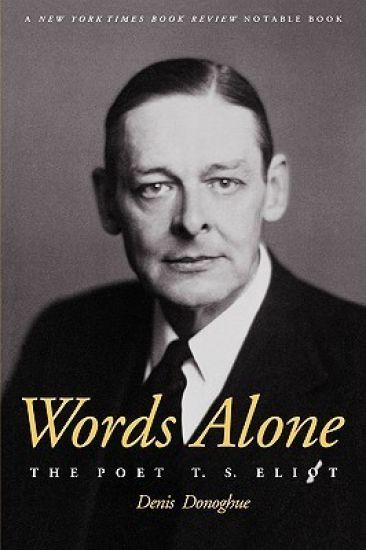
Words Alone

Words Alone

Denis Donoghue

Yale University Press
2002
pokkari
When Denis Donoghue left Warrenpoint and went to Dublin in September 1946, he entered University College as a student of Latin and English. A few months later he also started as a student of lieder at the Royal Irish Academy of Music. These studies have informed his reading of English, Irish, and American literature. Now in this volume, one of our most distinguished readers of modern literature offers his most personal book of literary criticism. Donoghue’s Words Alone is an intellectual memoir, a lucid and illuminating account of his engagement with the works of T. S. Eliot—from initial undergraduate encounters with “The Love Song of J. Alfred Prufrock” to later submission to Eliot’s entire writings. “The pleasure of Eliot’s words persists,” Donoghue says, “only because in good faith it can’t be denied.”Submission to Eliot, in Donoghue’s case, involves the ear as much as it does the mind. He is a reader who listens attentively and a writer whose own music in these pages commands attention. Whether he is writing about Eliot’s poetry or confronting the (often contentious) prose, Donoghue eloquently demonstrates what it means to read and to hear a master of language.
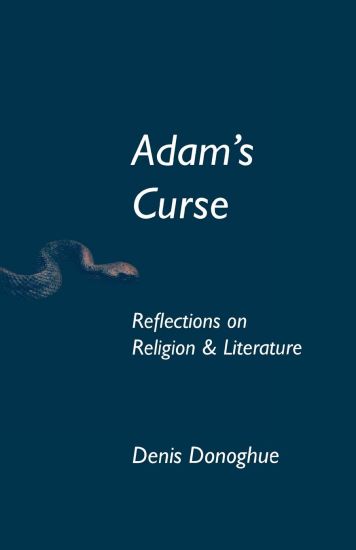
Adam's Curse

Adam's Curse

Denis Donoghue

University of Notre Dame Press
2001
nidottu
Taking its title from a poem of William Butler Yeats, this collection of essays focuses on "Adam's Curse"—the burdens and harsh conditions that, as Denis Donoghue underscores throughout, make any human achievement difficult. As he says, those "conditions include at various levels of reference the Fall of Man, categorical failure, loss, the limitations inscribed so insistently in human life that they seem to be in the nature of things, like death and weather." But hope is never ruled out, as Donoghue reminds us of "the possibility of putting up with the conditions and turning them to some account." It is the "putting up with the conditions and turning them to some account"—a post-lapsarian struggle fraught with religious questions—that most interests Donoghue. These essays, which are explorations of both faith and literary works that engage faith, address a dazzling range of texts and writers: Yeats, Milton, Larkin, Heaney, Emmanuel Levinas, Alasdair MacIntyre, John Crowe Ransom, Henry Adams, William Lynch's Christ and Apollo, and Robert Bellah's Beyond Belief, among others. Common to all is an alertness to the social bearing of literature and the role it plays in relation to politics, religion, and especially ethics. What emerges, for Donoghue, is the need to restore the primacy of theology and church doctrine without evading the "dark parts" of the Old and New Testaments. Through his probing, reflective encounters with philosophical and religious issues, we witness a magisterial intelligence at work.
Adam's Curse

Adam's Curse

Denis Donoghue

University of Notre Dame Press
2001
sidottu
Taking its title from a poem of William Butler Yeats, this collection of essays focuses on "Adam's Curse"—the burdens and harsh conditions that, as Denis Donoghue underscores throughout, make any human achievement difficult. As he says, those "conditions include at various levels of reference the Fall of Man, categorical failure, loss, the limitations inscribed so insistently in human life that they seem to be in the nature of things, like death and weather." But hope is never ruled out, as Donoghue reminds us of "the possibility of putting up with the conditions and turning them to some account." It is the "putting up with the conditions and turning them to some account"—a post-lapsarian struggle fraught with religious questions—that most interests Donoghue. These essays, which are explorations of both faith and literary works that engage faith, address a dazzling range of texts and writers: Yeats, Milton, Larkin, Heaney, Emmanuel Levinas, Alasdair MacIntyre, John Crowe Ransom, Henry Adams, William Lynch's Christ and Apollo, and Robert Bellah's Beyond Belief, among others. Common to all is an alertness to the social bearing of literature and the role it plays in relation to politics, religion, and especially ethics. What emerges, for Donoghue, is the need to restore the primacy of theology and church doctrine without evading the "dark parts" of the Old and New Testaments. Through his probing, reflective encounters with philosophical and religious issues, we witness a magisterial intelligence at work.
The Practice of Reading

The Practice of Reading

Denis Donoghue

Yale University Press
2000
pokkari
This lucid and elegantly written book is a sustained conversation about the nature and importance of literary interpretation. Distinguished critic Denis Donoghue argues that we must read texts closely and imaginatively, as opposed to merely or mistakenly theorizing about them. He shows what serious reading entails by discussing texts that range from Shakespeare's plays to a novel by Cormac McCarthy.Donoghue begins with a personal chapter about his own early experiences reading literature while he was living and teaching in Ireland. He then deals with issues of theory, focusing on the validity of different literary theories, on words and their performances, on the impingement of oral and written conditions of reading, and on such current forces as technology and computers that impinge on the very idea of reading. Finally he examines certain works of literature: Shakespeare’s Othello and Macbeth, Swift’s Gulliver's Travels, a passage from Wordsworth’s The Prelude, a chapter of Joyce’s Ulysses, Yeats’s "Leda and the Swan" and "Coole and Ballylee, 1931," and Cormac McCarthy’s Blood Meridian demonstrating what these texts have in common and how they must be differentiated through a sympathetic, imaginative, and informed reading.