Kirjojen hintavertailu. Mukana 12 595 353 kirjaa ja 12 kauppaa.

Kirjailija

Denis Rothman

Kirjat ja teokset yhdessä paikassa: 12 kirjaa, julkaisuja vuosilta 2018-2026, suosituimpien joukossa RAG-Driven Generative AI. Vertaile teosten hintoja ja tarkista saatavuus suomalaisista kirjakaupoista.

12 kirjaa

Kirjojen julkaisuhaarukka 2018-2026.

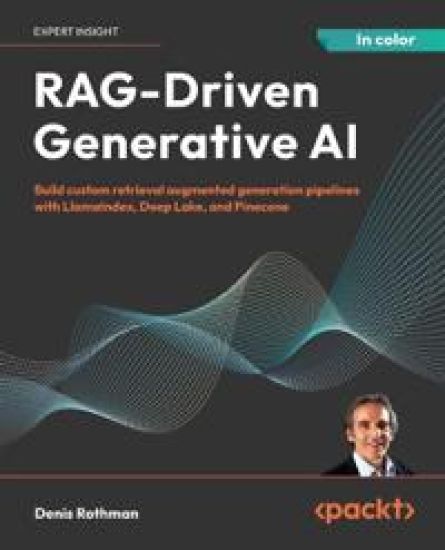
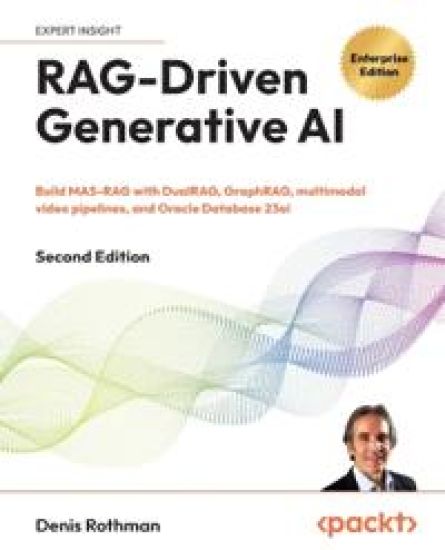
RAG-Driven Generative AI

RAG-Driven Generative AI

Denis Rothman

PACKT PUBLISHING LIMITED
2026
nidottu
Building MAS-RAG (multi-agent AI systems for RAG) that reason over real-world data using hybrid retrieval and scalable architectures for production use. Free with your book: DRM-free PDF version + access to Packt's next-gen Reader* Key Features Master DualRAG by combining vector search with SQL filtering over structured enterprise data Implement GraphRAG, Spatial-RAG, and vector search natively in Oracle Database 23ai Build multimodal video pipelines with human-feedback loops and fine-tuned models Book DescriptionStop moving your data to the AI. This second edition defines a revolutionary architectural shift: bringing the AI to the data. By using Oracle Database 23ai as a converged engine in this book, you will architect Sovereign AI systems that eliminate the fragmentation, latency, and massive security risks inherent in traditional data extraction. You’ll work with DualRAG, synchronizing unstructured vector semantics with the deterministic truth of structured SQL, Graph, and Spatial retrieval. This allows your systems to reason over verified corporate data rather than probabilistic guesses, reducing hallucinations at the source. Moving beyond simple pipelines, you’ll also build MAS-RAG (multi-agent systems for RAG), where autonomous agents coordinate across hybrid retrieval workflows, multimodal video pipelines, and graph-based knowledge structures. Designed for developers and architects, these blueprints transform disconnected data silos into a unified engine to architect autonomous enterprise intelligence that scales with RLHF and model fine-tuning. By the end of the book, you’ll be able to design and deploy enterprise AI systems that combine retrieval, reasoning, and structured data to build reliable generative AI applications. *Email sign-up and proof of purchase requiredWhat you will learn Bring intelligence directly to the data within Oracle Database 23ai Defeat hallucinations and data poisoning with DualRAG, synchronizing vector semantics with structured SQL Build MAS-RAG pipelines with Planner, Agent Registry, and MCP-standardized sovereign agents Engineer an inference-time router using hybrid adaptive RAG to switch between reasoning, retrieval, and human feedback Fuse vector similarity, Oracle Spatial, and SQL Property Graph traversal into a converged hyper-query Multimodal video RAG with version-controlled schema registry and semantic vector search over visual assets Who this book is forThis book is for AI engineers, ML engineers, data scientists, and MLOps professionals who want to build production-ready generative AI systems grounded in enterprise data. It will also benefit solutions architects, database engineers, and software developers looking to integrate large language models with structured and unstructured data sources using modern retrieval architectures. Readers should be comfortable with Python and have a basic understanding of machine learning concepts. Prior experience with generative AI or vector databases will help you get the most out of this book.
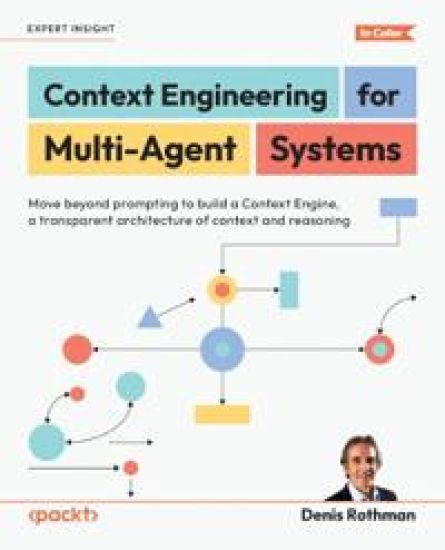
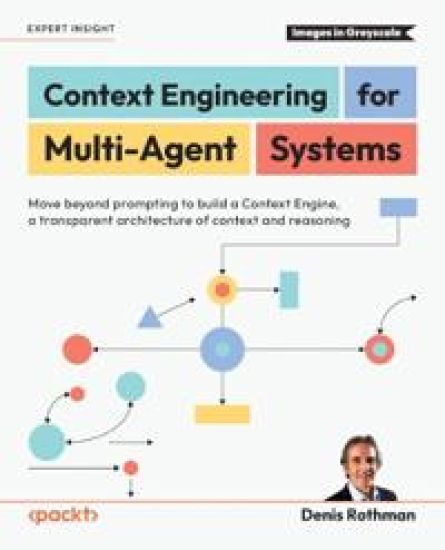
Context Engineering for Multi-Agent Systems

Context Engineering for Multi-Agent Systems

Denis Rothman

PACKT PUBLISHING LIMITED
2025
nidottu
Build AI that thinks in context using semantic blueprints, multi-agent orchestration, memory, RAG pipelines, and safeguards to create your own Context Engine Free with your book: DRM-free PDF version + access to Packt's next-gen Reader* Key Features Design semantic blueprints to give AI structured, goal-driven contextual awareness Orchestrate multi-agent workflows with MCP for adaptable, context-rich reasoning Engineer a glass-box Context Engine with high-fidelity RAG, trust, and safeguards Book DescriptionGenerative AI is powerful, yet often unpredictable. This guide shows you how to turn that unpredictability into reliability by thinking beyond prompts and approaching AI like an architect. At its core is the Context Engine, a glass-box, multi-agent system you’ll learn to design and apply across real-world scenarios. Written by an AI guru and author of various cutting-edge AI books, this book takes you on a hands-on journey from the foundations of context design to building a fully operational Context Engine. Instead of relying on brittle prompts that give only simple instructions, you’ll begin with semantic blueprints that map goals and roles with precision, then orchestrate specialized agents using the Model Context Protocol. As the engine evolves, you’ll integrate memory and high-fidelity retrieval with citations, implement safeguards against data poisoning and prompt injection, and enforce moderation to keep outputs aligned with policy. You’ll also harden the system into a resilient architecture, then see it pivot across domains, from legal compliance to strategic marketing, proving its domain independence. By the end of this book, you’ll be equipped with the skills to engineer an adaptable, verifiable architecture you can repurpose across domains and deploy with confidence. *Email sign-up and proof of purchase requiredWhat you will learn Develop memory models to retain short-term and cross-session context Craft semantic blueprints and drive multi-agent orchestration with MCP Implement high-fidelity RAG pipelines with verifiable citations Apply safeguards against prompt injection and data poisoning Enforce moderation and policy-driven control in AI workflows Repurpose the Context Engine across legal, marketing, and beyond Deploy a scalable, observable Context Engine in production Who this book is forThis book is for AI engineers, software developers, system architects, and data scientists who want to move beyond ad hoc prompting and learn how to design structured, transparent, and context-aware AI systems. It will also appeal to ML engineers and solutions architects with basic familiarity with LLMs who are eager to understand how to orchestrate agents, integrate memory and retrieval, and enforce safeguards.
Context Engineering  for Multi-Agent Systems

Context Engineering for Multi-Agent Systems

Denis Rothman

PACKT PUBLISHING LIMITED
2025
nidottu
Build AI that thinks in context using semantic blueprints, multi-agent orchestration, memory, RAG pipelines, and safeguards to create your own Context Engine Free with your book: DRM-free PDF version + access to Packt's next-gen Reader* Key Features Design semantic blueprints to give AI structured, goal-driven contextual awareness Orchestrate multi-agent workflows with MCP for adaptable, context-rich reasoning Engineer a glass-box Context Engine with high-fidelity RAG, trust, and safeguards Book DescriptionGenerative AI is powerful, yet often unpredictable. This guide shows you how to turn that unpredictability into reliability by thinking beyond prompts and approaching AI like an architect. At its core is the Context Engine, a glass-box, multi-agent system you’ll learn to design and apply across real-world scenarios. Written by an AI guru and author of various cutting-edge AI books, this book takes you on a hands-on journey from the foundations of context design to building a fully operational Context Engine. Instead of relying on brittle prompts that give only simple instructions, you’ll begin with semantic blueprints that map goals and roles with precision, then orchestrate specialized agents using the Model Context Protocol. As the engine evolves, you’ll integrate memory and high-fidelity retrieval with citations, implement safeguards against data poisoning and prompt injection, and enforce moderation to keep outputs aligned with policy. You’ll also harden the system into a resilient architecture, then see it pivot across domains, from legal compliance to strategic marketing, proving its domain independence. By the end of this book, you’ll be equipped with the skills to engineer an adaptable, verifiable architecture you can repurpose across domains and deploy with confidence. *Email sign-up and proof of purchase requiredWhat you will learn Develop memory models to retain short-term and cross-session context Craft semantic blueprints and drive multi-agent orchestration with MCP Implement high-fidelity RAG pipelines with verifiable citations Apply safeguards against prompt injection and data poisoning Enforce moderation and policy-driven control in AI workflows Repurpose the Context Engine across legal, marketing, and beyond Deploy a scalable, observable Context Engine in production Who this book is forThis book is for AI engineers, software developers, system architects, and data scientists who want to move beyond ad hoc prompting and learn how to design structured, transparent, and context-aware AI systems. It will also appeal to ML engineers and solutions architects with basic familiarity with LLMs who are eager to understand how to orchestrate agents, integrate memory and retrieval, and enforce safeguards.
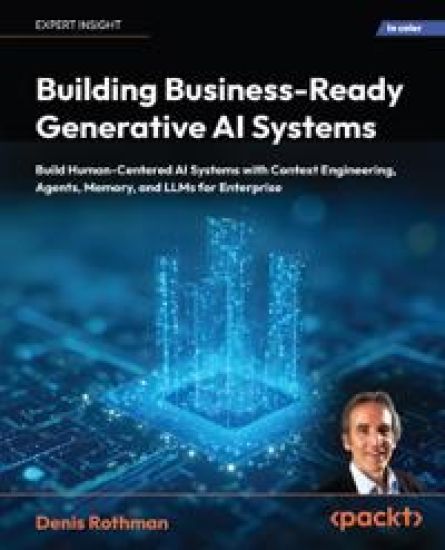
Building Business-Ready Generative AI Systems

Building Business-Ready Generative AI Systems

Denis Rothman

PACKT PUBLISHING LIMITED
2025
nidottu
Supercharge your business with context-aware AI controllers, adaptive agents, multimodal reasoning functionality, neuroscientific memory systems, and flexible handler mechanisms that integrate the emerging generative AI models. Get with your book: PDF copy, AI Assistant, and Next-Gen Reader free. Key Features Build an adaptive, context-aware AI controller with advanced memory strategies Enhance GenAISys with multi-domain, multimodal reasoning capabilities and Chain of Thought (CoT) Seamlessly integrate cutting-edge OpenAI and DeepSeek models as you see fit Book DescriptionStandalone LLMs no longer deliver sufficient business value on their own. This guide moves beyond basic chatbots, showing you how to build agentic, ChatGPT-grade systems capable of sophisticated semantic and sentiment analysis, powered by context engineering. You'll design AI controller architectures with multi-user memory retention to dynamically adapt your system to diverse user and system inputs. You'll architect a Retrieval-Augmented Generation system with Pinecone to combine instruction-driven scenarios. Through context engineering, you’ll minimize token usage, maximize response quality, and create systems that reason across complex tasks with precision. You'll enhance your system’s intelligence with multimodal capabilities—image generation, voice interactions, and machine-driven reasoning—leveraging Chain-of-Thought and context chaining to address cross-domain automation challenges. You'll also integrate OpenAI’s suite and DeepSeek-R1 without disrupting your existing GenAISys ecosystem. With context engineering as the backbone, every step becomes a deliberate act of shaping model behavior. Your GenAISys will apply neuroscience-inspired insights to marketing strategies, predict human mobility, integrate smoothly into human workflows, and connect to live external data, all wrapped in a polished, investor-ready interface.What you will learn Implement an AI controller with a conversation AI agent and orchestrator at its core Build contextual awareness with short-term, long-term, and cross-session memory Design cross-domain automation with multimodal reasoning, image generation, and voice features Expand a CoT agent by integrating consumer-memory understanding Integrate cutting-edge models of your choice without disrupting your existing GenAISys Connect to real-time external data while blocking security breaches Who this book is forThis book is for AI and Machine Learning Engineers seeking to enhance their understanding of Generative AI and its enterprise applications. It will particularly benefit those interested in building AI agents, creating advanced orchestration systems, and leveraging AI for automation in marketing, production, and logistics. Software architects and enterprise developers looking to build scalable AI-driven systems will also find immense value in this guide. No prior superintelligence experience is necessary, but familiarity with AI concepts is recommended.
RAG-Driven Generative AI

RAG-Driven Generative AI

Denis Rothman

PACKT PUBLISHING LIMITED
2024
nidottu
Minimize AI hallucinations and build accurate, custom generative AI pipelines with RAG using embedded vector databases and integrated human feedback Purchase of the print or Kindle book includes a free eBook in PDF format Key Features Implement RAG’s traceable outputs, linking each response to its source document to build reliable multimodal conversational agents Deliver accurate generative AI models in pipelines integrating RAG, real-time human feedback improvements, and knowledge graphs Balance cost and performance between dynamic retrieval datasets and fine-tuning static data Book DescriptionRAG-Driven Generative AI provides a roadmap for building effective LLM, computer vision, and generative AI systems that balance performance and costs. This book offers a detailed exploration of RAG and how to design, manage, and control multimodal AI pipelines. By connecting outputs to traceable source documents, RAG improves output accuracy and contextual relevance, offering a dynamic approach to managing large volumes of information. This AI book shows you how to build a RAG framework, providing practical knowledge on vector stores, chunking, indexing, and ranking. You’ll discover techniques to optimize your project’s performance and better understand your data, including using adaptive RAG and human feedback to refine retrieval accuracy, balancing RAG with fine-tuning, implementing dynamic RAG to enhance real-time decision-making, and visualizing complex data with knowledge graphs. You’ll be exposed to a hands-on blend of frameworks like LlamaIndex and Deep Lake, vector databases such as Pinecone and Chroma, and models from Hugging Face and OpenAI. By the end of this book, you will have acquired the skills to implement intelligent solutions, keeping you competitive in fields from production to customer service across any project.What you will learn Scale RAG pipelines to handle large datasets efficiently Employ techniques that minimize hallucinations and ensure accurate responses Implement indexing techniques to improve AI accuracy with traceable and transparent outputs Customize and scale RAG-driven generative AI systems across domains Find out how to use Deep Lake and Pinecone for efficient and fast data retrieval Control and build robust generative AI systems grounded in real-world data Combine text and image data for richer, more informative AI responses Who this book is forThis book is ideal for data scientists, AI engineers, machine learning engineers, and MLOps engineers. If you are a solutions architect, software developer, product manager, or project manager looking to enhance the decision-making process of building RAG applications, then you’ll find this book useful.
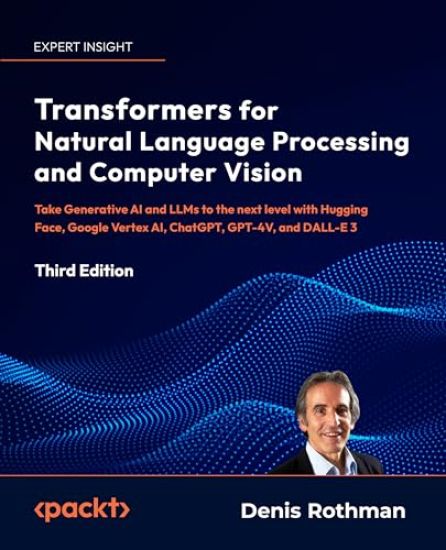
Transformers for Natural Language Processing and Computer Vision
The definitive guide to LLMs, from architectures, pretraining, and fine-tuning to Retrieval Augmented Generation (RAG), multimodal AI, risk mitigation, and practical implementations with ChatGPT, Hugging Face, and Vertex AI Key Features Compare and contrast 20+ models (including GPT, BERT, and Llama) and multiple platforms and libraries to find the right solution for your project Apply RAG with LLMs using customized texts and embeddings Mitigate LLM risks, such as hallucinations, using moderation models and knowledge bases Purchase of the print or Kindle book includes a free eBook in PDF format Book DescriptionTransformers for Natural Language Processing and Computer Vision, Third Edition, explores Large Language Model (LLM) architectures, practical applications, and popular platforms (Hugging Face, OpenAI, and Google Vertex AI) used for Natural Language Processing (NLP) and Computer Vision (CV). The book guides you through a range of transformer architectures from foundation models and generative AI. You’ll pretrain and fine-tune LLMs and work through different use cases, from summarization to question-answering systems leveraging embedding-based search. You'll also implement Retrieval Augmented Generation (RAG) to enhance accuracy and gain greater control over your LLM outputs. Additionally, you’ll understand common LLM risks, such as hallucinations, memorization, and privacy issues, and implement mitigation strategies using moderation models alongside rule-based systems and knowledge integration. Dive into generative vision transformers and multimodal architectures, and build practical applications, such as image and video classification. Go further and combine different models and platforms to build AI solutions and explore AI agent capabilities. This book provides you with an understanding of transformer architectures, including strategies for pretraining, fine-tuning, and LLM best practices. What you will learn Breakdown and understand the architectures of the Transformer, BERT, GPT, T5, PaLM, ViT, CLIP, and DALL-E Fine-tune BERT, GPT, and PaLM models Learn about different tokenizers and the best practices for preprocessing language data Pretrain a RoBERTa model from scratch Implement retrieval augmented generation and rules bases to mitigate hallucinations Visualize transformer model activity for deeper insights using BertViz, LIME, and SHAP Go in-depth into vision transformers with CLIP, DALL-E, and GPT Who this book is forThis book is ideal for NLP and CV engineers, data scientists, machine learning practitioners, software developers, and technical leaders looking to advance their expertise in LLMs and generative AI or explore latest industry trends. Familiarity with Python and basic machine learning concepts will help you fully understand the use cases and code examples. However, hands-on examples involving LLM user interfaces, prompt engineering, and no-code model building ensure this book remains accessible to anyone curious about the AI revolution.
Interpretable Machine Learning with Python

Interpretable Machine Learning with Python

Serg Masís; Aleksander Molak; Denis Rothman

PACKT PUBLISHING LIMITED
2023
nidottu
A deep dive into the key aspects and challenges of machine learning interpretability using a comprehensive toolkit, including SHAP, feature importance, and causal inference, to build fairer, safer, and more reliable models. Purchase of the print or Kindle book includes a free eBook in PDF format. Key Features Interpret real-world data, including cardiovascular disease data and the COMPAS recidivism scores Build your interpretability toolkit with global, local, model-agnostic, and model-specific methods Analyze and extract insights from complex models from CNNs to BERT to time series models Book DescriptionInterpretable Machine Learning with Python, Second Edition, brings to light the key concepts of interpreting machine learning models by analyzing real-world data, providing you with a wide range of skills and tools to decipher the results of even the most complex models. Build your interpretability toolkit with several use cases, from flight delay prediction to waste classification to COMPAS risk assessment scores. This book is full of useful techniques, introducing them to the right use case. Learn traditional methods, such as feature importance and partial dependence plots to integrated gradients for NLP interpretations and gradient-based attribution methods, such as saliency maps. In addition to the step-by-step code, you’ll get hands-on with tuning models and training data for interpretability by reducing complexity, mitigating bias, placing guardrails, and enhancing reliability. By the end of the book, you’ll be confident in tackling interpretability challenges with black-box models using tabular, language, image, and time series data.What you will learn Progress from basic to advanced techniques, such as causal inference and quantifying uncertainty Build your skillset from analyzing linear and logistic models to complex ones, such as CatBoost, CNNs, and NLP transformers Use monotonic and interaction constraints to make fairer and safer models Understand how to mitigate the influence of bias in datasets Leverage sensitivity analysis factor prioritization and factor fixing for any model Discover how to make models more reliable with adversarial robustness Who this book is forThis book is for data scientists, machine learning developers, machine learning engineers, MLOps engineers, and data stewards who have an increasingly critical responsibility to explain how the artificial intelligence systems they develop work, their impact on decision making, and how they identify and manage bias. It’s also a useful resource for self-taught ML enthusiasts and beginners who want to go deeper into the subject matter, though a good grasp of the Python programming language is needed to implement the examples.
Transformers for Natural Language Processing

Transformers for Natural Language Processing

Denis Rothman; Antonio Gulli

PACKT PUBLISHING LIMITED
2022
nidottu
OpenAI's GPT-3, ChatGPT, GPT-4 and Hugging Face transformers for language tasks in one book. Get a taste of the future of transformers, including computer vision tasks and code writing and assistance.Purchase of the print or Kindle book includes a free eBook in PDF formatKey FeaturesImprove your productivity with OpenAI's ChatGPT and GPT-4 from prompt engineering to creating and analyzing machine learning modelsPretrain a BERT-based model from scratch using Hugging FaceFine-tune powerful transformer models, including OpenAI's GPT-3, to learn the logic of your dataBook DescriptionTransformers are...well...transforming the world of AI. There are many platforms and models out there, but which ones best suit your needs? Transformers for Natural Language Processing, 2nd Edition, guides you through the world of transformers, highlighting the strengths of different models and platforms, while teaching you the problem-solving skills you need to tackle model weaknesses. You'll use Hugging Face to pretrain a RoBERTa model from scratch, from building the dataset to defining the data collator to training the model. If you're looking to fine-tune a pretrained model, including GPT-3, then Transformers for Natural Language Processing, 2nd Edition, shows you how with step-by-step guides. The book investigates machine translations, speech-to-text, text-to-speech, question-answering, and many more NLP tasks. It provides techniques to solve hard language problems and may even help with fake news anxiety (read chapter 13 for more details). You'll see how cutting-edge platforms, such as OpenAI, have taken transformers beyond language into computer vision tasks and code creation using DALL-E 2, ChatGPT, and GPT-4. By the end of this book, you'll know how transformers work and how to implement them and resolve issues like an AI detective.What you will learnDiscover new techniques to investigate complex language problemsCompare and contrast the results of GPT-3 against T5, GPT-2, and BERT-based transformersCarry out sentiment analysis, text summarization, casual speech analysis, machine translations, and more using TensorFlow, PyTorch, and GPT-3Find out how ViT and CLIP label images (including blurry ones!) and create images from a sentence using DALL-ELearn the mechanics of advanced prompt engineering for ChatGPT and GPT-4Who this book is forIf you want to learn about and apply transformers to your natural language (and image) data, this book is for you.You'll need a good understanding of Python and deep learning and a basic understanding of NLP to benefit most from this book. Many platforms covered in this book provide interactive user interfaces, which allow readers with a general interest in NLP and AI to follow several chapters. And don't worry if you get stuck or have questions; this book gives you direct access to our AI/ML community to help guide you on your transformers journey!
Transformers for Natural Language Processing

Transformers for Natural Language Processing

Denis Rothman

Packt Publishing Limited
2021
nidottu
Publisher's Note: A new edition of this book is out now that includes working with GPT-3 and comparing the results with other models. It includes even more use cases, such as casual language analysis and computer vision tasks, as well as an introduction to OpenAI's Codex. Key Features Build and implement state-of-the-art language models, such as the original Transformer, BERT, T5, and GPT-2, using concepts that outperform classical deep learning models Go through hands-on applications in Python using Google Colaboratory Notebooks with nothing to install on a local machine Test transformer models on advanced use cases Book DescriptionThe transformer architecture has proved to be revolutionary in outperforming the classical RNN and CNN models in use today. With an apply-as-you-learn approach, Transformers for Natural Language Processing investigates in vast detail the deep learning for machine translations, speech-to-text, text-to-speech, language modeling, question answering, and many more NLP domains with transformers. The book takes you through NLP with Python and examines various eminent models and datasets within the transformer architecture created by pioneers such as Google, Facebook, Microsoft, OpenAI, and Hugging Face. The book trains you in three stages. The first stage introduces you to transformer architectures, starting with the original transformer, before moving on to RoBERTa, BERT, and DistilBERT models. You will discover training methods for smaller transformers that can outperform GPT-3 in some cases. In the second stage, you will apply transformers for Natural Language Understanding (NLU) and Natural Language Generation (NLG). Finally, the third stage will help you grasp advanced language understanding techniques such as optimizing social network datasets and fake news identification. By the end of this NLP book, you will understand transformers from a cognitive science perspective and be proficient in applying pretrained transformer models by tech giants to various datasets.What you will learn Use the latest pretrained transformer models Grasp the workings of the original Transformer, GPT-2, BERT, T5, and other transformer models Create language understanding Python programs using concepts that outperform classical deep learning models Use a variety of NLP platforms, including Hugging Face, Trax, and AllenNLP Apply Python, TensorFlow, and Keras programs to sentiment analysis, text summarization, speech recognition, machine translations, and more Measure the productivity of key transformers to define their scope, potential, and limits in production Who this book is forSince the book does not teach basic programming, you must be familiar with neural networks, Python, PyTorch, and TensorFlow in order to learn their implementation with Transformers. Readers who can benefit the most from this book include experienced deep learning & NLP practitioners and data analysts & data scientists who want to process the increasing amounts of language-driven data.
Hands-On Explainable AI (XAI) with Python

Hands-On Explainable AI (XAI) with Python

Denis Rothman

Packt Publishing Limited
2020
nidottu
Resolve the black box models in your AI applications to make them fair, trustworthy, and secure. Familiarize yourself with the basic principles and tools to deploy Explainable AI (XAI) into your apps and reporting interfaces.Key FeaturesLearn explainable AI tools and techniques to process trustworthy AI resultsUnderstand how to detect, handle, and avoid common issues with AI ethics and biasIntegrate fair AI into popular apps and reporting tools to deliver business value using Python and associated toolsBook DescriptionEffectively translating AI insights to business stakeholders requires careful planning, design, and visualization choices. Describing the problem, the model, and the relationships among variables and their findings are often subtle, surprising, and technically complex.Hands-On Explainable AI (XAI) with Python will see you work with specific hands-on machine learning Python projects that are strategically arranged to enhance your grasp on AI results analysis. You will be building models, interpreting results with visualizations, and integrating XAI reporting tools and different applications.You will build XAI solutions in Python, TensorFlow 2, Google Cloud’s XAI platform, Google Colaboratory, and other frameworks to open up the black box of machine learning models. The book will introduce you to several open-source XAI tools for Python that can be used throughout the machine learning project life cycle.You will learn how to explore machine learning model results, review key influencing variables and variable relationships, detect and handle bias and ethics issues, and integrate predictions using Python along with supporting the visualization of machine learning models into user explainable interfaces.By the end of this AI book, you will possess an in-depth understanding of the core concepts of XAI.What you will learnPlan for XAI through the different stages of the machine learning life cycleEstimate the strengths and weaknesses of popular open-source XAI applicationsExamine how to detect and handle bias issues in machine learning dataReview ethics considerations and tools to address common problems in machine learning dataShare XAI design and visualization best practicesIntegrate explainable AI results using Python modelsUse XAI toolkits for Python in machine learning life cycles to solve business problemsWho this book is forThis book is not an introduction to Python programming or machine learning concepts. You must have some foundational knowledge and/or experience with machine learning libraries such as scikit-learn to make the most out of this book.Some of the potential readers of this book include:Professionals who already use Python for as data science, machine learning, research, and analysisData analysts and data scientists who want an introduction into explainable AI tools and techniquesAI Project managers who must face the contractual and legal obligations of AI Explainability for the acceptance phase of their applications
Artificial Intelligence By Example

Artificial Intelligence By Example

Denis Rothman

Packt Publishing Limited
2020
nidottu
Understand the fundamentals and develop your own AI solutions in this updated edition packed with many new examplesKey FeaturesAI-based examples to guide you in designing and implementing machine intelligenceBuild machine intelligence from scratch using artificial intelligence examplesDevelop machine intelligence from scratch using real artificial intelligenceBook DescriptionAI has the potential to replicate humans in every field. Artificial Intelligence By Example, Second Edition serves as a starting point for you to understand how AI is built, with the help of intriguing and exciting examples.This book will make you an adaptive thinker and help you apply concepts to real-world scenarios. Using some of the most interesting AI examples, right from computer programs such as a simple chess engine to cognitive chatbots, you will learn how to tackle the machine you are competing with. You will study some of the most advanced machine learning models, understand how to apply AI to blockchain and Internet of Things (IoT), and develop emotional quotient in chatbots using neural networks such as recurrent neural networks (RNNs) and convolutional neural networks (CNNs).This edition also has new examples for hybrid neural networks, combining reinforcement learning (RL) and deep learning (DL), chained algorithms, combining unsupervised learning with decision trees, random forests, combining DL and genetic algorithms, conversational user interfaces (CUI) for chatbots, neuromorphic computing, and quantum computing.By the end of this book, you will understand the fundamentals of AI and have worked through a number of examples that will help you develop your AI solutions.What you will learnApply k-nearest neighbors (KNN) to language translations and explore the opportunities in Google TranslateUnderstand chained algorithms combining unsupervised learning with decision treesSolve the XOR problem with feedforward neural networks (FNN) and build its architecture to represent a data flow graphLearn about meta learning models with hybrid neural networksCreate a chatbot and optimize its emotional intelligence deficiencies with tools such as Small Talk and data loggingBuilding conversational user interfaces (CUI) for chatbotsWriting genetic algorithms that optimize deep learning neural networksBuild quantum computing circuitsWho this book is forDevelopers and those interested in AI, who want to understand the fundamentals of Artificial Intelligence and implement them practically. Prior experience with Python programming and statistical knowledge is essential to make the most out of this book.
Artificial Intelligence By Example

Artificial Intelligence By Example

Denis Rothman

Packt Publishing Limited
2018
nidottu
Publisher's Note: This edition from 2018 is outdated! A new second edition, completely updated for Python 3.x and its latest libraries, and TensorFlow 2.x, is now available. It features new and more practical examples executed on various platforms like TensorBoard, IBMQ, Google Dialogflow, Quirk, and more.Key FeaturesAI-based examples to guide you in designing and implementing machine intelligenceDevelop your own method for future AI solutionsAcquire advanced AI, machine learning, and deep learning design skillsBook DescriptionArtificial intelligence has the potential to replicate humans in every field. Artificial Intelligence By Example serves as a starting point for you to understand how AI is built, with the help of intriguing examples and case studies.Artificial Intelligence By Example will make you an adaptive thinker and help you apply concepts to real-life scenarios. Using some of the most interesting AI examples, right from a simple chess engine to a cognitive chatbot, you will learn how to tackle the machine you are competing with. You will study some of the most advanced machine learning models, understand how to apply AI to blockchain and IoT, and develop emotional quotient in chatbots using neural networks.You will move on to designing AI solutions in a simple manner rather than get confused by complex architectures and techniques. This comprehensive guide will be a starter kit for you to develop AI applications on your own.By the end of this book, you will have understood the fundamentals of AI and worked through a number of case studies that will help you develop your business vision.What you will learnUse adaptive thinking to solve real-life AI case studiesRise beyond being a modern-day factory code workerAcquire advanced AI, machine learning, and deep learning designing skillsLearn about cognitive NLP chatbots, quantum computing, and IoT and blockchain technologyUnderstand future AI solutions and adapt quickly to themDevelop out-of-the-box thinking to face any challenge the market presentsWho this book is forArtificial Intelligence by Example is a simple, explanatory, and descriptive guide for junior developers, experienced developers, technology consultants, and those interested in AI who want to understand the fundamentals of artificial intelligence and implement it practically by devising smart solutions. Prior experience with Python and statistical knowledge is essential to make the most out of this book.