Kirjojen hintavertailu. Mukana 12 657 676 kirjaa ja 12 kauppaa.
Kirjailija
Denis Talay
Kirjat ja teokset yhdessä paikassa: 5 kirjaa, julkaisuja vuosilta 1996-2020, suosituimpien joukossa Probabilistic Models for Nonlinear Partial Differential Equations. Vertaile teosten hintoja ja tarkista saatavuus suomalaisista kirjakaupoista.
An introduction to mathematical concepts useful in understanding the algorithms used in finance, especially in option pricing and portfolio management. Concepts are introduced in the context of financial questions and illustrated with examples. The result is a uniform treatment of the subject suitable for students and practitioners in mathematical finance.
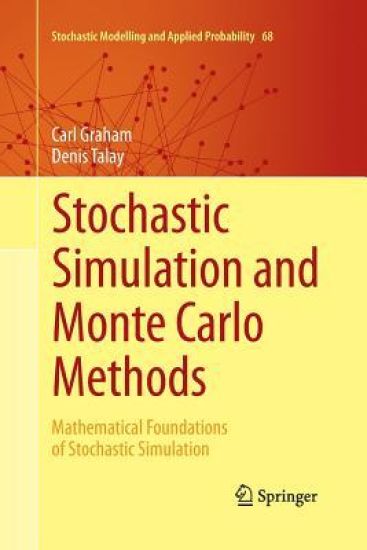
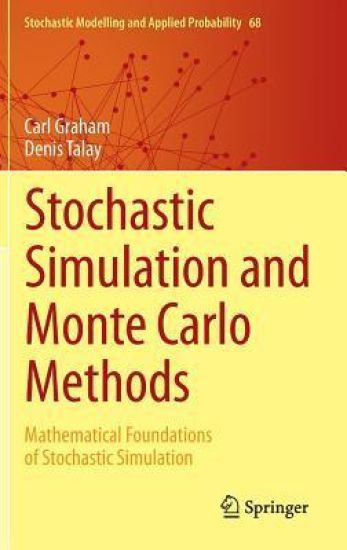
In various scientific and industrial fields, stochastic simulations are taking on a new importance. This is due to the increasing power of computers and practitioners’ aim to simulate more and more complex systems, and thus use random parameters as well as random noises to model the parametric uncertainties and the lack of knowledge on the physics of these systems. The error analysis of these computations is a highly complex mathematical undertaking. Approaching these issues, the authors present stochastic numerical methods and prove accurate convergence rate estimates in terms of their numerical parameters (number of simulations, time discretization steps). As a result, the book is a self-contained and rigorous study of the numerical methods within a theoretical framework. After briefly reviewing the basics, the authors first introduce fundamental notions in stochastic calculus and continuous-time martingale theory, then develop the analysis of pure-jump Markov processes, Poisson processes, and stochastic differential equations. In particular, they review the essential properties of Itô integrals and prove fundamental results on the probabilistic analysis of parabolic partial differential equations. These results in turn provide the basis for developing stochastic numerical methods, both from an algorithmic and theoretical point of view. The book combines advanced mathematical tools, theoretical analysis of stochastic numerical methods, and practical issues at a high level, so as to provide optimal results on the accuracy of Monte Carlo simulations of stochastic processes. It is intended for master and Ph.D. students in the field of stochastic processes and their numerical applications, as well as for physicists, biologists, economists and other professionals working with stochastic simulations, who will benefit from the ability to reliably estimate and control the accuracy of their simulations.
In various scientific and industrial fields, stochastic simulations are taking on a new importance. This is due to the increasing power of computers and practitioners’ aim to simulate more and more complex systems, and thus use random parameters as well as random noises to model the parametric uncertainties and the lack of knowledge on the physics of these systems. The error analysis of these computations is a highly complex mathematical undertaking. Approaching these issues, the authors present stochastic numerical methods and prove accurate convergence rate estimates in terms of their numerical parameters (number of simulations, time discretization steps). As a result, the book is a self-contained and rigorous study of the numerical methods within a theoretical framework. After briefly reviewing the basics, the authors first introduce fundamental notions in stochastic calculus and continuous-time martingale theory, then develop the analysis of pure-jump Markov processes, Poisson processes, and stochastic differential equations. In particular, they review the essential properties of Itô integrals and prove fundamental results on the probabilistic analysis of parabolic partial differential equations. These results in turn provide the basis for developing stochastic numerical methods, both from an algorithmic and theoretical point of view. The book combines advanced mathematical tools, theoretical analysis of stochastic numerical methods, and practical issues at a high level, so as to provide optimal results on the accuracy of Monte Carlo simulations of stochastic processes. It is intended for master and Ph.D. students in the field of stochastic processes and their numerical applications, as well as for physicists, biologists, economists and other professionals working with stochastic simulations, who will benefit from the ability to reliably estimate and control the accuracy of their simulations.
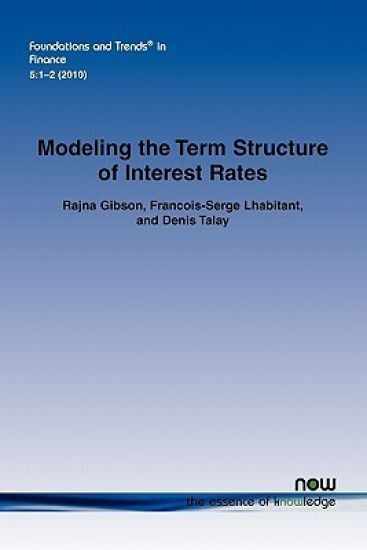
Modeling the Term Structure of Interest Rates provides a comprehensive review of the continuous-time modeling techniques of the term structure applicable to value and hedge default-free bonds and other interest rate derivatives.The aim of this survey is to provide a comprehensive review of these continuous time modeling techniques of the term structure applicable to value and hedge default-free bonds and other interest rate derivatives. The originality of the survey lies in the fact that it provides a unifying framework in which most continuous-time term structure models can be nested and thus related to each other. Thus, it presents the most important continuous-time term structure models in the literature but also provide a mathematically rigorous and unifying setting in which these models can be compared in terms of their similarities, distinguished in terms of their idiosyncratic features and in which their main contributions and limitations can easily be highlighted.
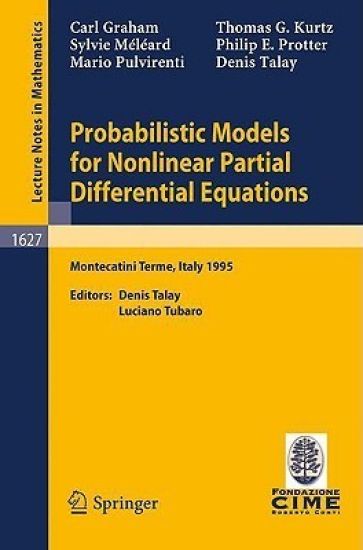
The lecture courses of the CIME Summer School on Probabilistic Models for Nonlinear PDE's and their Numerical Applications (April 1995) had a three-fold emphasis: first, on the weak convergence of stochastic integrals; second, on the probabilistic interpretation and the particle approximation of equations coming from Physics (conservation laws, Boltzmann-like and Navier-Stokes equations); third, on the modelling of networks by interacting particle systems. This book, collecting the notes of these courses, will be useful to probabilists working on stochastic particle methods and on the approximation of SPDEs, in particular, to PhD students and young researchers.