Kirjailija
Dennis Adams
Kirjat ja teokset yhdessä paikassa: 36 kirjaa, julkaisuja vuosilta 1994-2023, suosituimpien joukossa The Garbage Man. Vertaile teosten hintoja ja tarkista saatavuus suomalaisista kirjakaupoista.
36 kirjaa
Kirjojen julkaisuhaarukka 1994-2023.
Father, may I write my autobiography? It's a collection of tiny stories from my life, piece by piece, encompassing my blessings, lessons, and victories achieved in life. It's about the involvement of family and good friends along the way. It's the intimate accounts of a personal lord and savior, Christ Jesus. It's the story of the greatest comeback since the resurrection of Christ from the grave, having overcome death. Similar to my comeback after having been marked for death, publically crushed, and humiliated. By way of witchcraft, voodoo, and a diabolical hex. I was in need of a miracle and received one right in the nick of time. It's a hero story of how a relationship with Christ in faith and trusting him enabled us to undo the elaborate plot of the devil. I was blessed with divine intercession from a loving Father who sat me down and explained to me my mistake and the unseen trap set in place. Our Father God was able to turn around the situation I was a part of, redirecting the enemy's intent to destroy me. He changed that mind to bless me, rewarding my righteousness and re-establishing a lost culture back into the existence of self-care, black excellence, nobility, and creativity, our black renaissance or rebirth. This book serves as a guide on how to win in life as done by Christ Jesus, following his example of obedience to God and service to your community.
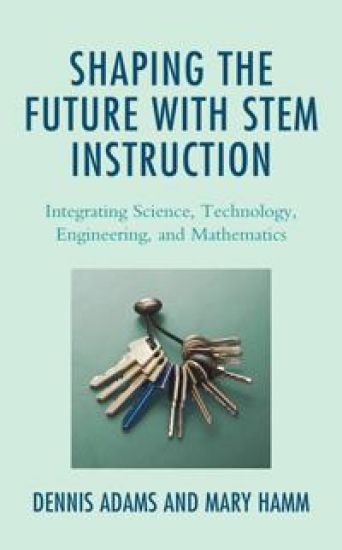
This book builds on an interdisciplinary approach that combines two or more of the STEM subjects. The goal is to help students see the relationship among science, technology, engineering, and mathematics. Useful ideas, activities, and lesson plans are part of the package.It is up to the teachers to encourage students to apply STEM knowledge to interesting real-world problems. Motivating ideas and activities are presented in this book. Teacher/student friendly suggestions build on collaboration, communication, critical thinking, and creativity.Creating a STEM culture in the classroom can help students learn the qualities that must be cultivated in a technology-intensive world. Innovations that radiate from the STEM subjects are driven by intellectual curiosity and the ability to act on beliefs.The future is something we can and should influence. Understanding of the STEM subjects is key to making a positive difference.
Collaboration, Communications, and Critical Thinking
Dennis Adams; Mary Hamm
Rowman Littlefield
2019
nidottu
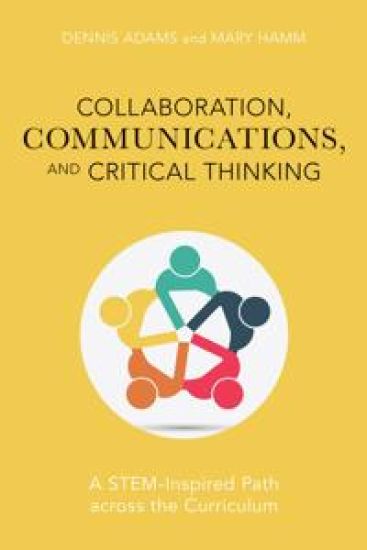
This book makes a case for a STEM-based approach across the curriculum by highlighting the potential impacts of rapid societal change, newly emerging information technologies, and the increasing demand for a new generation of skillful and well-rounded citizens and workers. The book discusses how thinking skills, collaborative learning, communications-related information technologies, science and math, language and literacy, and arts education can be used as mutually reinforcing instruments in preparing young learners. The role of the family, teachers, and school administration in creating an environment where young students can stand a chance is also articulated. Above all, the book reiterates the value of pedagogically attuned teachers who are sensitive to the diversity of backgrounds and capabilities of students. They will oversee and guide the transformation of young learners who will be trained to trust their creativity, humanity, and critical thinking skills in navigating the 21st century world.
Collaboration, Communications, and Critical Thinking
Dennis Adams; Mary Hamm
Rowman Littlefield
2019
sidottu
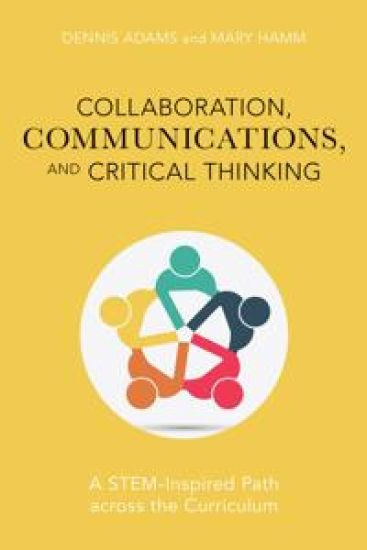
This book makes a case for a STEM-based approach across the curriculum by highlighting the potential impacts of rapid societal change, newly emerging information technologies, and the increasing demand for a new generation of skillful and well-rounded citizens and workers. The book discusses how thinking skills, collaborative learning, communications-related information technologies, science and math, language and literacy, and arts education can be used as mutually reinforcing instruments in preparing young learners. The role of the family, teachers, and school administration in creating an environment where young students can stand a chance is also articulated. Above all, the book reiterates the value of pedagogically attuned teachers who are sensitive to the diversity of backgrounds and capabilities of students. They will oversee and guide the transformation of young learners who will be trained to trust their creativity, humanity, and critical thinking skills in navigating the 21st century world.
I used to work as a garbage man, so I decided to write a book that no one else has ever done before. So I hope yall enjoy this book as much as I enjoyed writing it. I do appreciate anybody who has worked as a garbage man or otherwise, but it is a job. So please do not be a shamed of what you do for living Just be proud that you have a job to support your family. Some people dont even have a job. So even if you get mad, please take time to think before you do something drastic And I really hope yall love this book as much as I loved writing it. So we hope theres many more books to write before you read. So until next time. God bless yall
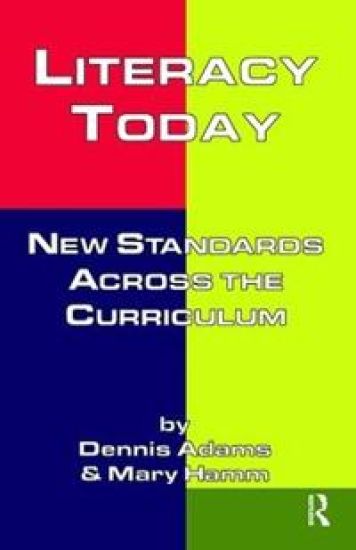
This book defines literacy broadly as it explores concepts within core subjects and shows how to make standards-based literacy the goal and outcome of school reform. It imagines a future digital medium where educational technology is worthy of the spirit our children bring to it. Classrooms and schools centered on learners and learning can be intellectually exciting places. This book attends to that concern while giving a great deal of attention to connecting overlapping themes to good teaching.Literacy Today sets out to challenge teachers to make literacy and learning more relevant and lasting for their students. By providing a standards-based context for connecting basic subjects, it encourages teachers to reflect upon their practices while building a conceptual framework for new directions and new approaches to the curriculum. As the concept of literacy expands to meet the needs of today's complex world, teachers need all the assistance that they can get. The standards movement does not authoritatively tell teachers what to do. rather, it helps them make decisions about what to teach, what to spend time on, and what to eliminate from the curriculum. This books gives teachers a road map and a literacy-intensive destination. It highlights some of the better routes and helps teachers with good activities and professional development along the way.
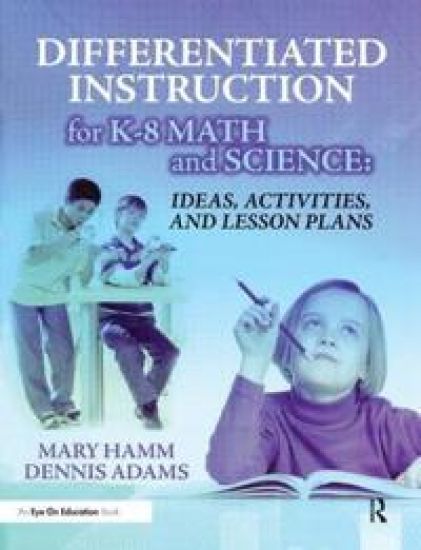
This book offers practical recommendations to reach every student in a K-8 classroom. Research-based and written in a teacher-friendly style, it will help teachers with classroom organization and lesson planning in math and science. Included are math and science games, activities, ideas, and lesson plans based on the math and science standards. This book will help your students to develop positive attitudes and raise competency in math and science.
This book will help educators design STEM programs and lessons that foster teamwork and thinking while getting students actively involved in their own learning. There are many practical ideas and lesson plans that will help teachers reach both eager and reluctant learners. The suggestions for STEM curriculum and instruction are research based and standards driven. This book looks at collaborative learning, differentiation, and diversity all the while building instruction in the STEM subjects and good hands-on materials. This is done in a way that is designed to help every student feel successful and part of the class as a whole. It shows a deep respect for the unique relationship between teachers and their students as they try to navigate their way into the future. Suggestions are designed to help learners question, analyze, interpret, problem solve, and discover. The STEM subjects of science, technology, engineering, and math are essential to understanding the world of today and the world of tomorrow. The authors view is that it takes more than innovation alone; for innovation to be useful, products of the imagination must be arranged in ways that allow them to be used to solve real world problems.
In this book, the authors integrate STEM (i.e., science, technology, engineering, and mathematics) concepts and the cultivation of young minds in order to be open to innovation. This book uses STEM instruction as blurring the lines among basic subject areas. Often, it’s more than integrating science, mathematics, engineering, and technology. Ideas, activities, and projects can be integrated with lessons from the language arts to the Arts as well. In this book, STEM is treated as more of a philosophy than a program or a set of activities.
Teaching Math, Science, and Technology in Schools Today
Dennis Adams; Mary Hamm
Rowman Littlefield
2014
nidottu
Teaching Math, Science, and Technology in Schools Today: Guidelines for Engaging Both Eager and Reluctant Learners offers unique, engaging, and thought-provoking ideas. The activities open imaginative doors to learning and provide opportunities for all learners. It surveys today’s most important trends and dilemmas while explaining how collaboration and critical thinking can be translated into fresh classroom practices. Questions, engagement, and curiosity are viewed as natural partners for mathematical problem solving, scientific inquiry, and learning about technology. Like the Common Core State Standards, the book builds on the social nature of learning to provide suggestions for both eager and reluctant learners. The overall goal of the book is to deepen the collective conversation, challenge thinking, and provide some up-to-date tools for teachers so they can help reverse the steady erosion of math, science, and technology understanding in the general population.
Teaching Math, Science, and Technology in Schools Today
Dennis Adams; Mary Hamm
Rowman Littlefield
2014
sidottu
Teaching Math, Science, and Technology in Schools Today: Guidelines for Engaging Both Eager and Reluctant Learners offers unique, engaging, and thought-provoking ideas. The activities open imaginative doors to learning and provide opportunities for all learners. It surveys today’s most important trends and dilemmas while explaining how collaboration and critical thinking can be translated into fresh classroom practices. Questions, engagement, and curiosity are viewed as natural partners for mathematical problem solving, scientific inquiry, and learning about technology. Like the Common Core State Standards, the book builds on the social nature of learning to provide suggestions for both eager and reluctant learners. The overall goal of the book is to deepen the collective conversation, challenge thinking, and provide some up-to-date tools for teachers so they can help reverse the steady erosion of math, science, and technology understanding in the general population.
Demystify Math, Science, and Technology
Dennis Adams; Mary Hamm
Rowman Littlefield Education
2013
nidottu
In a rapidly evolving local and global economy, skills related to mathematical problem solving, scientific inquiry, and technological innovation are becoming more critical for success in and out of school. Thus, Demystify Math, Science, and Technology addresses the need to cultivate these skills in young students so that ingenuity, teamwork, and imaginative skills become part of their arsenal in dealing with real world challenges. This whole package of attributes is essential for learners imagining new scenarios and future work in areas that don’t even exist yet. Another important issue is that teachers now deal with students who span the entire spectrum of learning. Students differ widely in levels of preparedness, personal interests, and cultural ways of seeing and experiencing the world. One size does not fit all. Teachers need to learn to turn diversity into an advantage because innovation builds on the social nature of learning; the more diverse the inputs, the more interesting the outputs. The authors also believe that no one should be sidelined with basic skill training in a way that keeps them away from the creative and collaborative engagement associated with problem solving, inquiry, and the technological products of math and science.
Demystify Math, Science, and Technology
Dennis Adams; Mary Hamm
Rowman Littlefield Education
2013
sidottu
In a rapidly evolving local and global economy, skills related to mathematical problem solving, scientific inquiry, and technological innovation are becoming more critical for success in and out of school. Thus, Demystify Math, Science, and Technology addresses the need to cultivate these skills in young students so that ingenuity, teamwork, and imaginative skills become part of their arsenal in dealing with real world challenges. This whole package of attributes is essential for learners imagining new scenarios and future work in areas that don’t even exist yet. Another important issue is that teachers now deal with students who span the entire spectrum of learning. Students differ widely in levels of preparedness, personal interests, and cultural ways of seeing and experiencing the world. One size does not fit all. Teachers need to learn to turn diversity into an advantage because innovation builds on the social nature of learning; the more diverse the inputs, the more interesting the outputs. The authors also believe that no one should be sidelined with basic skill training in a way that keeps them away from the creative and collaborative engagement associated with problem solving, inquiry, and the technological products of math and science.
Activating Assessment for All Students
Mary Hamm; Dennis Adams
Rowman Littlefield Education
2012
nidottu
Hamm and Adams present models to help teachers identify student learning problems—recognizing when to re-teach, when to move ahead, and when to explain or give more examples. Activating Assessment for All Students takes all of these into account when it provides differentiated science/math methods and goes on to suggest ways that formative assessment practices can inform differentiated teaching, learning, and assessment. These methods promote success for more students by helping teachers develop informative assessment for lessons and related tools for reaching the varying levels of student competencies within their classes. This book builds on the expanding knowledge of what works in classrooms and suggests approaches that can open up individual and group possibilities for science and mathematics instruction. It intends to help you answer the following questions: * What is differentiated instructional assessment? * How can I amplify the results of DI by using formative assessments? * How might quality assessment tools (like portfolios) benefit all students? * How will I know that differentiated formative assessment works?
Profound societal changes in the economic, technological, social, and educational fronts pose challenges for educators in their ability to equip young students with the skills and capabilities needed to navigate a digitally connected and complex world. Tomorrow’s Innovators: Essential Skills For A Changing World focuses on approaches and methods to help teachers infuse their basic subject matter lessons with creativity, innovation, and adaptability. On a broader scale, we provide elementary and middle school educators with insights into current educational issues and suggestions for converting new ideas into practical classroom applications. Teachers need to transform the classroom or school into a contemporary learning environment by paying attention to consistent classroom routines, using assessment data for improvement, and having a coherent organizational structure. The old foundations of reading, writing, and mathematics and the new basics of science, technology, and the arts will be at the core of schooling. More than ever, thinking about curriculum and instruction has to occur as the traditional boundaries between politics, technology, culture, education, and ecology disappear.
Shaping the Future with Math, Science, and Technology
Dennis Adams; Mary Hamm
Rowman Littlefield Education
2011
sidottu
Shaping the Future with Math, Science, and Technology examines how ingenuity, creativity, and teamwork skills are part of an intellectual toolbox associated with math, science, and technology. The book provides new ideas, proven processes, practical tools, and examples useful to educators who want to encourage students to solve problems and express themselves in imaginative ways. The development of a technological knowledge-based economy depends on the development of educational systems that allow schools, teachers, and students of diverse capabilities, backgrounds and learning preferences do better with both content and imaginative problem solving. This book makes the case that it is, indeed, possible to educate our way to a better economy and a better future. Paying attention to 21st century approaches and skills can help accomplish those goals.
Shaping the Future with Math, Science, and Technology
Dennis Adams; Mary Hamm
Rowman Littlefield Education
2011
nidottu
Shaping the Future with Math, Science, and Technology examines how ingenuity, creativity, and teamwork skills are part of an intellectual toolbox associated with math, science, and technology. The book provides new ideas, proven processes, practical tools, and examples useful to educators who want to encourage students to solve problems and express themselves in imaginative ways. The development of a technological knowledge-based economy depends on the development of educational systems that allow schools, teachers, and students of diverse capabilities, backgrounds and learning preferences do better with both content and imaginative problem solving. This book makes the case that it is, indeed, possible to educate our way to a better economy and a better future. Paying attention to 21st century approaches and skills can help accomplish those goals.