Kirjojen hintavertailu. Mukana 12 116 103 kirjaa ja 12 kauppaa.

Kirjailija

Derek Eaton

Kirjat ja teokset yhdessä paikassa: 18 kirjaa, julkaisuja vuosilta 2001-2025, suosituimpien joukossa New Directions for Projecting Land Power in the Indo-Pacific. Vertaile teosten hintoja ja tarkista saatavuus suomalaisista kirjakaupoista.

18 kirjaa

Kirjojen julkaisuhaarukka 2001-2025.

New Directions for Projecting Land Power in the Indo-Pacific

New Directions for Projecting Land Power in the Indo-Pacific

Jonathan P Wong; Michael J Mazarr; Nathan Beauchamp-Mustafaga; Michael Bohnert; Scott Boston; Christian Curriden; Derek Eaton; Gregory Weider Fauerbach; Joslyn Fleming; Katheryn Giglio; Dahlia Anne Goldfeld; Derek Grossman; Timothy R Heath; John C Jackson; Michael E Linick; Eric Robinson; Lisa Saum-Manning; Ryan A Schwankhart; Michael Schwille; Stephan B Seabrook; Alice Shih; Jonathan Welch

RAND Corporation
2023
pokkari
This report seeks to address how the U.S. Army can most effectively project and employ land power in the Indo-Pacific, during competition and conflict, with a focus on scenarios involving China. The authors developed three concepts to guide the Army's ground force role in the theater, offering the essential architecture of basing, information, relationships, and flexible combat power needed to make the joint force effective.
Assessing Security Cooperation as a Preventive Tool

Assessing Security Cooperation as a Preventive Tool

Michael J. McNerney; Angela O'Mahony; Thomas S. Szayna; Derek Eaton; Caroline Baxter; Colin P. Clarke; Emma Cutrufello; Michael McGee; Heather Peterson; Leslie Adrienne Payne; Calin Trenkov-Wermuth

RAND
2014
pokkari
The report tested the assertion that U.S. security cooperation (SC) can help reduce fragility in partner states. Based on an analysis of SC data and state fragility scores for 107 countries in 1991 2008, the study found a correlation between provision of SC by the United States and a reduction in partner state fragility, though the presence and degree of correlation depended on partner country characteristics and the type of SC provided."
The Emergence of Peer Competitors

The Emergence of Peer Competitors

Thomas S. Szayna; Daniel L. Byman; Steven C. Bankes; Derek Eaton; Seth G. Jones

RAND
2001
pokkari
One-liner: A framework for intelligence analysts to use to think systematically about the potential for the rise of a peer competitor to the United States. The potential emergence of a peer competitor is probably the most important long-term planning challenge for the Department of Defense. This report addresses the issue by developing a conceptual framework of how a proto-peer (meaning a state that is not yet a peer but has the potential to become one) might interact with the hegemon (the dominant global power). The central aspect of the framework is an interaction between the main strategies for power aggregation available to the proto-peer and the main strategies for countering the rise of a peer available to the hegemon. Then, using exploratory modeling techniques, the pathways of the various proto-peer and hegemon interactions are modeled to identify the specific patterns and combinations of actions that might lead to rivalries. The dominant power has an array of options available to limit the growth of its rivals or to change their ultimate intentions.Too confrontational a strategy, however, risks making a potential neutral power into a foe, while too conciliatory a stance may speed the growth of a competitor. Exploratory modeling suggests which attributes of the countries are most important and the sensitivity of the dominant power to perception errors.
Responses to Territorial Revision: Historical Lessons

Responses to Territorial Revision: Historical Lessons

Michael J. Mazarr; Duncan Long; Derek Eaton

RAND Corporation
2025
nidottu
Previous research has identified that logistics and sustainment shortfalls are a critical barrier to U.S. operational success in the Indo-Pacific. In this report, the authors identify five case countries (Australia, Japan, the Philippines, Singapore, and South Korea) and assess their potential to support the logistics and sustainment activities that are critical to the success of military operations.
Sustaining U.S. Army Operations in the Indo-Pacific: Potential Roles of Allies and Partners
Previous research has identified that logistics and sustainment shortfalls are a critical barrier to U.S. operational success in the Indo-Pacific. In this report, the authors identify five case countries (Australia, Japan, the Philippines, Singapore, and South Korea) and assess their potential to support the logistics and sustainment activities that are critical to the success of military operations.
Defense Planning in a Time of Conflict

Defense Planning in a Time of Conflict

Eric V Larson; Derek Eaton; Michael E Linick

RAND
2021
nidottu
This Executive Summary highlights findings from a comparative historical analysis of the four Quadrennial Defense Reviews conducted after 1997 (in 2001, 2006, 2010, and 2014), identifying trends, implications, and recommendations for the Army and Defense Department in order to shape the conduct of and improve future reviews.
What Deters and Why

What Deters and Why

Michael J Mazarr; Nathan Beauchamp-Mustafaga; Timothy R Heath; Derek Eaton

RAND
2021
nidottu
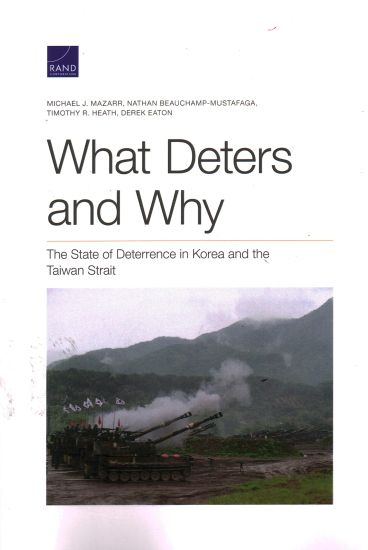
As part of a series of reports in which RAND researchers examine the established concepts of deterrence and develop a framework for evaluating the strength of deterrent relationships, this report explores two ongoing examples of extended deterrence. In particular, RAND researchers apply the established framework to U.S. efforts to deter North Korean aggression against South Korea and U.S. efforts to deter Chinese aggression against Taiwan.
Defense Planning in a Time of Conflict

Defense Planning in a Time of Conflict

Eric V Larson; Derek Eaton; Michael E Linick

RAND
2018
nidottu
This report presents a comparative historical analysis of the four Quadrennial Defense Reviews (QDRs) conducted after 1997 (in 2001, 2006, 2010, and 2014) and identifies trends, implications, and recommendations for the Army and U.S. Department of Defense in order to shape the conduct of and improve future reviews.
Supporting Persistent and Networked Special Operations Forces (Sof) Operations
Using a multipronged approach, RAND Corporation researchers identified three key operational challenges that forward-deployed personnel have encountered--unity of effort, continuity of effort, and administrative complexity--and then assessed the extent to which persistent, networked, and distributed operations can mitigate these challenges.
The Global Landpower Network

The Global Landpower Network

Angela O'Mahony; Thomas S Szayna; Christopher G Pernin; Laurinda L Rohn; Derek Eaton; Elizabeth Bodine-Baron; Joshua Mendelsohn; Osonde A Osoba; Sherry Oehler; Katharina Ley Best; Leila Bighash

RAND
2017
nidottu
The U.S. Army has introduced the global landpower network (GLN) concept as a means to integrate, sustain, and advance the Army's considerable ongoing efforts to meet U.S. national security guidance emphasizing the importance of working closely with partner nations to achieve U.S. strategic objectives. This report develops the GLN concept further.
Considerations for Integrating Women into Closed Occupations in U.S. Special Operations Forces

Considerations for Integrating Women into Closed Occupations in U.S. Special Operations Forces

Thomas S. Szayna; Eric V. Larson; Angela O'Mahony; Sean Robson; Agnes Gereben Schaefer; Miriam Matthews; J.Michael Polich; Lynsay Ayer; Derek Eaton; William Marcellino; Lisa Miyashiro; Marek Posard; James Syme; Zev Winkelman; Cameron Wright; Megan Zander-Cotugno; William Welser

RAND
2016
pokkari
Integrating women into special operations forces poses potential challenges for unit cohesion. The integration of women raises issues of effectiveness, in terms of physical standards and ensuring the readiness, cohesion, and morale essential to high-performing teams. This report assesses those challenges and provides analytical support for validating occupational standards for positions controlled by U.S. Special Operations Command.
Strategy-Policy Mismatch

Strategy-Policy Mismatch

Timothy M. Bonds; Eric V. Larson; Derek Eaton; Richard E. Darilek

RAND
2014
pokkari
Although two successive presidents have determined that weapons of mass destruction (WMD) pose the greatest threat to the American people and have listed countering their proliferation as a top strategic priority, neither administration has followed through by allocating appropriate budgetary resources to it. This report addresses and analyzes the ground force capacity and capabilities needed to perform WMD elimination missions and tasks.
Developing an Army Strategy for Building Partner Capacity for Stability Operations

Developing an Army Strategy for Building Partner Capacity for Stability Operations

Jefferson P. Marquis; Jennifer D. P. Moroney; Justin Beck; Derek Eaton; Scott Hiromoto

RAND
2010
pokkari
The U.S. government is facing the dual challenge of building its own interagency capacity for conducting stability operations while simultaneously building partner capacity (BPC) for stability operations. This study finds that although BPC and stability operations are receiving a good deal of attention in official strategy and planning documents, insufficient attention is being paid to the details of an integrated strategy.
Guidebook for Supporting Economic Development in Stability Operations

Guidebook for Supporting Economic Development in Stability Operations

Keith Crane; Olga Oliker; Nora Bensahel; Derek Eaton; Jamie S Gayton

RAND
2009
pokkari
This guidebook is designed to help U.S. Army personnel more effectively use economic assistance to support economic and infrastructure development. It should help tactical commanders choose and implement more effective programs and projects in their areas of responsibility and better understand the economic context of their efforts. It also provides suggestions on what to and what not to do, with examples from current and past operations.
War and Escalation in South Asia

War and Escalation in South Asia

John E. Peters; James Dickens; Derek Eaton; Christine Fair; Nina Hachigian; Theodore W. Karasik; Rollie Lal; Rachel Swanger; Gregory F. Treverton; Charles Wolf

RAND
2005
pokkari
Highlights key factors in South Asia imperiling U.S. interests, and suggests how and where the U.S. military might play an expanded, influential role. It suggests steps the military might take to better advance and defend U.S. interests in the area. This monograph highlights key factors in South Asia imperiling U.S. interests, and suggests how and where the U.S. military might play an expanded, influential role. It suggests seven steps the military might take to better advance and defend U.S. interests in South Asia, the Middle East, and Asia at large. Washington should intensify involvement in South Asia and become more influential with the governments there. Given the area's potential for violence, it should also shape part of the U.S. military to meet potential crises.
Toward a Long-term Strategy for Assuring Access in Key Strategic Regions

Toward a Long-term Strategy for Assuring Access in Key Strategic Regions

Eric R. Larson; Derek Eaton; Paul Elrick; Theodore Karasik; Robert Klein; Sherrill Lingel; Brian Nichiporuk; Robert Uy; John Zavadil

RAND
2004
pokkari
How does the Army plan to ensure its continued access to potential trouble spots around the world? The authors developed scenarios and conducted political-military games to determine what strategies, tactics, and capabilities potential adversaries might use to complicate U.S. access to key areas and how effective the U.S. counters to these tactics are. They were sanguine about the ability of the U.S. to prevail in the short-term but also identified several conc erns and suggested areas of improvement, including expanding the number of in-theater bases that might be available; enhancing the flexibility and deployability of U.S. forces to more austere bases; and upgrading detection, warning, and force protection measures.