

Kirjailija
Derek R. Ford
Kirjat ja teokset yhdessä paikassa: 12 kirjaa, julkaisuja vuosilta 2015-2023, suosituimpien joukossa Teaching the Actuality of Revolution. Vertaile teosten hintoja ja tarkista saatavuus suomalaisista kirjakaupoista.
Mukana myös kirjoitusasut: Derek R Ford
12 kirjaa
Kirjojen julkaisuhaarukka 2015-2023.
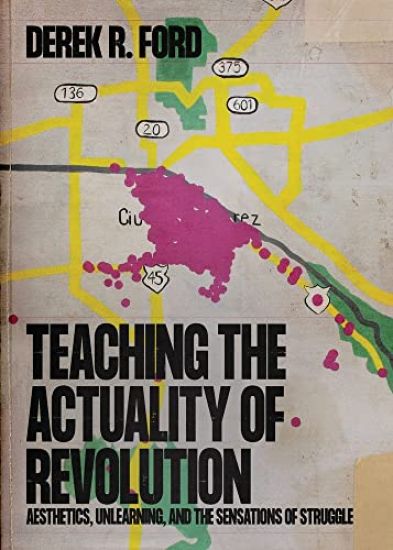


In the second edition of this groundbreaking work, Derek R. Ford contends that radical politics needs educational theory, posing a series of educational questions pertinent to revolutionary movements: How can pedagogy bridge the gap between what is and what can be, while respecting the gap and its uncertainty and contingency? How can pedagogy accommodate ambiguity while remaining faithful to the communist project? In answering these questions, Ford develops a dyanmic pedagogical constellation that radically opens up what education is and what it can mean for revolutionary struggle. In charting this constellation, Ford takes the reader on a journey that traverses disciplinary boundaries, innovatively reading theorists as diverse as Lenin, Agamben, Marx, Lyotard, Althusser, and Butler. Demonstrating how learning underpins capitalism and democracy, Ford articulates a theory of communist study as an alternative and oppositional logic that, perhaps paradoxically, demands the revolutionary reclamation of testing. Poetic, performative, and provocative, communist study is oriented toward what Ford calls “the sublime feeling of being-in-common,” which, as he insists, is always a commonness against.
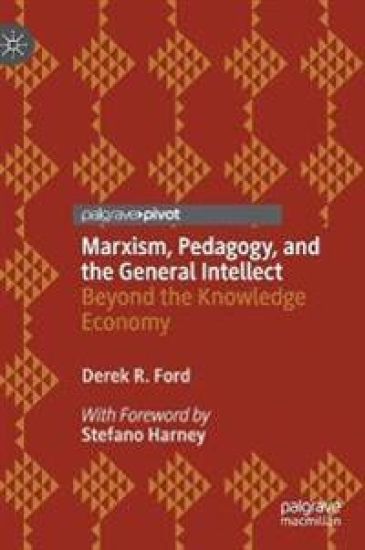
Marxism, Pedagogy, and the General Intellect
Derek R. Ford
Springer Nature Switzerland AG
2021
sidottu
This book is the first to articulate and challenge the consensus on the right and left that knowledge is the key to any problem, demonstrating how the left’s embrace of knowledge productivity keeps it trapped within capital’s circuits. As the knowledge economy has forced questions of education to the forefront, the book engages pedagogy as an underlying yet neglected motor of capitalism and its forms of oppression. Most importantly, it assembles new pedagogical resources for responding to the range of injustices that permeate our world. Building on yet critiquing the Marxist notion of the general intellect, Derek R. Ford theorizes stupidity as a necessary alternative pedagogical logic, an anti-value that is infinitely mute and unproductive.

In the first monograph on Lyotard and education, the author approaches Lyotard's thought as pedagogical in itself. The result is a novel, soft, and accessible study of Lyotard organized around two inhuman educations: that of "the system" and that of "the human." The former enforces an interminable process of development, dialogue and exchange, while the latter finds its force in the mute, secret, opaque, and inarticulable. Threading together a range of Lyotard's work through four pedagogical processes--reading, writing, voicing, and listening--the author insists on the distinct educational logics that can uphold or interrupt different ways of being-together in the world, touching on a range of topics from literacy and aesthetics to time and political-economy. While Inhuman Educations can serve as an introduction to Lyotard's philosophy, it also constitutes a singular, provocative, and fresh take on his thought.
Those who are in shock that truth doesn’t seem to matter in politics miss the mark: politics has never corresponded with the truth. Rather, political struggle is about the formulation and materialization of new truths. The “post-truth” era thus offers an important opportunity to push forward into a different world. Embracing this opportunity, Derek R. Ford articulates a new educational philosophy and praxis that emerges from within the nexus of social theory and political struggle. Blocking together aesthetics, queer theory, urbanism, postmodern philosophy, and radical politics, Ford develops arguments and proposals on key topics ranging from debt and time, to the death drive and forms of political organization. Through forceful yet accessible prose, Ford offers contemporary left politics an imaginative and potent set of educational concepts and practices.
Those who are in shock that truth doesn’t seem to matter in politics miss the mark: politics has never corresponded with the truth. Rather, political struggle is about the formulation and materialization of new truths. The “post-truth” era thus offers an important opportunity to push forward into a different world. Embracing this opportunity, Derek R. Ford articulates a new educational philosophy and praxis that emerges from within the nexus of social theory and political struggle. Blocking together aesthetics, queer theory, urbanism, postmodern philosophy, and radical politics, Ford develops arguments and proposals on key topics ranging from debt and time, to the death drive and forms of political organization. Through forceful yet accessible prose, Ford offers contemporary left politics an imaginative and potent set of educational concepts and practices.
Contending that radical politics needs educational theory, Communist Study: Education for the Commons poses a series of educational questions pertinent to revolutionary movements: How can pedagogy bridge the gap between what is and what can be, while respecting the gap and its uncertainty and figurality? How can pedagogy accommodate ambiguity while remaining faithful to the communist project? In answering these questions, educational theorist Derek R. Ford develops a pedagogical constellation that radically opens up what education is and what it can mean for revolutionary struggle. To chart this constellation, Ford takes the reader on a journey that traverses disciplinary and ideological boundaries, innovatively reading theorists as diverse as Agamben, Marx, Lyotard, Butler, and Lenin. Demonstrating that learning is the educational logic that underpins capitalism and democracy, Ford articulates a theory of communist study as an alternative and oppositional logic. Poetic, performative, and provocative, this theory of study is oriented toward what Ford calls “the sublime feeling of being-in-common,” which, as he insists, is always a commonness against.
Marx, Capital, and Education
Derek R. Ford; Curry Stephenson Malott
Peter Lang Publishing Inc
2015
nidottu
With the contradictions of capitalism heightening and intensifying, and with new social movements spreading across the globe, revolutionary transformation is once again on the agenda. For radicals, the most pressing question is: How can we transform ourselves and our world into something else, something just? In Marx, Capital, and Education, Curry Stephenson Malott and Derek R. Ford develop a «critical pedagogy of becoming» that is concerned with precisely this question. The authors boldly investigate the movement toward communism and the essential role that critical pedagogy can play in this transition. Performing a novel and educational reading of Karl Marx and radical theorists and activists, Malott and Ford present a critical understanding of the past and present, of the underlying logics and (often opaque) forces that determine the world-historical moment. Yet Malott and Ford are equally concerned with examining the specific ways in which we can teach, learn, study, and struggle ourselves beyond capitalism; how we can ultimately overthrow the existing order and institute a new mode of production and set of social relations. This incisive and timely book, penned by two militant teachers, organizers, and academics, reconfigures pedagogy and politics. Educators and organizers alike will find that it provides new ammunition in the struggle for the world that we deserve.
Marx, Capital, and Education
Derek R. Ford; Curry Stephenson Malott
Peter Lang Publishing Inc
2015
sidottu
With the contradictions of capitalism heightening and intensifying, and with new social movements spreading across the globe, revolutionary transformation is once again on the agenda. For radicals, the most pressing question is: How can we transform ourselves and our world into something else, something just? In Marx, Capital, and Education, Curry Stephenson Malott and Derek R. Ford develop a «critical pedagogy of becoming» that is concerned with precisely this question. The authors boldly investigate the movement toward communism and the essential role that critical pedagogy can play in this transition. Performing a novel and educational reading of Karl Marx and radical theorists and activists, Malott and Ford present a critical understanding of the past and present, of the underlying logics and (often opaque) forces that determine the world-historical moment. Yet Malott and Ford are equally concerned with examining the specific ways in which we can teach, learn, study, and struggle ourselves beyond capitalism; how we can ultimately overthrow the existing order and institute a new mode of production and set of social relations. This incisive and timely book, penned by two militant teachers, organizers, and academics, reconfigures pedagogy and politics. Educators and organizers alike will find that it provides new ammunition in the struggle for the world that we deserve.