Kirjojen hintavertailu. Mukana 12 595 353 kirjaa ja 12 kauppaa.

Kirjailija

Desmond King

Kirjat ja teokset yhdessä paikassa: 21 kirjaa, julkaisuja vuosilta 1995-2024, suosituimpien joukossa Fed Power. Vertaile teosten hintoja ja tarkista saatavuus suomalaisista kirjakaupoista.

21 kirjaa

Kirjojen julkaisuhaarukka 1995-2024.

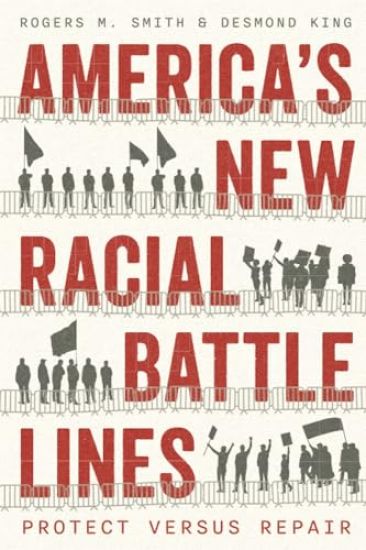
America’s New Racial Battle Lines

America’s New Racial Battle Lines

Rogers M. Smith; Desmond King

THE UNIVERSITY OF CHICAGO PRESS
2024
nidottu
A sobering portrait of the United States’ divided racial politics. For nearly two decades, Rogers M. Smith and Desmond King have charted the shifting racial policy alliances that have shaped American politics across different eras. In America’s New Racial Battle Lines, they show that US racial policy debates are undergoing fundamental change. Disputes over colorblind versus race-conscious policies have given way to new lines of conflict. Today’s conservatives promise to protect traditionalist, predominantly white, Christian Americans against what they call the “radical” Left. Meanwhile, today’s progressives seek not just to integrate American institutions but to more fully transform and “repair” pervasive systemic racism. Drawing on interviews with activists, surveys, social network analyses, and comprehensive reviews of federal, state, and local policies and advocacy groups, Smith and King map the memberships and goals of two rival racial policy alliances and delineate the contrasting stories each side tells. They also show that these increasingly polarized racial policy alliances are substantially funded on both the Left and Right. Placing today’s conflicts in theoretical and historical perspectives, Smith and King analyze where these intensifying clashes may take the nation in the years ahead. They highlight the great potential for mounting violence, as well as the remaining possibilities for finding common ground.
America’s New Racial Battle Lines

America’s New Racial Battle Lines

Rogers M. Smith; Desmond King

THE UNIVERSITY OF CHICAGO PRESS
2024
sidottu
A sobering portrait of the United States’ divided racial politics. For nearly two decades, Rogers M. Smith and Desmond King have charted the shifting racial policy alliances that have shaped American politics across different eras. In America’s New Racial Battle Lines, they show that US racial policy debates are undergoing fundamental change. Disputes over colorblind versus race-conscious policies have given way to new lines of conflict. Today’s conservatives promise to protect traditionalist, predominantly white, Christian Americans against what they call the “radical” Left. Meanwhile, today’s progressives seek not just to integrate American institutions but to more fully transform and “repair” pervasive systemic racism. Drawing on interviews with activists, surveys, social network analyses, and comprehensive reviews of federal, state, and local policies and advocacy groups, Smith and King map the memberships and goals of two rival racial policy alliances and delineate the contrasting stories each side tells. They also show that these increasingly polarized racial policy alliances are substantially funded on both the Left and Right. Placing today’s conflicts in theoretical and historical perspectives, Smith and King analyze where these intensifying clashes may take the nation in the years ahead. They highlight the great potential for mounting violence, as well as the remaining possibilities for finding common ground.
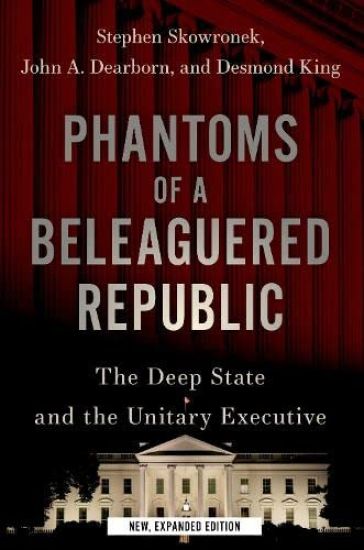
Phantoms of a Beleaguered Republic

Phantoms of a Beleaguered Republic

Stephen Skowronek; John A. Dearborn; Desmond King

OXFORD UNIVERSITY PRESS INC
2022
nidottu
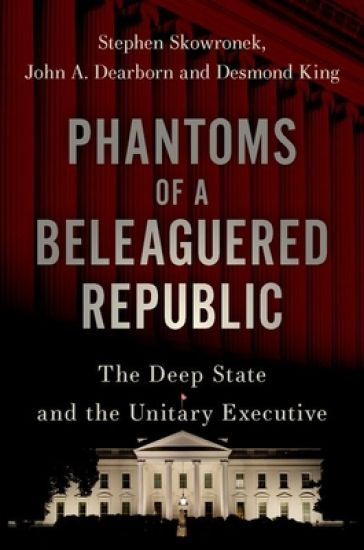
A powerful dissection of one of the fundamental problems in American governance today: the clash between presidents determined to redirect the nation through ever-tighter control of administration and an executive branch still organized to promote shared interests in steady hands, due deliberation, and expertise. President Trump pitted himself repeatedly against the institutions and personnel of the executive branch. In the process, two once-obscure concepts came center stage in an eerie faceoff. On one side was the specter of a "Deep State" conspiracy--administrators threatening to thwart the will of the people and undercut the constitutional authority of the president they elected to lead them. On the other side was a raw personalization of presidential power, one that a theory of "the unitary executive" gussied up and allowed to run roughshod over reason and the rule of law. The Deep State and the unitary executive framed every major contest of the Trump presidency. Like phantom twins, they drew each other out. These conflicts are not new. Stephen Skowronek, John A. Dearborn, and Desmond King trace the tensions between presidential power and the depth of the American state back through the decades and forward through the various settlements arrived at in previous eras. Phantoms of a Beleaguered Republic is about the breakdown of settlements and the abiding vulnerabilities of a Constitution that gave scant attention to administrative power. Rather than simply dump on Trump, the authors provide a richly historical perspective on the conflicts that rocked his presidency, and they explain why, if left untamed, the phantom twins will continue to pull the American government apart. Now, in this expanded paperback edition, they address the tumultuous Trump-Biden transition and reflect more broadly on the problems of presidential democracy in America today.
Phantoms of a Beleaguered Republic

Phantoms of a Beleaguered Republic

Stephen Skowronek; John A. Dearborn; Desmond King

Oxford University Press Inc
2021
sidottu
A powerful dissection of one of the fundamental problems in American governance today: the clash between presidents determined to redirect the nation through ever-tighter control of administration and an executive branch still organized to promote shared interests in steady hands, due deliberation, and expertise. President Trump pitted himself repeatedly against the institutions and personnel of the executive branch. In the process, two once-obscure concepts came center stage in an eerie faceoff. On one side was the specter of a "Deep State" conspiracy—administrators threatening to thwart the will of the people and undercut the constitutional authority of the president they elected to lead them. On the other side was a raw personalization of presidential power, one that a theory of "the unitary executive" gussied up and allowed to run roughshod over reason and the rule of law. The Deep State and the unitary executive framed every major contest of the Trump presidency. Like phantom twins, they drew each other out. These conflicts are not new. Stephen Skowronek, John A. Dearborn, and Desmond King trace the tensions between presidential power and the depth of the American state back through the decades and forward through the various settlements arrived at in previous eras. Phantoms of a Beleaguered Republic is about the breakdown of settlements and the abiding vulnerabilities of a Constitution that gave scant attention to administrative power. Rather than simply dump on Trump, the authors provide a richly historical perspective on the conflicts that rocked his presidency, and they explain why, if left untamed, the phantom twins will continue to pull the American government apart.
Fed Power

Fed Power

Lawrence Jacobs; Desmond King

Oxford University Press Inc
2021
sidottu
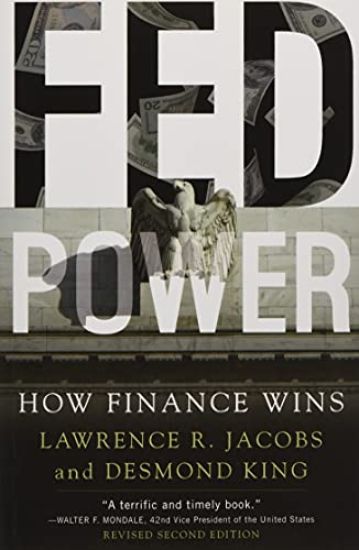
An eye-opening analysis of the Federal Reserve's massive and unwarranted power in American life and how it favors the financial sector over everyone else. The Federal Reserve, created more than a century ago, is the most powerful central bank in the world. The Fed's power, which derives from its ability to alter the money supply and move interest rates, weighs heavily not only on the US economy, but on the world economy as well. Lawrence R. Jacobs and Desmond King's Fed Power is the first sustained synthesis of the Fed's political role--especially the way in which it uses its power to benefit some interest groups and not others--since the 2008 financial crisis. In this fully updated and revised second edition, Fed Power addresses new developments during Trump's presidency--particularly the Fed's massive and unprecedented injection of liquidity into the US economy following the COVID epidemic-and offers fresh insights on the Fed's outsized role in picking winners and losers in the American economy. King and Jacobs conclude with bold proposals to reform America's financial management to prevent future crises and to restore democratic accountability. A powerful critique of how the Federal Reserve governs the American economy, Fed Power will be essential reading for anyone interested in the role that the Fed's policies have played in increasing economic and racial inequality across both the Obama and Trump presidencies and the new directions pursued by the Biden administration and progressive activists.
Fed Power

Fed Power

Lawrence Jacobs; Desmond King

Oxford University Press Inc
2021
nidottu
An eye-opening analysis of the Federal Reserve's massive and unwarranted power in American life and how it favors the financial sector over everyone else. The Federal Reserve, created more than a century ago, is the most powerful central bank in the world. The Fed's power, which derives from its ability to alter the money supply and move interest rates, weighs heavily not only on the US economy, but on the world economy as well. Lawrence R. Jacobs and Desmond King's Fed Power is the first sustained synthesis of the Fed's political role--especially the way in which it uses its power to benefit some interest groups and not others--since the 2008 financial crisis. In this fully updated and revised second edition, Fed Power addresses new developments during Trump's presidency--particularly the Fed's massive and unprecedented injection of liquidity into the US economy following the COVID epidemic-and offers fresh insights on the Fed's outsized role in picking winners and losers in the American economy. King and Jacobs conclude with bold proposals to reform America's financial management to prevent future crises and to restore democratic accountability. A powerful critique of how the Federal Reserve governs the American economy, Fed Power will be essential reading for anyone interested in the role that the Fed's policies have played in increasing economic and racial inequality across both the Obama and Trump presidencies and the new directions pursued by the Biden administration and progressive activists.
Shoji and Kumiko Design: Book 4 Diamond Patterns
Book 4 Diamond Patterns is the fourth book in the Shoji and Kumiko Design series, and follows on seamlessly from Book 3 Hexagonal Patterns. In Book 4, Des King gives detailed instructions on making 31 stunning patterns in the diamond (hishi-gata) jigumi arrangement, including the spectacular yotsu-kude four-way joint and tombo dragonfly pattern.More than 350 photographs and diagrams guide you at each stage on making these patterns using tools found in any Western workshop, and simple shop-made jigs. As with Books 1, 2 and 3, no specialized tools are required for any of the patterns covered in Book 4.
Shoji and Kumiko Design: Book 3 Hexagonal Patterns
Book 3 Hexagonal Patterns is the third and final book in the Shoji and Kumiko Design series, and follows on seamlessly from Book 2 - Beyond the Basics. In Book 3, Des King gives detailed, step-by-step instructions on making 45 stunning patterns in the hexagonal jigumi arrangement, ranging from the very simple, to the highly complex and extremely difficult.More than 500 photographs and diagrams guide you at each stage on making these patterns using tools found in any Western workshop, and simple shop-made jigs. As with Book 1 and Book 2, no specialised tools are required for any of the patterns covered in Book 3.The patterns in this book are indeed items of art, and can be applied in a broad range of furniture and artistic designs to set your work apart from all others.
Shoji and Kumiko Design: Book 2 Beyond the Basics
In Shoji and Kumiko Design Book 2 Beyond the Basics, Des King continues on from where he finished with Book 1 The Basics, and takes instruction in shoji patterns and kumiko art to the next level.Book 2 explores much more complex kumiko arrangements with two stunning shoji projects, and an extensive array of beautiful and intricate kumiko patterns, ranging from relatively simple, to highly advanced.He provides detailed instructions with more than 500 photographs and diagrams on how to make more than forty kumiko patterns in the square, diamond and hexagonal layout using tools found in any Western workshop, and simple shop-made jigs. No specialized tools are required for the patterns covered in Book 2.The kinds of patterns in this book will turn a simple attractive shoji into a an exquisite and eye-catching work of art that will add great flair and style to your home.
Still a House Divided

Still a House Divided

Desmond King; Rogers M. Smith

Princeton University Press
2013
pokkari
Why have American policies failed to reduce the racial inequalities still pervasive throughout the nation? Has President Barack Obama defined new political approaches to race that might spur unity and progress? Still a House Divided examines the enduring divisions of American racial politics and how these conflicts have been shaped by distinct political alliances and their competing race policies. Combining deep historical knowledge with a detailed exploration of such issues as housing, employment, criminal justice, multiracial census categories, immigration, voting in majority-minority districts, and school vouchers, Desmond King and Rogers Smith assess the significance of President Obama's election to the White House and the prospects for achieving constructive racial policies for America's future. Offering a fresh perspective on the networks of governing institutions, political groups, and political actors that influence the structure of American racial politics, King and Smith identify three distinct periods of opposing racial policy coalitions in American history. The authors investigate how today's alliances pit color-blind and race-conscious approaches against one another, contributing to political polarization and distorted policymaking. Contending that President Obama has so far inadequately confronted partisan divisions over race, the authors call for all sides to recognize the need for a balance of policy measures if America is to ever cease being a nation divided. Presenting a powerful account of American political alliances and their contending racial agendas, Still a House Divided sheds light on a policy path vital to the country's future.
Sterilized by the State

Sterilized by the State

Randall Hansen; Desmond King

Cambridge University Press
2013
pokkari
This book is the first comprehensive analysis of eugenics in North America focused on the second half of the twentieth century. Based on new research, Randall Hansen and Desmond King show why eugenic sterilization policies persisted after the 1940s in the United States and Canada. Through extensive archival research, King and Hansen show how both superintendents at homes for the 'feebleminded' and pro-sterilization advocates repositioned themselves after 1945 to avoid the taint of Nazi eugenics. Drawing on interviews with victims of sterilization and primary documents, this book traces the post-1940s development of eugenic policy and shows that both eugenic arguments and committed eugenicists informed population, welfare, and birth control policy in postwar America. In providing revisionist histories of the choice movement, the anti-population growth movement, and the Great Society programs, this book contributes to public policy and political and intellectual history.
Sterilized by the State

Sterilized by the State

Randall Hansen; Desmond King

Cambridge University Press
2013
sidottu
This book is the first comprehensive analysis of eugenics in North America focused on the second half of the twentieth century. Based on new research, Randall Hansen and Desmond King show why eugenic sterilization policies persisted after the 1940s in the United States and Canada. Through extensive archival research, King and Hansen show how both superintendents at homes for the 'feebleminded' and pro-sterilization advocates repositioned themselves after 1945 to avoid the taint of Nazi eugenics. Drawing on interviews with victims of sterilization and primary documents, this book traces the post-1940s development of eugenic policy and shows that both eugenic arguments and committed eugenicists informed population, welfare, and birth control policy in postwar America. In providing revisionist histories of the choice movement, the anti-population growth movement, and the Great Society programs, this book contributes to public policy and political and intellectual history.
Shoji and Kumiko Design: Book 1 The Basics
With its history of nearly a thousand years, shoji - translucent paper-backed sliding doors and screens - are an inherent part of Japanese tradition and culture. But their beauty and charm can equally be adapted to rooms in a Western home.In this book, Des King examines basic shoji making and design. He gives comprehensive background information about shoji and how they have evolved, and detailed step-by-step instructions, supported by many diagrams and photographs, on how to make three shoji with progressively more complex kumiko arrangements, and variations on structure and joinery.Kumiko patterns enhance the uniqueness and charm of shoji, and Des King introduces three different kinds of patterns, and provides detailed instructions on how to make each kind, including dimensional diagrams of jigs that will improve work efficiency.He also dispels many of the myths about the Japanese hand-plane - the kanna - with an extensive description of how to set up, use and maintain this exceptional tool, including problems that can arise and how to avoid them.Through his highly structured and traditional approach in Book 1, Des King lays solid foundations from which any woodworker can confidently look toward tackling much more complex kumiko patterns and arrangements that can enhance the flair and individuality of shoji in any setting.
Still a House Divided

Still a House Divided

Desmond King; Rogers M. Smith

Princeton University Press
2011
sidottu
Why have American policies failed to reduce the racial inequalities still pervasive throughout the nation? Has President Barack Obama defined new political approaches to race that might spur unity and progress? "Still a House Divided" examines the enduring divisions of American racial politics and how these conflicts have been shaped by distinct political alliances and their competing race policies. Combining deep historical knowledge with a detailed exploration of such issues as housing, employment, criminal justice, multiracial census categories, immigration, voting in majority-minority districts, and school vouchers, Desmond King and Rogers Smith assess the significance of President Obama's election to the White House and the prospects for achieving constructive racial policies for America's future. Offering a fresh perspective on the networks of governing institutions, political groups, and political actors that influence the structure of American racial politics, King and Smith identify three distinct periods of opposing racial policy coalitions in American history. The authors investigate how today's alliances pit color-blind and race-conscious approaches against one another, contributing to political polarization and distorted policymaking. Contending that President Obama has so far inadequately confronted partisan divisions over race, the authors call for all sides to recognize the need for a balance of policy measures if America is to ever cease being a nation divided. Presenting a powerful account of American political alliances and their contending racial agendas, "Still a House Divided" sheds light on a policy path vital to the country's future.
Separate and Unequal

Separate and Unequal

Desmond King

Oxford University Press Inc
2007
nidottu
"In this landmark book, Desmond King reveals and corrects a glaring gap at the epicenter of studies of racial inequality and political development in the United States: their blindness to the pivotal role of the state in making race. With historical precision and analytic rigor, he demonstrates how, for seven decades following the legal affirmation of the doctrine 'separate and equal' in 1896, the federal government both bolstered and expanded racial separation, in effect nationalizing the pattern of black subordination elaborated by Southern segregationists in the aftermath of abolition. The abiding social and symbolic marginality of the African American community in US society thus emerges, not as an inert legacy of slavery or a result of its alleged cultural failings, but as a creature of state policies studiously enforced by the federal bureaucracy until the 1960s. Enriched by a postscript that reviews and revises its core argument, this new edition of Separate and Unequal is one that every serious student of racial domination and comparative politics will want to read and engage."--Loïc Wacquant, University of California, Berkeley, and Centre de sociologie européenne, Paris Despite major strides in combating racial segregation and oppression since the Civil Rights movement, racial inequality remains a persistent and vexing problem in America today. At the forefront of recent scholarship highlighting the central influence of the US federal government on race relations well before the 1960s, Separate and Unequal uncovers, through archival research, how the federal government used its power to impose a segregated pattern of race relations among its employees and, through its programs, upon the whole of American society. In a new postscript to this revised edition, Desmond King places his original, groundbreaking analysis in the context of recent studies and connects the legacy of exclusionary programs and policies to current racial disparities in welfare reform, prisons, and education.
The Liberty of Strangers

The Liberty of Strangers

Desmond King

Oxford University Press Inc
2006
nidottu
Spanning the entire twentieth century and encompassing immigration policies, the nationalistic fallout from both world wars, the civil rights movement, and nation-building efforts in the postcolonial era, The Liberty of Strangers advances a major new interpretation of American nationalism and the future prospects for diverse democracies. Tracing how Americans have confronted and relinquished, but mostly clung to group identities over the past century, Desmond King here debunks one of the guiding assumptions of American nationhood, namely that group distinction and identification would gradually dissolve over time, creating a "postethnic" nation. The divisions in American society have consistently proven themselves too strong to dissolve and, for better or for worse, the often-disparaged politics of multiculturalism are here to stay, with profound implications for America's democracy.
Making Americans

Making Americans

Desmond King

Harvard University Press
2002
nidottu
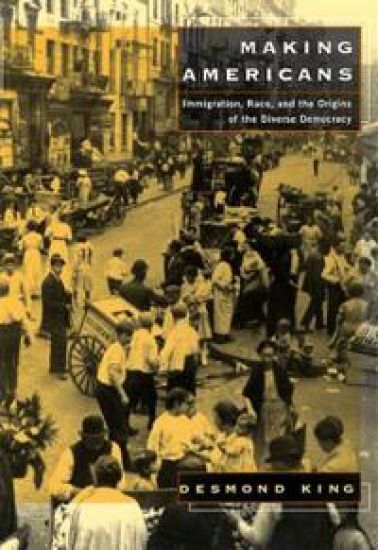
In the nineteenth century, virtually anyone could get into the United States. But by the 1920s, U.S. immigration policy had become a finely filtered regime of selection. Desmond King looks at this dramatic shift, and the debates behind it, for what they reveal about the construction of an "American" identity.Specifically, the debates in the three decades leading up to 1929 were conceived in terms of desirable versus undesirable immigrants. This not only cemented judgments about specific European groups but reinforced prevailing biases against groups already present in the United States, particularly African Americans, whose inferior status and second-class citizenship--enshrined in Jim Crow laws and embedded in pseudo-scientific arguments about racial classifications--appear to have been consolidated in these decades. Although the values of different groups have always been recognized in the United States, King gives the most thorough account yet of how eugenic arguments were used to establish barriers and to favor an Anglo-Saxon conception of American identity, rejecting claims of other traditions. Thus the immigration controversy emerges here as a significant precursor to recent multicultural debates.Making Americans shows how the choices made about immigration policy in the 1920s played a fundamental role in shaping democracy and ideas about group rights in America.
In The Name of Liberalism

In The Name of Liberalism

Desmond King

Oxford University Press
1999
sidottu
Why have British and North American governments adopted illiberal social policies during this century? In the Name of Liberalism investigates examples of social policy in Britain and the United States that conflict with liberal democratic ideals. The book examines the use of eugenic arguments in the 1920s and 1930s, the use of work camps in the 1930s as a response to mass unemployment and the introduction of work-for-welfare programs since the 1980s. The book argues that existing accounts of American and British political development neglect how illiberal social policies are intertwined in the creation of modern liberal democratic institutions. Such policies are, paradoxically, justified in terms of the liberal democratic framework itself. In the light of the books research, the author suggests that there is a need to know more about the internal workings of democracies to justify the claim that liberal democracy represents the most attractive set of political institutions.
In The Name of Liberalism

In The Name of Liberalism

Desmond King

Oxford University Press
1999
nidottu
Why have British and North American governments adopted illiberal social policies during this century? In the Name of Liberalism investigates examples of social policy in Britain and the United States that conflict with liberal democratic ideals. The book examines the use of eugenic arguments in the 1920s and 1930s, the use of work camps in the 1930s as a response to mass unemployment and the introduction of work-for-welfare programs since the 1980s. The book argues that existing accounts of American and British political development neglect how illiberal social policies are intertwined in the creation of modern liberal democratic institutions. Such policies are, paradoxically, justified in terms of the liberal democratic framework itself. In the light of the books research, the author suggests that there is a need to know more about the internal workings of democracies to justify the claim that liberal democracy represents the most attractive set of political institutions.
Rethinking Local Democracy

Rethinking Local Democracy

D. King; Gerry Stoker; Desmond King

Red Globe Press
1996
nidottu
The transformation of British local government into a new and complex system of local governance raises fundamental theoretical questions as well as empirical ones. Rethinking Local Democracy argues that traditional defences of local government are no longer adequate and that the case for local autonomy and local democracy needs to be radically rethought. It brings together a set of specially-commissioned chapters by leading academics designed to stimulate and contribute to debate on these issues.