Kirjojen hintavertailu. Mukana 12 207 394 kirjaa ja 12 kauppaa.

Kirjailija

Devin T. Hagerty

Kirjat ja teokset yhdessä paikassa: 5 kirjaa, julkaisuja vuosilta 2005-2019, suosituimpien joukossa South Asia in World Politics. Vertaile teosten hintoja ja tarkista saatavuus suomalaisista kirjakaupoista.

5 kirjaa

Kirjojen julkaisuhaarukka 2005-2019.

South Asia in World Politics

South Asia in World Politics

Devin T. Hagerty

Rowman Littlefield Publishers
2005
sidottu
South Asia in World Politics offers a comprehensive introduction to the politics and international relations of South Asia, a key area encompassing the states of Afghanistan, Bangladesh, Bhutan, India, the Maldives, Nepal, Pakistan, and Sri Lanka. While U.S. interest has long been sporadic and reactive, 9/11 alerted Washington that paying only fitful attention to one of the world's most volatile and populous regions was a recipe for everyday instability, repeated international crises, major and minor wars, and conditions so chronically unsettled that they continue to provide a fertile breeding ground for transnational Islamic terrorism. Exploring the many facets of this dynamic region, the book also assesses U.S. policy toward Afghanistan and explains the importance of Bangladesh and Pakistan, two of only a handful of Islamic states with significant track records as democracies.
South Asia in World Politics

South Asia in World Politics

Devin T. Hagerty

Rowman Littlefield Publishers
2005
nidottu
South Asia in World Politics offers a comprehensive introduction to the politics and international relations of South Asia, a key area encompassing the states of Afghanistan, Bangladesh, Bhutan, India, the Maldives, Nepal, Pakistan, and Sri Lanka. While U.S. interest has long been sporadic and reactive, 9/11 alerted Washington that paying only fitful attention to one of the world's most volatile and populous regions was a recipe for everyday instability, repeated international crises, major and minor wars, and conditions so chronically unsettled that they continue to provide a fertile breeding ground for transnational Islamic terrorism. Exploring the many facets of this dynamic region, the book also assesses U.S. policy toward Afghanistan and explains the importance of Bangladesh and Pakistan, two of only a handful of Islamic states with significant track records as democracies.
Nuclear Weapons and Deterrence Stability in South Asia

Nuclear Weapons and Deterrence Stability in South Asia

Devin T. Hagerty

Springer Nature Switzerland AG
2019
sidottu
This book examines the theory and practice of nuclear deterrence between India and Pakistan, two highly antagonistic South Asian neighbors who recently moved into their third decade of overt nuclear weaponization. It assesses the stability of Indo-Pakistani nuclear deterrence and argues that, while deterrence dampens the likelihood of escalation to conventional—and possibly nuclear—war, the chronically embittered relations between New Delhi and Islamabad mean that deterrence failure resulting in major warfare cannot be ruled out. Through an empirical examination of the effects of nuclear weapons during five crises between India and Pakistan since 1998, as well as a discussion of the theoretical logic of Indo-Pakistani nuclear deterrence, the book offers suggestions for enhancing deterrence stability between these two countries.
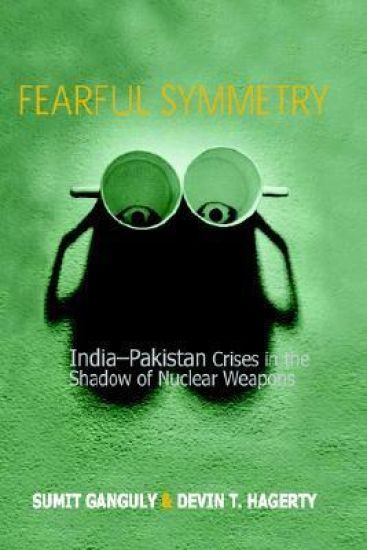
Fearful Symmetry

Fearful Symmetry

Sumit Ganguly; Devin T. Hagerty

University of Washington Press
2015
sidottu
With the nuclearization of the Indian subcontinent, Indo-Pakistani crisis behavior has acquired a deadly significance. The past two decades have witnessed no fewer than six crises against the backdrop of a vigorous nuclear arms race. Except for the Kargil war of 1998-9, all these events were resolved peacefully.Nuclear war was avoided despite bitter mistrust, everyday tensions, an intractable political conflict over Kashmir, three wars, and the steady refinement of each side's nuclear capabilities. Sumit Ganguly and Devin T. Hagerty carefully analyze each crisis, reviewing the Indian and Pakistani domestic political systems and key decisions during the relevant period.This lucid and comprehensive study of the two nations' crisis behavior in the nuclear age is the first work on Indo-Pakistani relations to take systematic account of the role played by the United States in South Asia's security dynamics over the past two decades in the context of unipolarization, and formulates a blueprint for American policy toward a more positive and productive India-Pakistan relationship.
Fearful Symmetry

Fearful Symmetry

Sumit Ganguly; Devin T. Hagerty

University of Washington Press
2006
pokkari
With the nuclearization of the Indian subcontinent, Indo-Pakistani crisis behavior has acquired a deadly significance. The past two decades have witnessed no fewer than six crises against the backdrop of a vigorous nuclear arms race. Except for the Kargil war of 1998-9, all these events were resolved peacefully.Nuclear war was avoided despite bitter mistrust, everyday tensions, an intractable political conflict over Kashmir, three wars, and the steady refinement of each side's nuclear capabilities. Sumit Ganguly and Devin T. Hagerty carefully analyze each crisis, reviewing the Indian and Pakistani domestic political systems and key decisions during the relevant period.This lucid and comprehensive study of the two nations' crisis behavior in the nuclear age is the first work on Indo-Pakistani relations to take systematic account of the role played by the United States in South Asia's security dynamics over the past two decades in the context of unipolarization, and formulates a blueprint for American policy toward a more positive and productive India-Pakistan relationship.