Kirjojen hintavertailu. Mukana 12 595 353 kirjaa ja 12 kauppaa.

Kirjailija

Devinder Sivia

Kirjat ja teokset yhdessä paikassa: 2 kirjaa, julkaisuja vuosilta 2000-2020, suosituimpien joukossa Foundations of Physics for Chemists. Vertaile teosten hintoja ja tarkista saatavuus suomalaisista kirjakaupoista.

2 kirjaa

Kirjojen julkaisuhaarukka 2000-2020.

Foundations of Science Mathematics

Foundations of Science Mathematics

Devinder Sivia; Joanna Rhodes; Steve Rawlings

Oxford University Press
2020
nidottu
Mathematics plays a key part in every quantitative and theoretical subject, and is taught to all science and engineering students. Foundations of Science Mathematics bridges the gap between school and university, and spans a large range of topics, from basic arithmetic and algebra to calculus, Fourier transforms, and elementary data analysis. Problems and worked solutions are presented in an informal and readable tutorial style, making the text accessible to the novice, while its concise nature ensures that it is a useful reference for the experienced professional. The first edition primer and its companion 'Worked Problems' workbook are combined in this new edition, and a new chapter on data analysis has been added to ensure the book remains as comprehensive and useful to students as possible.
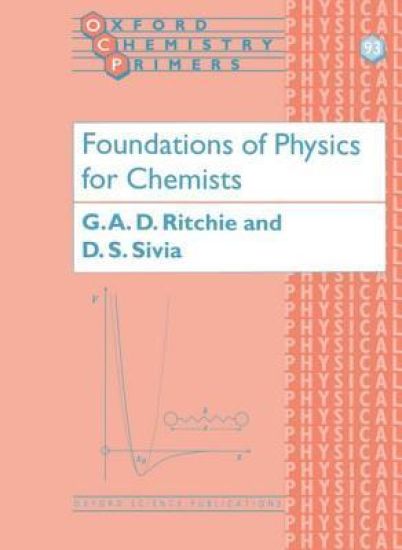
Foundations of Physics for Chemists

Foundations of Physics for Chemists

Grant Ritchie; Devinder Sivia

Oxford University Press
2000
nidottu
Foundations of Physics for Chemists presents the fundamental physics required for a full understanding of a diverse range of chemical phenomena and techniques such as diffraction, reaction rates and nuclear magnetic resonance. The text begins with a discussion of classical and wave mechanics which allows quantum mechanics to be introduced at an early stage. The ideas presented in these early chapters are subsequently developed to deal with the traditional physics topics of kinetic theory, electrostatics, magnetism and optics. However, the text maintains a distinct chemical perspecive by focusing on relevant chemical examples rather than the more hypothetical examples favoured by the majority of introductory physics texts. The students will find the information presented directly applicable to the concepts and examples that they will encounter throughout an undergraduate course in chemistry.