Kirjojen hintavertailu. Mukana 12 390 323 kirjaa ja 12 kauppaa.

Kirjailija

Dianna Xu

Kirjat ja teokset yhdessä paikassa: 3 kirjaa, julkaisuja vuosilta 2013-2015, suosituimpien joukossa A Guide to the Classification Theorem for Compact Surfaces. Vertaile teosten hintoja ja tarkista saatavuus suomalaisista kirjakaupoista.

3 kirjaa

Kirjojen julkaisuhaarukka 2013-2015.

A Guide to the Classification Theorem for Compact Surfaces

A Guide to the Classification Theorem for Compact Surfaces

Jean Gallier; Dianna Xu

Springer-Verlag Berlin and Heidelberg GmbH Co. K
2015
nidottu
This welcome boon for students of algebraic topology cuts a much-needed central path between other texts whose treatment of the classification theorem for compact surfaces is either too formalized and complex for those without detailed background knowledge, or too informal to afford students a comprehensive insight into the subject. Its dedicated, student-centred approach details a near-complete proof of this theorem, widely admired for its efficacy and formal beauty. The authors present the technical tools needed to deploy the method effectively as well as demonstrating their use in a clearly structured, worked example.Ideal for students whose mastery of algebraic topology may be a work-in-progress, the text introduces key notions such as fundamental groups, homology groups, and the Euler-Poincaré characteristic. These prerequisites are the subject of detailed appendices that enable focused, discrete learning where it is required, without interrupting the carefully planned structure of the core exposition. Gently guiding readers through the principles, theory, and applications of the classification theorem, the authors aim to foster genuine confidence in its use and in so doing encourage readers to move on to a deeper exploration of the versatile and valuable techniques available in algebraic topology.
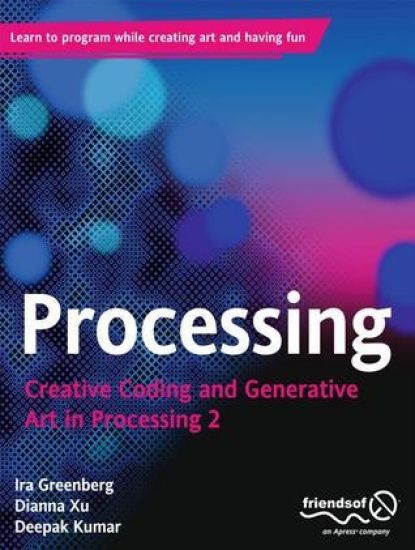
Processing

Processing

Ira Greenberg; Dianna Xu; Deepak Kumar

APress
2013
nidottu
Processing: Creative Coding and Generative Art in Processing 2 is a fun and creative approach to learning programming. Using the easy to learn Processing programming language, you will quickly learn how to draw with code, and from there move to animating in 2D and 3D. These basics will then open up a whole world of graphics and computer entertainment. If you’ve been curious about coding, but the thought of it also makes you nervous, this book is for you; if you consider yourself a creative person, maybe worried programming is too non-creative, this book is also for you; if you want to learn about the latest Processing 2.0 language release and also start making beautiful code art, this book is also definitely for you. You will learn how to develop interactive simulations, create beautiful visualizations, and even code image-manipulation applications. All this is taught using hands-on creative coding projects. Processing 2.0 is the latest release of the open-source Processing language, and includes exciting new features, such as OpenGL 2 support for enhanced 3D graphics performance. Processing: Creative Coding and Generative Art in Processing 2 is designed for independent learning and also as a primary text for an introductory computing class. Based on research funded by the National Science Foundation, this book brings together some of the most engaging and successful approaches from the digital arts and computer science classrooms. Teaches you how to program using a fun and creative approach. Covers the latest release of the Processing 2.0 language. Presents a research based approach to learning computing.
A Guide to the Classification Theorem for Compact Surfaces

A Guide to the Classification Theorem for Compact Surfaces

Jean Gallier; Dianna Xu

Springer-Verlag Berlin and Heidelberg GmbH Co. K
2013
sidottu
This welcome boon for students of algebraic topology cuts a much-needed central path between other texts whose treatment of the classification theorem for compact surfaces is either too formalized and complex for those without detailed background knowledge, or too informal to afford students a comprehensive insight into the subject. Its dedicated, student-centred approach details a near-complete proof of this theorem, widely admired for its efficacy and formal beauty. The authors present the technical tools needed to deploy the method effectively as well as demonstrating their use in a clearly structured, worked example.Ideal for students whose mastery of algebraic topology may be a work-in-progress, the text introduces key notions such as fundamental groups, homology groups, and the Euler-Poincaré characteristic. These prerequisites are the subject of detailed appendices that enable focused, discrete learning where it is required, without interrupting the carefully planned structure of the core exposition. Gently guiding readers through the principles, theory, and applications of the classification theorem, the authors aim to foster genuine confidence in its use and in so doing encourage readers to move on to a deeper exploration of the versatile and valuable techniques available in algebraic topology.