Kirjojen hintavertailu. Mukana 12 152 606 kirjaa ja 12 kauppaa.

Kirjailija

Dick Hobbs

Kirjat ja teokset yhdessä paikassa: 12 kirjaa, julkaisuja vuosilta 1988-2021, suosituimpien joukossa Policing the 2012 London Olympics. Vertaile teosten hintoja ja tarkista saatavuus suomalaisista kirjakaupoista.

12 kirjaa

Kirjojen julkaisuhaarukka 1988-2021.

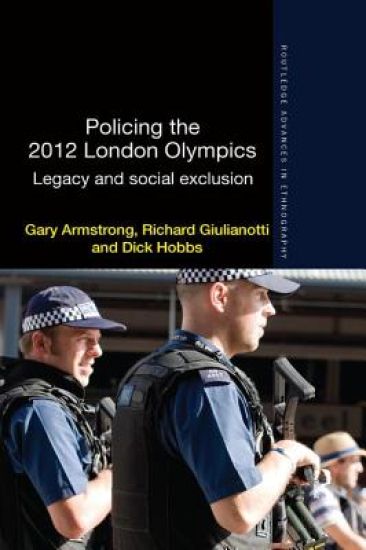
Policing the 2012 London Olympics

Policing the 2012 London Olympics

Gary Armstrong; Richard Giulianotti; Dick Hobbs

Routledge
2019
nidottu
The summer Olympic Games are renowned for producing the world’s biggest single-city cultural event. While the Olympics and other sport mega-events have received growing levels of academic investigation from a variety of disciplinary approaches, relatively little is known about how such occasions are experienced directly by local host communities and publics. This ethnography examines the everyday policing of the London Borough of Newham in relation to the London 2012 Olympics. It explains how police defined, monitored, prioritized, contained and investigated ‘Olympic-related’ crime, and how ‘Olympic-related’ policing connected to the policing of Newham. The authors examine how the threat of terrorism impacted on the everyday policing of the 2012 Olympics, as well as the exaggeration of other threats to the Games – such as youth gangs – for political reasons. The book also explores local resistance to Olympic policing, and the legacy of the Games with regard to policing, local housing, demographics and social exclusion.Discussing the lessons that can be learned for the future staging of sporting mega-events, this book will appeal to scholars and students with interests in sport, policing, crime and criminology, mega-events, event management, urban studies, global studies and sociology.
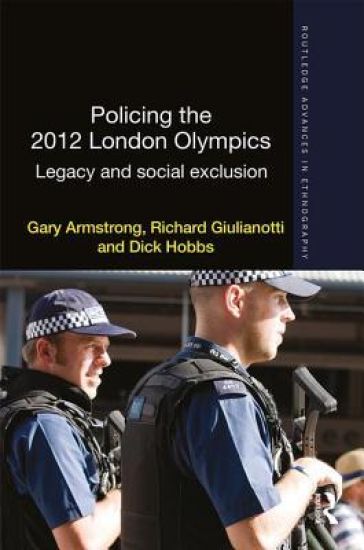
Policing the 2012 London Olympics

Policing the 2012 London Olympics

Gary Armstrong; Richard Giulianotti; Dick Hobbs

Routledge
2016
sidottu
The summer Olympic Games are renowned for producing the world’s biggest single-city cultural event. While the Olympics and other sport mega-events have received growing levels of academic investigation from a variety of disciplinary approaches, relatively little is known about how such occasions are experienced directly by local host communities and publics. This ethnography examines the everyday policing of the London Borough of Newham in relation to the London 2012 Olympics. It explains how police defined, monitored, prioritized, contained and investigated ‘Olympic-related’ crime, and how ‘Olympic-related’ policing connected to the policing of Newham. The authors examine how the threat of terrorism impacted on the everyday policing of the 2012 Olympics, as well as the exaggeration of other threats to the Games – such as youth gangs – for political reasons. The book also explores local resistance to Olympic policing, and the legacy of the Games with regard to policing, local housing, demographics and social exclusion.Discussing the lessons that can be learned for the future staging of sporting mega-events, this book will appeal to scholars and students with interests in sport, policing, crime and criminology, mega-events, event management, urban studies, global studies and sociology.
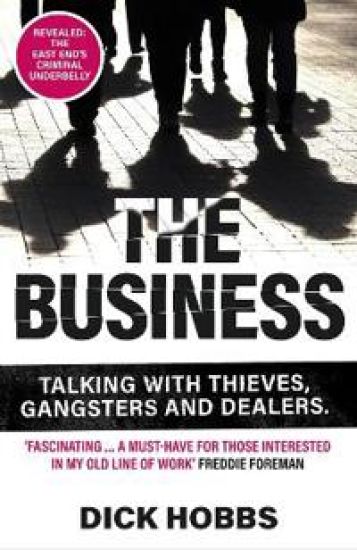
The Business

The Business

Dick Hobbs

John Blake Publishing Ltd
2021
nidottu
Professor Dick Hobbs is a leading commentator on the culture of crime and criminality. East End born and bred, he is a fascinating dichotomy of the criminal and the intellectual world, allowing him a unique insight into a subject that holds fascination for so many. When he was growing up, the East End was rocking with dock strikes, thievery and the kind of family values practiced by the Krays the Tibbs and a few dozen other outlaw clans. Violence was everywhere Crime was an unavoidable fact of life. However, his real education in Plaistow taught him that the real essence of illegal capitalism is to be found amongst the poor bloody infantry of the crime world; the jump up merchants, lorry highjackers, warehouse thieves, and middle-market drug dealers. These are the people with whom he has spent most of his professional life, and along with more exalted villains such as Mad Frankie Frazer and Charlie Richardson, these are the characters who will feature in the book, weaving the stories of these fearsome gangsters with the history and evolution of the UK underworld.
Securing and Sustaining the Olympic City

Securing and Sustaining the Olympic City

Pete Fussey; Jon Coaffee; Dick Hobbs

Routledge
2020
nidottu
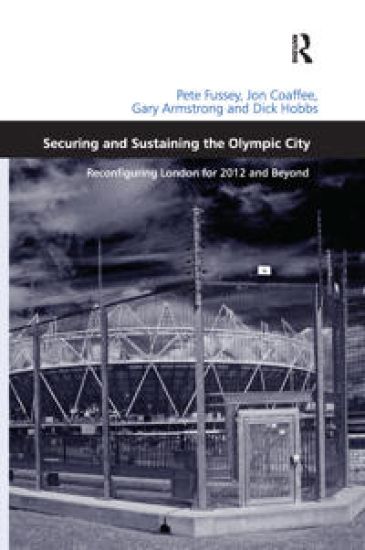
Often seen as the host nation's largest ever logistical undertaking, accommodating the Olympics and its attendant security infrastructure brings seismic changes to both the physical and social geography of its destination. Since 1976, the defence of the spectacle has become the central feature of its planning, one that has assumed even greater prominence following the bombing of the 1996 Atlanta Games and, most importantly, 9/11. Indeed, the quintupled cost of securing the first post-9/11 summer Games in Athens demonstrates the considerable scale and complexity currently implicated in these operations. Such costs are not only fiscal. The Games stimulate a tidal wave of redevelopment ushering in new gentrified urban settings and an associated investment that may or may not soak through to the incumbent community. Given the unusual step of developing London's Olympic Park in the heart of an existing urban milieu and the stated commitments to 'community development' and 'legacy', these constitute particularly acute issues for the 2012 Games. In addition to sealing the Olympic Park from perceived threats, 2012 security operations have also harnessed the administrative criminological staples of community safety and crime reduction to generate an ordered space in the surrounding areas. Of central importance here are the issues of citizenship, engagement and access in urban spaces redeveloped upon the themes of security and commerce. Through analyzing the social and community impact of the 2012 Games and its security operation on East London, this book concludes by considering the key debates as to whether utopian visions of legacy can be sustained given the demands of providing a global securitized event of the magnitude of the modern Olympics.
Lush Life

Lush Life

Dick Hobbs

Oxford University Press
2013
sidottu
Lush Life: Constructing Organized Crime in the UK opens 'the box marked do not open, too difficult to deal with', in the words of one Assistant Chief Constable, to explore the contested notion of British organized crime. The first book to trace the history and policing of British organized crime, it addresses how the interlocking processes of de-industrialisation, globalisation and neo-liberalism have normalised activity that was previously the exclusive domain of professional criminals. With both historical and sociological analyses, informed by the author's long term connection to an ethnographic site called 'Dogtown', a composite of several overlapping neighbourhoods in East London, this book critically addresses clichés such as criminal underworlds and the notion of the criminal firm. It considers the precursors to British organized crime, as well as the careers of famous crime families such as the Krays and the Richardsons, alongside the emergence of specialised law enforcement institutions to deal with this newly discovered threat. It also focuses on the various ways in which violence functions within organised crime, the role of rumour in formulating order within crime networks, the social construction of organised crime, the development of the cosmopolitan criminal and the all-inclusive nature of the contemporary criminal community of practice. Permeating throughout is a discussion of the flexible nature of the criminal market, the constructed nature of the notion of organised crime, and the normalisation of criminality. Underpinned by rich, context-specific examples, case studies, stories, and other qualitative evidence based on ethnographic research and interviews, Lush Life follows on from the author's work on normal crime (Doing the Business), and professional crime (Bad Business).
Securing and Sustaining the Olympic City

Securing and Sustaining the Olympic City

Pete Fussey; Jon Coaffee; Dick Hobbs

Ashgate Publishing Limited
2011
sidottu
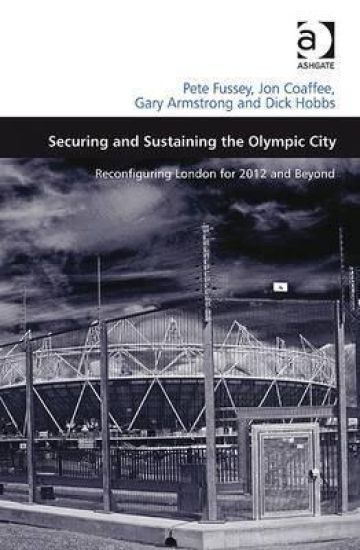
Often seen as the host nation's largest ever logistical undertaking, accommodating the Olympics and its attendant security infrastructure brings seismic changes to both the physical and social geography of its destination. Since 1976, the defence of the spectacle has become the central feature of its planning, one that has assumed even greater prominence following the bombing of the 1996 Atlanta Games and, most importantly, 9/11. Indeed, the quintupled cost of securing the first post-9/11 summer Games in Athens demonstrates the considerable scale and complexity currently implicated in these operations. Such costs are not only fiscal. The Games stimulate a tidal wave of redevelopment ushering in new gentrified urban settings and an associated investment that may or may not soak through to the incumbent community. Given the unusual step of developing London's Olympic Park in the heart of an existing urban milieu and the stated commitments to 'community development' and 'legacy', these constitute particularly acute issues for the 2012 Games. In addition to sealing the Olympic Park from perceived threats, 2012 security operations have also harnessed the administrative criminological staples of community safety and crime reduction to generate an ordered space in the surrounding areas. Of central importance here are the issues of citizenship, engagement and access in urban spaces redeveloped upon the themes of security and commerce. Through analyzing the social and community impact of the 2012 Games and its security operation on East London, this book concludes by considering the key debates as to whether utopian visions of legacy can be sustained given the demands of providing a global securitized event of the magnitude of the modern Olympics.
Gun Crime

Gun Crime

Dick Hobbs

Ashgate Publishing Limited
2008
sidottu
Gun Crime brings together a collection of texts drawn from a diverse range of disciplines which have contributed towards understanding the impact of gun crime within western societies. The book is divided into four interconnected sections which examine the use of firearms to commit offences. Part one explores the problems of youth, gang membership and guns in society. Part two examines the act of robbery where firearms are deployed by criminals in order to facilitate and commission robbery offences. Part three analyses the problem of violence and homicide associated with firearm offending. In the fourth and final part of the collection the texts focus on firearm injury trauma caused as a result of gun crime. The book provides insights for students and researchers, law enforcement agencies, community-based activists and policy-makers seeking to understand issues embedded within firearms offending and to develop initiatives to tackle gun crime.
Bouncers

Bouncers

Dick Hobbs; Philip Hadfield; Stuart Lister; Simon Winlow

Oxford University Press
2005
nidottu
In recent years, the expansion of night-time leisure has emerged as a key indicator of post-industrial urban prosperity, attracting investment, creating employment and re-generating the built environment. These leisure economies are youth-dominated, focusing upon the sale and consumption of alcohol. Unprecedented numbers of young people now flock to town centres that are crammed with bars, pubs and clubs, and the resulting violent disorder has over run police resources that remain geared to the drinking patterns and alcohol cultures of previous generations. Post-industrial re-structuring has spawned an increasingly complex mass of night-time leisure options through which numerous licit and illicit commercial opportunities flow. Yet, regardless of the fashionable and romantic notions of many contemporary urban theorists, it is alcohol, mass intoxication and profit rather than 'cultural regeneration,' which lies at the heart of this rapidly expanding dimension of post-industrial urbanism. Private security in the bulky form of bouncers fills the void left by the public police. These men (only 7% are women), whose activities are barely regulated by the State, are dominated by a powerful subculture rooted in routine violence and intimidation. Using ethnography, participant observation and extensive interviews with all the main players, this controversial book charts the emergence of the bouncer as one of the most graphic symbols in the iconography of post industrial Britain.
Bouncers

Bouncers

Dick Hobbs; Philip Hadfield; Stuart Lister; Simon Winlow

Oxford University Press
2003
sidottu
In recent years, the expansion of night-time leisure has emerged as a key indicator of post-industrial urban prosperity, attracting investment, creating employment, and re-generating the built environment. These leisure economies are youth-dominated, focusing upon the sale and consumption of alcohol. Unprecedented numbers of young people now flock to town centres that are crammed with bars, pubs, and clubs, and the resulting violent disorder has over run police resources that remain geared to the drinking patterns and alcohol cultures of previous generations. Post-industrial re-structuring has spawned an increasingly complex mass of night-time leisure options through which numerous licit and illicit commercial opportunities flow. Yet, regardless of the fashionable and romantic notions of many contemporary urban theorists, it is alcohol, mass intoxication, and profit rather than 'cultural regeneration,' which lies at the heart of this rapidly expanding dimension of post-industrial urbanism. Private security in the bulky form of bouncers fills the void left by the public police. These men (only 7% are women), whose activities are barely regulated by the State, are dominated by a powerful subculture rooted in routine violence and intimidation. Using ethnography, participant observation, and extensive interviews with all the main players, this controversial book charts the emergence of the bouncer as one of the most graphic symbols in the iconography of post-industrial Britain.
Bad Business

Bad Business

Dick Hobbs

Oxford University Press
1995
sidottu
Written by a leading commentator on the culture of crime and criminality, this is a hard-hitting and disturbing insight into the activities and attitudes of professional criminals. The book is based upon interviews with generations of criminals whose activities range from violence, intimidation, and protection rackets through to drug dealing and car theft. Professional criminals talk in graphic detail about their violent methods and their often ruthless attitudes to those who stand in their way. Their stories show a picture of a community where criminals have an elevated status, where violence is seen as a way of life, and prison is an occupational hazard - not a deterrent. The author spent three years at street level talking to the people whose stories appear in this book, and he presents us with a picture of a world beyond the usual glamorous, media friendly images of the gangster: a place where it is a struggle to thrive in a dangerous and highly competitive environment.
Doing the Business

Doing the Business

Dick Hobbs

Clarendon Press
1993
nidottu
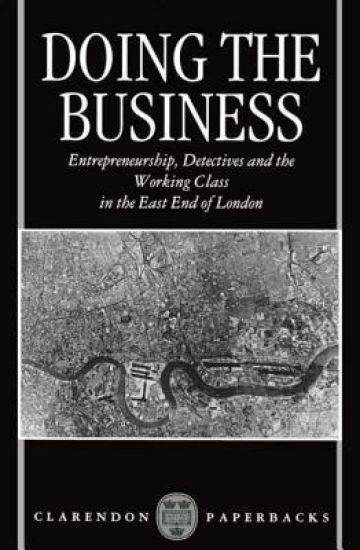
Doing the Business looks at the culture of London's East End and its relationship with the Criminal Investigation Department of the Metropolitan Police. The cultures of both the East End and the CID are examined in terms of their relationship with the market place and the emergent strategies of negotiation, trading, and, most importantly, entrepreneurship. The author breaks new ground in several crucial areas. He asks how well traditional notions of working class culture fit the East End, and argues convincingly that they do not. His model of an entrepreneurial working class culture (a shadow economy) is a departure from the routine 'them and us' picture of class relationships in Britain. He links the working class ethos peculiar to the East End with the occupational culture of detectives in an illuminating analysis of the working identity of plain clothes policing. There is also much of interest and originality in his theories of crime and delinquency, and in his documentation of the history of detective work in London. This is a highly original and at times controversial piece of work that contributes not only to our knowledge of culture and sub-culture, but also to the sociology of policing, and the study of class relations and organizations.
Doing the Business

Doing the Business

Dick Hobbs

Clarendon Press
1988
sidottu
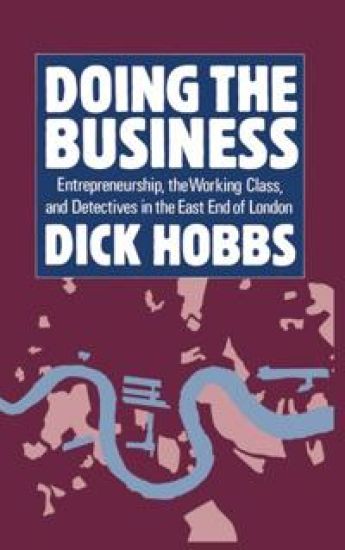
Doing the Business looks at the culture of London's East End and its relationship with the Criminal Investigation Department of the Metropolitan Police. The cultures of both the East End and the CID are examined in terms of their relationship with the market place and the emergent strategies of negotiation, trading, and, most importantly, entrepreneurship. The author breaks new ground in several crucial areas. He asks how well traditional notions of working class culture fit the East End, and argues convincingly that they do not. His model of an entrepreneurial working class culture (a shadow economy) is a departure from the routine 'them and us' picture of class relationships in Britain. He links the working class ethos peculiar to the East End with the occupational culture of detectives in an illuminating analysis of the working identity of plain clothes policing. There is also much of interest and originality in his theories of crime and delinquency, and in his documentation of the history of detective work in London. This is a highly original and at times controversial piece of work that contributes not only to our knowledge of culture and sub-culture, but also to the sociology of policing, and the study of class relations and organizations.