Kirjojen hintavertailu. Mukana 12 390 323 kirjaa ja 12 kauppaa.

Kirjailija

Dietmar Saupe

Kirjat ja teokset yhdessä paikassa: 10 kirjaa, julkaisuja vuosilta 1991-2012, suosituimpien joukossa Bausteine des Chaos Fraktale. Vertaile teosten hintoja ja tarkista saatavuus suomalaisista kirjakaupoista.

10 kirjaa

Kirjojen julkaisuhaarukka 1991-2012.

Fractals for the Classroom

Fractals for the Classroom

Heinz-Otto Peitgen; Hartmut Jürgens; Dietmar Saupe

Springer-Verlag New York Inc.
2012
nidottu
Fractals for the Classroom breaks new ground as it brings an exciting branch of mathematics into the classroom. The book is a collection of independent chapters on the major concepts related to the science and mathematics of fractals. Written at the mathematical level of an advanced secondary student, Fractals for the Classroom includes many fascinating insights for the classroom teacher and integrates illustrations from a wide variety of applications with an enjoyable text to help bring the concepts alive and make them understandable to the average reader. This book will have a tremendous impact upon teachers, students, and the mathematics education of the general public. With the forthcoming companion materials, including four books on strategic classroom activities and lessons with interactive computer software, this package will be unparalleled.
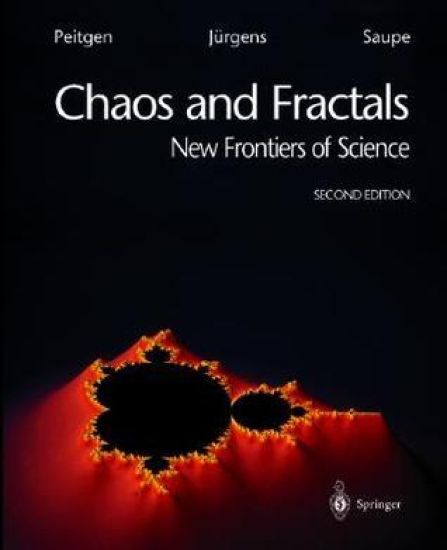
Chaos and Fractals

Chaos and Fractals

Heinz-Otto Peitgen; Hartmut Jürgens; Dietmar Saupe

Springer-Verlag New York Inc.
2012
nidottu
Almost 12 years have passed by since we wrote Chaos and Fractals. At the time we were hoping that our approach of writing a book which would be both accessible without mathematical sophistication and portray these exiting new fields in an authentic manner would find an audience. Now we know it did. We know from many reviews and personal letters that the book is used in a wide range of ways: researchers use it to acquaint themselves, teachers use it in college and university courses, students use it for background reading, and there is also a substantial audience of lay people who just want to know what chaos and fractals are about. Every book that is somewhat technical in nature is likely to have a number of misprints and errors in its first edition. Some of these were caught and brought to our attention by our readers. One of them, Hermann Flaschka, deserves to be thanked in particular for his suggestions and improvements. This second edition has several changes. We have taken out thetwo appendices from the firstedition. At the time of the first edition Yuval Fishers contribution, which we published as an appendix was probably the first complete expository account on fractal image compression. Meanwhile, Yuvals book Fractal Image Compression: Theory and Application appeared and is now the publication to refer to.
Bausteine des Chaos Fraktale

Bausteine des Chaos Fraktale

Heinz-Otto Peitgen; Hartmut Jürgens; Dietmar Saupe

Springer-Verlag Berlin and Heidelberg GmbH Co. K
2012
nidottu
Die Realitiit ist vielleicht das reinste Chaos. Georg Christoph Lichtenberg 1953 erkannte ich, daj3 die gerade Linie zum Untergang der Menschheitfiihrt. Aber die gerade Linie ist zur absoluten Tyrannei geworden. Die gerade Linie ist der Fluch unserer Zivilisation. Heute erleben wir den Triumph der rationalen Technik, und wiihrenddessen befinden wir uns gleichzeitig vor dem Nichts. Friedensreich Hundertwasser Dieses Buch ist weder ein typisches Mathematikbuch noch ein iibliches popularwis- senschaftliches Buch. Vielmehr war beabsichtigt, eine Art Lesebuch vorzulegen, das es auch Laien erlaubt, ohne den Ballast zu vieler technisch-mathematischer Notationen, einen soliden Einblick in die Welt der aktuellen Chaostheorie und der fraktalen Geo- metrie zu gewinnen. Dieser erste Band konzentriert sich dabei mehr auf geometrische Phanomene, wahrend der zweite Band Chaos - Bausteine der Ordnung sich vor allem auf dynamische Phanomene stiitzt. Seit Ende der siebziger Jahre lauft eine Welle durch Mathematik und Naturwissen- schaften, die in ihrer Kraft, Kreativitat und Weitraumigkeit langst ein interdisziplinares Ereignis ersten Ranges geworden ist: Chaos und Fraktale. Dies ist umso bemerkenswer- ter, als sich die Chaostheorie und die fraktale Geometrie eigentlich in keiner Hinsicht mit den groBartigen Entwiirfen dieses Jahrhunderts, wie etwa der Quantentheorie oder der Relativitatstheorie, messen k6nnen. Chaostheorie und fraktale Geometrie haben Naturwissenschaftler und Mathematiker mit einer Reihe von Dberraschungen konfrontiert, deren Konsequenzen im Verhaltnis zu den Angeboten einer sich oft omnipotent gebenden Wissenschaft und Technik zugleich emiichternd und dramatisch sind: - Zahlreiche Phanomene sind trotz strengem naturgesetzlichem Deterrninismus prin- zipiell nicht prognostizierbar.
Fractals for the Classroom

Fractals for the Classroom

Heinz-Otto Peitgen; Hartmut Jürgens; Dietmar Saupe

Springer-Verlag New York Inc.
2011
nidottu
Fractals for the Classroom breaks new ground as it brings an exciting branch of mathematics into the classroom. The book is a collection of independent chapters on the major concepts related to the science and mathematics of fractals. Written at the mathematical level of an advanced secondary student, Fractals for the Classroom includes many fascinating insights for the classroom teacher and integrates illustrations from a wide variety of applications with an enjoyable text to help bring the concepts alive and make them understandable to the average reader. This book will have a tremendous impact upon teachers, students, and the mathematics education of the general public. With the forthcoming companion materials, including four books on strategic classroom activities and lessons with interactive computer software, this package will be unparalleled.
Chaos and Fractals

Chaos and Fractals

Heinz-Otto Peitgen; Hartmut Jürgens; Dietmar Saupe

Springer-Verlag New York Inc.
2004
sidottu
Almost 12 years have passed by since we wrote Chaos and Fractals. At the time we were hoping that our approach of writing a book which would be both accessible without mathematical sophistication and portray these exiting new fields in an authentic manner would find an audience. Now we know it did. We know from many reviews and personal letters that the book is used in a wide range of ways: researchers use it to acquaint themselves, teachers use it in college and university courses, students use it for background reading, and there is also a substantial audience of lay people who just want to know what chaos and fractals are about. Every book that is somewhat technical in nature is likely to have a number of misprints and errors in its first edition. Some of these were caught and brought to our attention by our readers. One of them, Hermann Flaschka, deserves to be thanked in particular for his suggestions and improvements. This second edition has several changes. We have taken out thetwo appendices from the firstedition. At the time of the first edition Yuval Fishers contribution, which we published as an appendix was probably the first complete expository account on fractal image compression. Meanwhile, Yuvals book Fractal Image Compression: Theory and Application appeared and is now the publication to refer to.
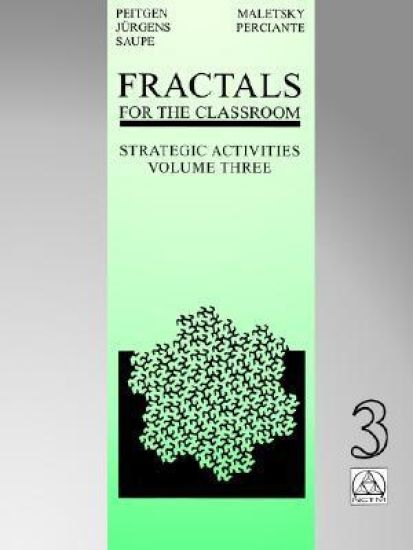
Fractals for the Classroom: Strategic Activities Volume Three

Fractals for the Classroom: Strategic Activities Volume Three

Heinz-Otto Peitgen; Hartmut Jürgens; Dietmar Saupe; Evan Maletsky; Terry Perciante

Springer-Verlag New York Inc.
1999
nidottu
This third and final volume of Strategic Activities on fractal geometry and chaos theory focuses upon the images that for many people have provided a compelling lure into an investigation of the intricate properties embedded within them. By themselves the figures posses fascinating features, but the mechanisms by which they are formed also highlight significant approaches to modeling natural processes and phenomena. The general pattern and specific steps used to construct a fractal image illustrated throughout this volume, comprise an iterated function system. The objective of this volume is to investigate the processes and often surprising results of applying such systems. These strategic activities have been developed from a sound instructional base, stressing the connections to the contemporary curriculum as recommended in the National Council of Teachers of Mathematics' Curriculum and Evaluation Standards for School Mathematics. Where appropriate, the activities take advantage of the technological power of the graphics calculator. The contents of this volume joined with the details contained in the prior two books. Together they provide a comprehensive survey of fractal geometry and chaos theory. The dynamic nature of the research and the experimental characteristics of related applications provides an engaging paradigm for classroom activity.
Chaos

Chaos

Heinz-Otto Peitgen; Hartmut Jürgens; Dietmar Saupe; Evan M. Maletsky; Terry Perciante; Lee Yunker

Springer-Verlag Berlin and Heidelberg GmbH Co. K
1992
nidottu
Das vorliegende Arbeitsbuch ist Teil eines Paketes von verschiedenen Materialien, die das Ziel haben, das Thema Chaos und Fraktale in den mathematisch-naturwissenschaftlichen Unterricht einzuführen. Ein weiteres Anliegen besteht darin, das mentale Bild von Mathematik im Bewußtsein der Schüler attraktiver zu gestalten. Mathematik ist die Antwort des Menschen auf die Komplexität der Welt. Mathematik ist die Ordnungsmacht im Dschungel der Phänomene. Deshalb ist Mathematik le­ bendig, frisch und aktuell. Deshalb gibt es zwischen einzelnen Teilgebieten und Ergebnissen der Mathematik immer wieder überraschende Querverbindungen, die oft das Verständnis einer Sache erst wirklich erhellen. Und deshalb bietet es sich an, durch entdeckendes, explorierendes Lernen die Anziehungskraft dieser Eigenschaften der Mathematik im Unterricht auszunutzen. Chaos und Fraktale bieten hierfür eine besondere neue Chance. Beide sind jung und aktuell und belegen so ohne weiteres, daß Mathematik lebt. Für beide gilt, daß einige ihrer schrittmachenden Entdeckungen nicht ohne Hilfe von Computern möglich gewesen wären. Damit rücken faszinie­ rende Computerexperimente natürlich in den Mittelpunkt. Beide sind hochgradig interdisziplinär. Dieses heißt, daß gehaltvolle Anwendungen nicht erst mühsam konstruiert werden müssen. Beide behandeln Themen, die von sich aus wirken. Tatsächlich durchlaufen seit Ende der siebziger Jahre Mathematik und Naturwissenschaften eine Welle, die in ihrer Kraft, Kreativität und Weiträumigkeit längst ein interdisziplinäres Ereignis er­ sten Ranges geworden ist. Das andauernde Interesse innerhalb und außerhalb der Wissenschaften ist in einer aufrüttelnden Betroffenheit begründet, die eine radikale Wende in dem überkommenen naturwissenschaftlichenWeltbild und manchen überdehnten Interpretationen ankündigt.
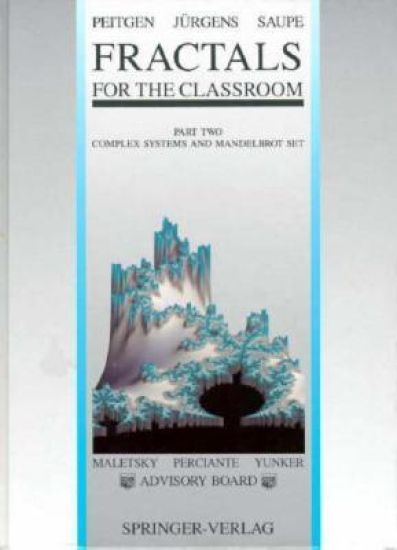
Fractals for the Classroom

Fractals for the Classroom

Heinz-Otto Peitgen; Hartmut Jurgens; Dietmar Saupe

Springer-Verlag New York Inc.
1992
sidottu
Fractals for the Classroom breaks new ground as it brings an exciting branch of mathematics into the classroom. The book is a collection of independent chapters on the major concepts related to the science and mathematics of fractals. Written at the mathematical level of an advanced secondary student, Fractals for the Classroom includes many fascinating insights for the classroom teacher and integrates illustrations from a wide variety of applications with an enjoyable text to help bring the concepts alive and make them understandable to the average reader. This book will have a tremendous impact upon teachers, students, and the mathematics education of the general public. With the forthcoming companion materials, including four books on strategic classroom activities and lessons with interactive computer software, this package will be unparalleled.
Fractals for the Classroom: Strategic Activities Volume Two

Fractals for the Classroom: Strategic Activities Volume Two

Heinz-Otto Peitgen; Hartmut Jurgens; Dietmar Saupe; Evan M. Maletsky; Terry Perciante; Lee E. Yunker

Springer-Verlag New York Inc.
1992
nidottu
The same factors that motivated the writing of our first volume of strategic activities on fractals continued to encourage the assembly of additional activities for this second volume. Fractals provide a setting wherein students can enjoy hands-on experiences that involve important mathematical content connected to a wide range of physical and social phenomena. The striking graphic images, unexpected geometric properties, and fascinating numerical processes offer unparalleled opportunity for enthusiastic student inquiry. Students sense the vigor present in the growing and highly integrative discipline of fractal geom­ etry as they are introduced to mathematical developments that have occurred during the last half of the twentieth century. Few branches of mathematics and computer science offer such a contem­ porary portrayal of the wonderment available in careful analysis, in the amazing dialogue between numeric and geometric processes, and in the energetic interaction between mathematics and other disciplines. Fractals continue to supply an uncommon setting for animated teaching and learn­ ing activities that focus upon fundamental mathematical concepts, connections, problem-solving techniques, and many other major topics of elementary and advanced mathematics. It remains our hope that, through this second volume of strategic activities, readers will find their enjoyment of mathematics heightened and their appreciation for the dynamics of the world in­ creased. We want experiences with fractals to enliven curiosity and to stretch the imagination.
Fractals for the Classroom: Strategic Activities Volume One

Fractals for the Classroom: Strategic Activities Volume One

Heinz-Otto Peitgen; Hartmut Jürgens; Dietmar Saupe; Evan Maletsky; Terry Perciante; Lee Yunker

Springer-Verlag New York Inc.
1991
nidottu
There are many reasons for writing this first volume of strategic activities on fractals. The most pervasive is the compelling desire to provide students of mathematics with a set of accessible, hands-on experiences with fractals and their underlying mathematical principles and characteristics. Another is to show how fractals connect to many different aspects of mathematics and how the study of fractals can bring these ideas together. A third is to share the beauty of their structure and shape both through what the eye sees and what the mind visualizes. Fractals have captured the attention, enthusiasm, and interest of many people around the world. To the casual observer, their color, beauty, and geometric structure captivates the visual senses like few other things they have ever experienced in mathematics. To the computer scientist, fractals offer a rich environment in which to explore, create, and build a new visual world as an artist creating a new work. To the student, fractals bring mathematics out of past history and into the twenty-first century. To the mathematics teacher, fractals offer a unique, new opportunity to illustrate both the dynamics of mathematics and its many connecting links.