Kirjojen hintavertailu. Mukana 12 114 707 kirjaa ja 12 kauppaa.

Kirjailija

Dimitris Ballas

Kirjat ja teokset yhdessä paikassa: 7 kirjaa, julkaisuja vuosilta 2006-2017, suosituimpien joukossa Post-Suburban Europe. Vertaile teosten hintoja ja tarkista saatavuus suomalaisista kirjakaupoista.

7 kirjaa

Kirjojen julkaisuhaarukka 2006-2017.

GIS and the Social Sciences

GIS and the Social Sciences

Dimitris Ballas; Graham Clarke; Rachel Franklin; Andy Newing

Routledge
2017
nidottu
GIS and the Social Sciences offers a uniquely social science approach on the theory and application of GIS with a range of modern examples. It explores how human geography can engage with a variety of important policy issues through linking together GIS and spatial analysis, and demonstrates the importance of applied GIS and spatial analysis for solving real-world problems in both the public and private sector. The book introduces basic theoretical material from a social science perspective and discusses how data are handled in GIS, what the standard commands within GIS packages are, and what they can offer in terms of spatial analysis. It covers the range of applications for which GIS has been primarily used in the social sciences, offering a global perspective of examples at a range of spatial scales. The book explores the use of GIS in crime, health, education, retail location, urban planning, transport, geodemographics, emergency planning and poverty/income inequalities. It is supplemented with practical activities and datasets that are linked to the content of each chapter and provided on an eResource page. The examples are written using ArcMap to show how the user can access data and put the theory in the textbook to applied use using proprietary GIS software. This book serves as a useful guide to a social science approach to GIS techniques and applications. It provides a range of modern applications of GIS with associated practicals to work through, and demonstrates how researcher and policy makers alike can use GIS to plan services more effectively. It will prove to be of great interest to geographers, as well as the broader social sciences, such as sociology, crime science, health, business and marketing.
GIS and the Social Sciences

GIS and the Social Sciences

Dimitris Ballas; Graham Clarke; Rachel Franklin; Andy Newing

Routledge
2017
sidottu
GIS and the Social Sciences offers a uniquely social science approach on the theory and application of GIS with a range of modern examples. It explores how human geography can engage with a variety of important policy issues through linking together GIS and spatial analysis, and demonstrates the importance of applied GIS and spatial analysis for solving real-world problems in both the public and private sector. The book introduces basic theoretical material from a social science perspective and discusses how data are handled in GIS, what the standard commands within GIS packages are, and what they can offer in terms of spatial analysis. It covers the range of applications for which GIS has been primarily used in the social sciences, offering a global perspective of examples at a range of spatial scales. The book explores the use of GIS in crime, health, education, retail location, urban planning, transport, geodemographics, emergency planning and poverty/income inequalities. It is supplemented with practical activities and datasets that are linked to the content of each chapter and provided on an eResource page. The examples are written using ArcMap to show how the user can access data and put the theory in the textbook to applied use using proprietary GIS software. This book serves as a useful guide to a social science approach to GIS techniques and applications. It provides a range of modern applications of GIS with associated practicals to work through, and demonstrates how researcher and policy makers alike can use GIS to plan services more effectively. It will prove to be of great interest to geographers, as well as the broader social sciences, such as sociology, crime science, health, business and marketing.
The Human Atlas of Europe

The Human Atlas of Europe

Dimitris Ballas; Danny Dorling; Benjamin Hennig

Policy Press
2017
nidottu
What does Brexit actually mean for the UK and what are the wider implications for Europe? Was the UK ‘leave’ vote actually symptomatic of broader issues within Europe such as population mobility and the rise of non-traditional parties? Written by leading international authors, this timely atlas explores Europe’s society, culture, economy, politics and environment using state of the art mapping techniques With maps covering over 80 topics ranging from life expectancy, greenhouse gas emissions, GDP to Eurovision voting, The Human Atlas of Europe addresses fundamental questions around social cohesion and sustainable growth as Europe negotiates the UK’s exit while continuing through the economic crisis. This concise, accessible atlas is packed with exciting features, including: • short introductions to each topic • maps using the very latest data • infographics bringing this all to life • summaries of key information including league tables • core statistics on Europe Taken as a whole, the atlas shows how geographical and state boundaries only tell a partial story and that we still live in a far more cohesive Europe than we realise.
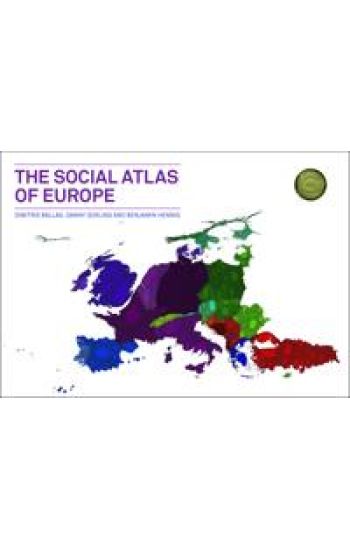
The Social Atlas of Europe

The Social Atlas of Europe

Dimitris Ballas; Danny Dorling; Benjamin Hennig

Policy Press
2014
sidottu
Many of us think of European countries as discreet entities - their own languages, cultures, food, and economies squarely contained within their national boundaries. But in fact Europe is at once a unified place and a sophisticatedly fragmented one, and national boundaries rarely reflect its social and economic realities. The social atlas of Europe is the first atlas to map Europe according to these realities, from the perspective of human geography rather than simply a political one. Using innovative full-color visualization methods, it reconsiders European identity through its many different facets: economy, culture, history, and human and physical geography, visualizing Europe and its people in a more fluid way, in some cases using maps without artificial national boundaries. It utilizes the latest available demographic, social, and economic data through state-of-the-art geographical information systems and new cartography techniques.Through these new visualizations, this highly illustrated book offers fresh perspectives on a range of topics, including social values, culture, education, employment, environmental footprints, health and well-being, and social inequalities and cohesion.It is a bold rethinking of Europe as we know it and will be of interest to anyone who wants to understand the continent in its truest form. Politics maps Eurovision voting patterns
Poverty, wealth and place in Britain, 1968 to 2005

Poverty, wealth and place in Britain, 1968 to 2005

Daniel Dorling; Jan Rigby; Ben Wheeler; Dimitris Ballas; Bethan Thomas; Eldin Fahmy; David Gordon; Ruth Lupton

Policy Press
2007
nidottu
This is the first detailed study of the recent geographical distribution of poverty and wealth in Britain. It presents the most comprehensive estimates of the changing levels of poverty and wealth from the late 1960s. A wide range of secondary data is used, beginning with the first national Poverty in the UK survey of Peter Townsend and colleagues, and ending with data released during the middle of the current decade. The authors extend concepts of social exclusion to establish 5 household groupings: the 'exclusive wealthy' - able to exclude themselves from the norms of society; those who are rich but not exclusively so; those who are neither rich nor poor; the 'breadline poor'; and the 'core poor' - who experience a combination of severe income poverty, material deprivation and subjective poverty. Poverty and wealth statistics are mapped in detail to explore geographical patterns over the last four decades, and analysed to determine whether poverty and wealth have become more or less polarised.
Post-Suburban Europe

Post-Suburban Europe

Nicholas A. Phelps; N. Parsons; Dimitris Ballas; Andrew Dowling

Palgrave Macmillan
2006
sidottu
The term 'edge city' describes the rapid growth of urban centres at the edge of established cities. Widely discussed in the US, very little has been written about European edge cities. This book gives a comparative analysis of examples in Greece, Spain, Paris, Finland and the UK, with a theoretical analysis of edge cities and post-suburban Europe.
Post-Suburban Europe

Post-Suburban Europe

Nicholas A. Phelps; N. Parsons; Dimitris Ballas; Andrew Dowling

Palgrave Macmillan
2006
nidottu
The term 'edge city' describes the rapid growth of urban centres at the edge of established cities. Widely discussed in the US, very little has been written about European edge cities. This book gives a comparative analysis of examples in Greece, Spain, Paris, Finland and the UK, with a theoretical analysis of edge cities and post-suburban Europe.