Kirjojen hintavertailu. Mukana 12 390 323 kirjaa ja 12 kauppaa.

Kirjailija

Ding Wang

Kirjat ja teokset yhdessä paikassa: 8 kirjaa, julkaisuja vuosilta 2012-2024, suosituimpien joukossa Adaptive Dynamic Programming with Applications in Optimal Control. Vertaile teosten hintoja ja tarkista saatavuus suomalaisista kirjakaupoista.

8 kirjaa

Kirjojen julkaisuhaarukka 2012-2024.

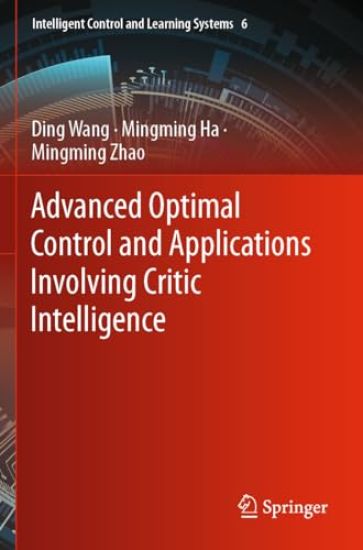
Advanced Optimal Control and Applications Involving Critic Intelligence

Advanced Optimal Control and Applications Involving Critic Intelligence

Ding Wang; Mingming Ha; Mingming Zhao

SPRINGER VERLAG, SINGAPORE
2024
nidottu
This book intends to report new optimal control results with critic intelligence for complex discrete-time systems, which covers the novel control theory, advanced control methods, and typical applications for wastewater treatment systems. Therein, combining with artificial intelligence techniques, such as neural networks and reinforcement learning, the novel intelligent critic control theory as well as a series of advanced optimal regulation and trajectory tracking strategies are established for discrete-time nonlinear systems, followed by application verifications to complex wastewater treatment processes. Consequently, developing such kind of critic intelligence approaches is of great significance for nonlinear optimization and wastewater recycling. The book is likely to be of interest to researchers and practitioners as well as graduate students in automation, computer science, and process industry who wish to learn core principles, methods, algorithms, and applications in the field of intelligent optimal control. It is beneficial to promote the development of intelligent optimal control approaches and the construction of high-level intelligent systems.
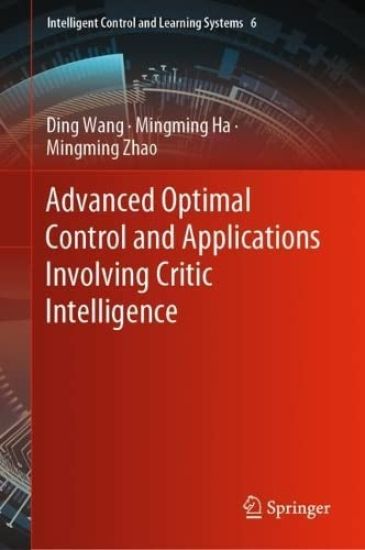
Advanced Optimal Control and Applications Involving Critic Intelligence

Advanced Optimal Control and Applications Involving Critic Intelligence

Ding Wang; Mingming Ha; Mingming Zhao

SPRINGER VERLAG, SINGAPORE
2023
sidottu
This book intends to report new optimal control results with critic intelligence for complex discrete-time systems, which covers the novel control theory, advanced control methods, and typical applications for wastewater treatment systems. Therein, combining with artificial intelligence techniques, such as neural networks and reinforcement learning, the novel intelligent critic control theory as well as a series of advanced optimal regulation and trajectory tracking strategies are established for discrete-time nonlinear systems, followed by application verifications to complex wastewater treatment processes. Consequently, developing such kind of critic intelligence approaches is of great significance for nonlinear optimization and wastewater recycling. The book is likely to be of interest to researchers and practitioners as well as graduate students in automation, computer science, and process industry who wish to learn core principles, methods, algorithms, and applications in the field of intelligent optimal control. It is beneficial to promote the development of intelligent optimal control approaches and the construction of high-level intelligent systems.
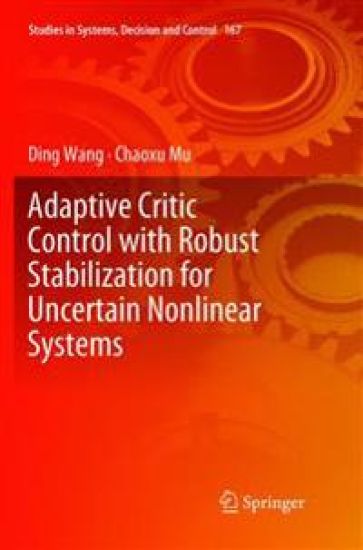
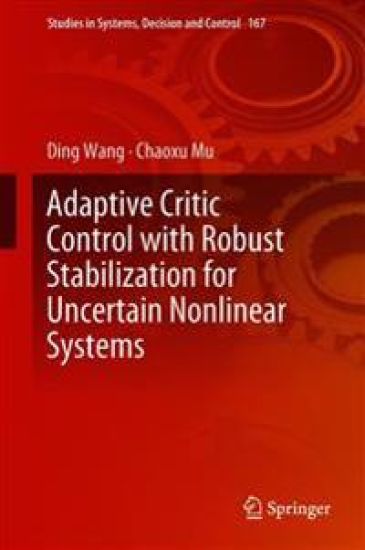
Adaptive Critic Control with Robust Stabilization for Uncertain Nonlinear Systems
This book reports on the latest advances in adaptive critic control with robust stabilization for uncertain nonlinear systems. Covering the core theory, novel methods, and a number of typical industrial applications related to the robust adaptive critic control field, it develops a comprehensive framework of robust adaptive strategies, including theoretical analysis, algorithm design, simulation verification, and experimental results. As such, it is of interest to university researchers, graduate students, and engineers in the fields of automation, computer science, and electrical engineering wishing to learn about the fundamental principles, methods, algorithms, and applications in the field of robust adaptive critic control. In addition, it promotes the development of robust adaptive critic control approaches, and the construction of higher-level intelligent systems.
Adaptive Critic Control with Robust Stabilization for Uncertain Nonlinear Systems
This book reports on the latest advances in adaptive critic control with robust stabilization for uncertain nonlinear systems. Covering the core theory, novel methods, and a number of typical industrial applications related to the robust adaptive critic control field, it develops a comprehensive framework of robust adaptive strategies, including theoretical analysis, algorithm design, simulation verification, and experimental results. As such, it is of interest to university researchers, graduate students, and engineers in the fields of automation, computer science, and electrical engineering wishing to learn about the fundamental principles, methods, algorithms, and applications in the field of robust adaptive critic control. In addition, it promotes the development of robust adaptive critic control approaches, and the construction of higher-level intelligent systems.
Adaptive Dynamic Programming with Applications in Optimal Control

Adaptive Dynamic Programming with Applications in Optimal Control

Derong Liu; Qinglai Wei; Ding Wang; Xiong Yang; Hongliang Li

Springer International Publishing AG
2018
nidottu
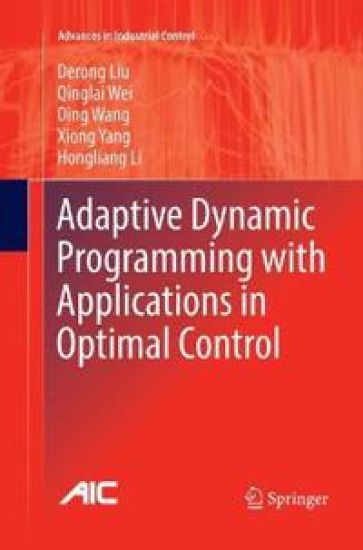
This book covers the most recent developments in adaptive dynamic programming (ADP). The text begins with a thorough background review of ADP making sure that readers are sufficiently familiar with the fundamentals. In the core of the book, the authors address first discrete- and then continuous-time systems. Coverage of discrete-time systems starts with a more general form of value iteration to demonstrate its convergence, optimality, and stability with complete and thorough theoretical analysis. A more realistic form of value iteration is studied where value function approximations are assumed to have finite errors. Adaptive Dynamic Programming also details another avenue of the ADP approach: policy iteration. Both basic and generalized forms of policy-iteration-based ADP are studied with complete and thorough theoretical analysis in terms of convergence, optimality, stability, and error bounds. Among continuous-time systems, the control of affine and nonaffine nonlinear systems is studied using the ADP approach which is then extended to other branches of control theory including decentralized control, robust and guaranteed cost control, and game theory. In the last part of the book the real-world significance of ADP theory is presented, focusing on three application examples developed from the authors’ work:• renewable energy scheduling for smart power grids;• coal gasification processes; and• water–gas shift reactions.Researchers studying intelligent control methods and practitioners looking to apply them in the chemical-process and power-supply industries will find much to interest them in this thorough treatment of an advanced approach to control.
Adaptive Dynamic Programming with Applications in Optimal Control

Adaptive Dynamic Programming with Applications in Optimal Control

Derong Liu; Qinglai Wei; Ding Wang; Xiong Yang; Hongliang Li

Springer International Publishing AG
2017
sidottu
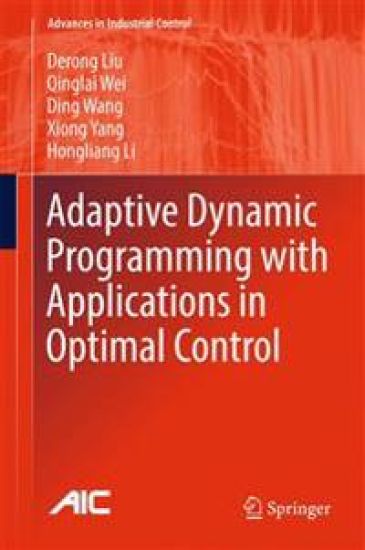
This book covers the most recent developments in adaptive dynamic programming (ADP). The text begins with a thorough background review of ADP making sure that readers are sufficiently familiar with the fundamentals. In the core of the book, the authors address first discrete- and then continuous-time systems. Coverage of discrete-time systems starts with a more general form of value iteration to demonstrate its convergence, optimality, and stability with complete and thorough theoretical analysis. A more realistic form of value iteration is studied where value function approximations are assumed to have finite errors. Adaptive Dynamic Programming also details another avenue of the ADP approach: policy iteration. Both basic and generalized forms of policy-iteration-based ADP are studied with complete and thorough theoretical analysis in terms of convergence, optimality, stability, and error bounds. Among continuous-time systems, the control of affine and nonaffine nonlinear systems is studied using the ADP approach which is then extended to other branches of control theory including decentralized control, robust and guaranteed cost control, and game theory. In the last part of the book the real-world significance of ADP theory is presented, focusing on three application examples developed from the authors’ work:• renewable energy scheduling for smart power grids;• coal gasification processes; and• water–gas shift reactions.Researchers studying intelligent control methods and practitioners looking to apply them in the chemical-process and power-supply industries will find much to interest them in this thorough treatment of an advanced approach to control.
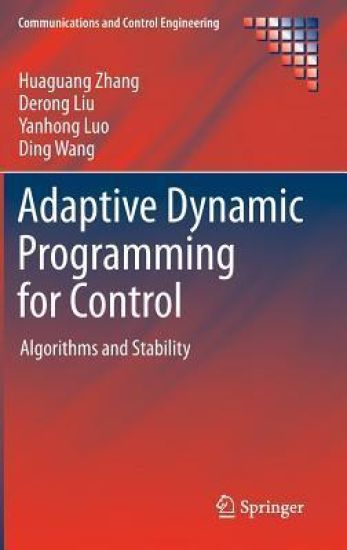
Adaptive Dynamic Programming for Control

Adaptive Dynamic Programming for Control

Huaguang Zhang; Derong Liu; Yanhong Luo; Ding Wang

Springer London Ltd
2015
nidottu
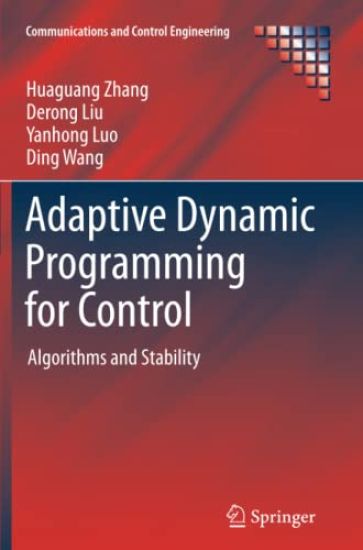
There are many methods of stable controller design for nonlinear systems. In seeking to go beyond the minimum requirement of stability, Adaptive Dynamic Programming in Discrete Time approaches the challenging topic of optimal control for nonlinear systems using the tools of adaptive dynamic programming (ADP). The range of systems treated is extensive; affine, switched, singularly perturbed and time-delay nonlinear systems are discussed as are the uses of neural networks and techniques of value and policy iteration. The text features three main aspects of ADP in which the methods proposed for stabilization and for tracking and games benefit from the incorporation of optimal control methods: • infinite-horizon control for which the difficulty of solving partial differential Hamilton–Jacobi–Bellman equations directly is overcome, and proof provided that the iterative value function updating sequence converges to the infimum of all the value functions obtained by admissible control law sequences; • finite-horizon control, implemented in discrete-time nonlinear systems showing the reader how to obtain suboptimal control solutions within a fixed number of control steps and with results more easily applied in real systems than those usually gained from infinite-horizon control; • nonlinear games for which a pair of mixed optimal policies are derived for solving games both when the saddle point does not exist, and, when it does, avoiding the existence conditions of the saddle point. Non-zero-sum games are studied in the context of a single network scheme in which policies are obtained guaranteeing system stability and minimizing the individual performance function yielding a Nash equilibrium. In order to make the coverage suitable for the student as well as for the expert reader, Adaptive Dynamic Programming in Discrete Time: • establishes the fundamental theory involved clearly with each chapter devoted to aclearly identifiable control paradigm; • demonstrates convergence proofs of the ADP algorithms to deepen understanding of the derivation of stability and convergence with the iterative computational methods used; and • shows how ADP methods can be put to use both in simulation and in real applications. This text will be of considerable interest to researchers interested in optimal control and its applications in operations research, applied mathematics computational intelligence and engineering. Graduate students working in control and operations research will also find the ideas presented here to be a source of powerful methods for furthering their study.
Adaptive Dynamic Programming for Control

Adaptive Dynamic Programming for Control

Huaguang Zhang; Derong Liu; Yanhong Luo; Ding Wang

Springer London Ltd
2012
sidottu
There are many methods of stable controller design for nonlinear systems. In seeking to go beyond the minimum requirement of stability, Adaptive Dynamic Programming in Discrete Time approaches the challenging topic of optimal control for nonlinear systems using the tools of adaptive dynamic programming (ADP). The range of systems treated is extensive; affine, switched, singularly perturbed and time-delay nonlinear systems are discussed as are the uses of neural networks and techniques of value and policy iteration. The text features three main aspects of ADP in which the methods proposed for stabilization and for tracking and games benefit from the incorporation of optimal control methods: • infinite-horizon control for which the difficulty of solving partial differential Hamilton–Jacobi–Bellman equations directly is overcome, and proof provided that the iterative value function updating sequence converges to the infimum of all the value functions obtained by admissible control law sequences; • finite-horizon control, implemented in discrete-time nonlinear systems showing the reader how to obtain suboptimal control solutions within a fixed number of control steps and with results more easily applied in real systems than those usually gained from infinite-horizon control; • nonlinear games for which a pair of mixed optimal policies are derived for solving games both when the saddle point does not exist, and, when it does, avoiding the existence conditions of the saddle point. Non-zero-sum games are studied in the context of a single network scheme in which policies are obtained guaranteeing system stability and minimizing the individual performance function yielding a Nash equilibrium. In order to make the coverage suitable for the student as well as for the expert reader, Adaptive Dynamic Programming in Discrete Time: • establishes the fundamental theory involved clearly with each chapter devoted to aclearly identifiable control paradigm; • demonstrates convergence proofs of the ADP algorithms to deepen understanding of the derivation of stability and convergence with the iterative computational methods used; and • shows how ADP methods can be put to use both in simulation and in real applications. This text will be of considerable interest to researchers interested in optimal control and its applications in operations research, applied mathematics computational intelligence and engineering. Graduate students working in control and operations research will also find the ideas presented here to be a source of powerful methods for furthering their study.