Kirjojen hintavertailu. Mukana 12 390 323 kirjaa ja 12 kauppaa.

Kirjailija

Dirk Geeraerts

Kirjat ja teokset yhdessä paikassa: 7 kirjaa, julkaisuja vuosilta 1994-2023, suosituimpien joukossa Ten Lectures on Cognitive Sociolinguistics. Vertaile teosten hintoja ja tarkista saatavuus suomalaisista kirjakaupoista.

7 kirjaa

Kirjojen julkaisuhaarukka 1994-2023.

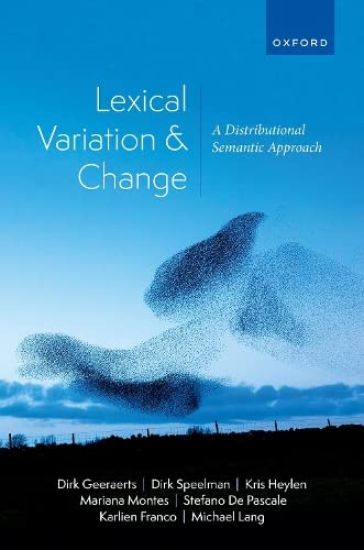
Lexical Variation and Change

Lexical Variation and Change

Dirk Geeraerts; Dirk Speelman; Kris Heylen; Mariana Montes; Stefano De Pascale; Karlien Franco; Michael Lang

Oxford University Press
2023
sidottu
This is an open access title available under the terms of a CC BY-NC-ND 4.0 International licence. It is free to read at Oxford Academic and offered as a free PDF download from OUP and selected open access locations. This book introduces a systematic framework for understanding and investigating lexical variation, using a distributional semantics approach. Distributional semantics embodies the idea that the context in which a word occurs reveals the meaning of that word. In contemporary corpus linguistics, that idea takes shape in various types of quantitative analysis of the corpus contexts in which words appear. In this book, the authors explore how count-based token-level semantic vector spaces, as an advanced form of such a quantitative methodology, can be applied to the study of polysemy, lexical variation, and lectometry. What can distributional models reveal about meaning? How can they be used to analyse the semantic relationship between near-synonyms, and to identify strict synonymy? How can they contribute to the study of lexical variation as a sociolinguistic variable, and to the use of those variables to measure convergence or divergence between language varieties? To answer these questions, the book presents a comprehensive model of lexical and semantic variation, based on the combination of a semasiological, an onomasiological, and a lectal dimension. It explains the mechanism of distributional modelling, both informally and technically, and introduces workflows and corpus linguistic tools that implement a distributional perspective in lexical research. Combining a cognitive linguistic interest in meaning with a sociolinguistic interest in variation, the authors illustrate this distributional methodology using case studies of Dutch and Spanish lexical data that focus on the detection of polysemy, the interaction of semasiological and onomasiological change, and sociolinguistic issues of lexical standardization and pluricentricity. Throughout, they highlight both the advantages and disadvantages of a distributional methodology: on the one hand, it has great potential to be scaled up for lexical research; on the other, its outcome does not necessarily neatly correspond with what would traditionally be considered different senses.
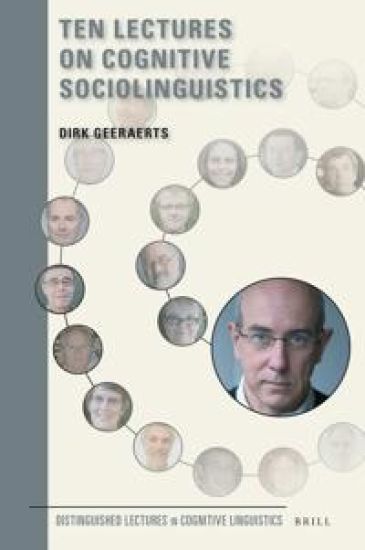
Ten Lectures on Cognitive Sociolinguistics
Cognitive Sociolinguistics combines the interest in meaning of Cognitive Linguistics with the interest in social variation of sociolinguistics, converging on two domains of enquiry: variation of meaning, and the meaning of variation. These Ten Lectures, a transcribed version of talks given by professor Geeraerts in 2009 at Beihang University in Beijing, introduce and illustrate both dimensions. The ‘variation of meaning’ perspective involves looking at types of semantic and categorial variation, at the role of social and cultural factors in semantic variation and change, and at the interplay of stereotypes, prototypes and norms. The ‘meaning of variation’ perspective involves looking at the way in which categorization processes of the type studied by Cognitive Linguistics shape how scholars and laymen think about language variation.
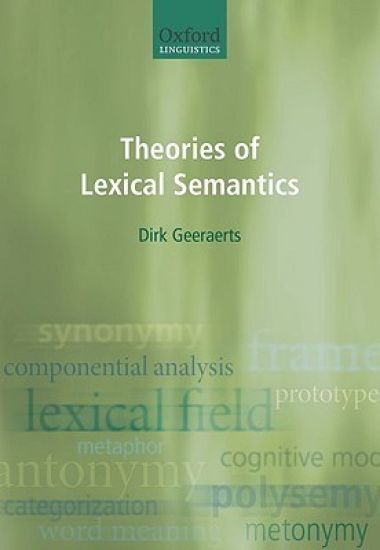
Theories of Lexical Semantics

Theories of Lexical Semantics

Dirk Geeraerts

Oxford University Press
2009
nidottu
Theories of Lexical Semantics offers a comprehensive overview of the major traditions of word meaning research in linguistics. In spite of the growing importance of the lexicon in linguistic theory, no overview of the main theoretical trends in lexical semantics is currently available. This book fills that gap by charting the evolution of the discipline from the mid nineteenth century to the present day. It presents the main ideas, the landmark publications, and the dominant figures of five traditions: historical-philological semantics, structuralist semantics, generativist semantics, neostructuralist semantics, and cognitive semantics. The theoretical and methodological relationship between the approaches is a major point of attention throughout the text: going well beyond a mere chronological enumeration, the book does not only describe the theoretical currents of lexical semantics, but also the undercurrents that have shaped its evolution.
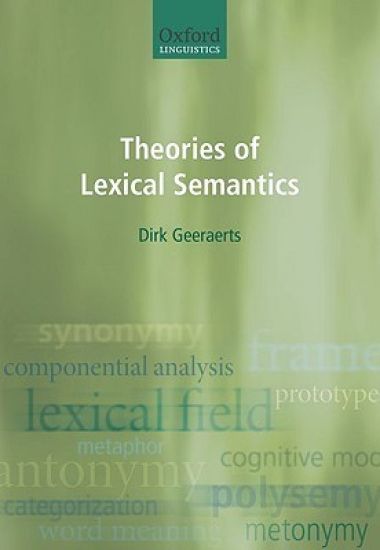
Theories of Lexical Semantics

Theories of Lexical Semantics

Dirk Geeraerts

Oxford University Press
2009
sidottu
Theories of Lexical Semantics offers a comprehensive overview of the major traditions of word meaning research in linguistics. In spite of the growing importance of the lexicon in linguistic theory, no overview of the main theoretical trends in lexical semantics is currently available. This book fills that gap by charting the evolution of the discipline from the mid nineteenth century to the present day. It presents the main ideas, the landmark publications, and the dominant figures of five traditions: historical-philological semantics, structuralist semantics, generativist semantics, neostructuralist semantics, and cognitive semantics. The theoretical and methodological relationship between the approaches is a major point of attention throughout the text: going well beyond a mere chronological enumeration, the book does not only describe the theoretical currents of lexical semantics, but also the undercurrents that have shaped its evolution.
Words and Other Wonders

Words and Other Wonders

Dirk Geeraerts

De Gruyter Mouton
2006
sidottu
Cognitive Linguistics has given a major impetus to the study of semantics and the lexicon. The present volume brings together seventeen previously published papers that testify to the fruitfulness of Cognitive Linguistics for the study of lexical and semantic topics. Spanning the period from the late 1980s to recent years, the collection features a number of papers that may be considered classics within the field of cognitive linguistic lexicology. The papers are grouped in thematic sections. The first section deals with prototypicality as a theoretical and practical model of semantic description. The second section discusses polysemy and criteria for distinguishing between meanings. The third section tackles questions of meaning description beyond the level of words, on the level of idioms and constructions. The following section casts the net even wider, dealing with the cultural aspects of meaning. Moving away from the theoretical and descriptive perspective towards applied concerns, the fifth section looks at lexicography from the point of view of Cognitive Linguistics. The final section has a metatheoretical orientation: it discusses the history and methodology of lexical semantics. Each paper is preceded by a newly written introduction that situates the text against the period in which it was first published, but that also points to further developments, in the author's own research or in Cognitive Linguistics at large. The variety of topics dealt with make this book an excellent introduction to the broad field of lexicological and lexical semantic research.
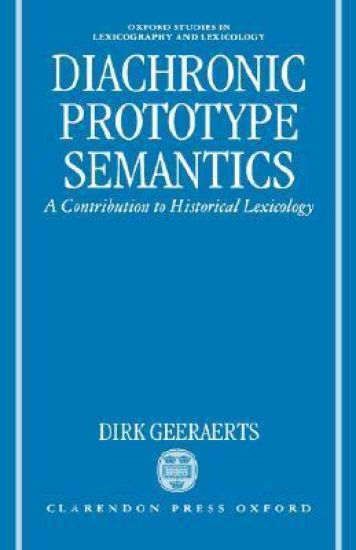
Diachronic Prototype Semantics

Diachronic Prototype Semantics

Dirk Geeraerts

Clarendon Press
1997
sidottu
Prototype theory makes a crucial distinction between the central and peripheral sense of words. Geeraerts explores the implications of this model for a theory of semantic change, in the first full-scale treatment of the impact of the most recent developments in lexicological theory on the study of meaning change. He identifies structural features of the development of word meanings which follow from a prototype-theoretical model of semantic structure, and incorporates these diachronic prototypicality effects into a theory of meaning change. The author strikes a balance between theoretical exploration and diachronic description, supporting each step in the argumentation with detailed case studies which chart the semantic development of particular words, or illustrate specific mechanisms of semantic change. Thus the book provides both a theoretical model for diachronic semantics and a number of methodological strategies and representational formats that exemplify how changes of word meaning can be studied in practice.