Kirjojen hintavertailu. Mukana 12 390 323 kirjaa ja 12 kauppaa.

Kirjailija

Division on Earth and Life Studies

Kirjat ja teokset yhdessä paikassa: 27 kirjaa, julkaisuja vuosilta 2022-2025, suosituimpien joukossa Gilbert W. Beebe Symposium: AI and ML Applications in Radiation Therapy, Medical Diagnostics, and Radiation Occupational Health and Safety. Vertaile teosten hintoja ja tarkista saatavuus suomalaisista kirjakaupoista.

27 kirjaa

Kirjojen julkaisuhaarukka 2022-2025.

Gilbert W. Beebe Symposium: AI and ML Applications in Radiation Therapy, Medical Diagnostics, and Radiation Occupational Health and Safety

Gilbert W. Beebe Symposium: AI and ML Applications in Radiation Therapy, Medical Diagnostics, and Radiation Occupational Health and Safety

National Academies of Sciences Engineeri; Division on Earth and Life Studies; Nuclear and Radiation Studies Board

National Academies Press
2025
nidottu
On March 13-14, 2025, the Nuclear and Radiation Studies Board of the National Academies of Sciences, Engineering, and Medicine hosted the most recent Gilbert W. Beebe symposium, with the goal of discussing the applications of artificial intelligence (AI) and machine learning (ML) in the fields of radiation therapy, medical diagnostics, and occupational health and safety. Among other topics, symposium participants discussed the importance of data for AI readiness, multimodal modeling, digital twins, uncertainty quantification and trustworthiness, and bias and ethics as it applies to each of these fields. The Gilbert W. Beebe Symposium was established by the Board on Radiation Effects Research (a predecessor of the Nuclear and Radiation Studies Board) in 2002 to honor the scientific achievements of the late Dr. Gilbert W. Beebe, a distinguished National Cancer Institute radiation epidemiologist who was one of the designers and key implementers of the epidemiology studies of Japanese atomic bomb survivors and a co-founder of the Medical Follow-up Agency. The symposium is used to promote discussions among scientists, federal staff, and other interested parties concerned with radiation health effects.
Effects of Human-Caused Greenhouse Gas Emissions on U.S. Climate, Health, and Welfare

Effects of Human-Caused Greenhouse Gas Emissions on U.S. Climate, Health, and Welfare

National Academies of Sciences Engineeri; Health and Medicine Division; Division on Earth and Life Studies

National Academies Press
2025
nidottu
The scientific community has been studying the question of how human-caused emissions of greenhouse gases are affecting the climate for well over a century. Much is known today, drawing on decades of direct observations of the Earth system and detailed research. This report summarizes the latest evidence on whether greenhouse gas emissions threaten public health and welfare in the United States. The impetus for this report was a notice of proposed rulemaking issued in August 2025 by the U.S. Environmental Protection Agency (EPA) indicating its intention to rescind the 2009 Finding of Endangerment and Cause or Contribute Findings for Greenhouse Gases Under Section 202(a) of the Clean Air Act. Recognizing that significantly more evidence is available today, the National Academies of Sciences, Engineering, and Medicine launched this study to review newly available scientific evidence on the topics included in a Technical Support Document that EPA prepared to inform its decision-making on the finding. The report's authoring committee found that EPA's 2009 finding that human-caused emissions of greenhouse gases adversely affect human health and welfare was accurate, has stood the test of time, and is now reinforced by even stronger evidence. Today, many of EPA's conclusions are further supported by longer observational records and multiple new lines of evidence. Moreover, research has uncovered additional risks that were not apparent in 2009.
Meeting Future U.S. Mineral Resource Needs: The Role of the U.S. Geological Survey Mineral Resources Program

Meeting Future U.S. Mineral Resource Needs: The Role of the U.S. Geological Survey Mineral Resources Program

National Academies of Sciences Engineeri; Division on Earth and Life Studies; Board on Earth Sciences and Resources

National Academies Press
2025
nidottu
Minerals form the foundation of our infrastructure, manufacturing, energy systems, and everyday technologies. Demand for these minerals, especially critical minerals, is rapidly increasing, highlighting the need for reliable sourcing and for resilient supply networks to ensure energy security and national competitiveness, and support technological innovation. The Mineral Resources Program (MRP), within the U.S. Geological Survey (USGS), plays a central role in addressing the nation's mineral resource challenges by providing the unbiased science and data needed to inform decision making across government, private industry, and academia. At the request of the USGS, the National Academies reviewed MRP and considered how it might best position itself to address current and future mineral resource challenges facing the nation. This report finds that MRP has demonstrated exceptional leadership and innovation during rapid budget fluctuations and renewed national attention on mineral resources, especially critical minerals, and has significantly advanced mineral deposit science, exploration, and analysis. The report recommends that MRP remain proactive in its priorities, set production targets for critical minerals, create a national atlas of resource potential, improve data delivery, establish external advisory input, regularly update its strategic plan, and strengthen collaboration across USGS and with external partners. These recommendations are intended to help MRP achieve its mission while supporting national objectives and remaining the national authority on minerals information, analysis, research, and assessment.
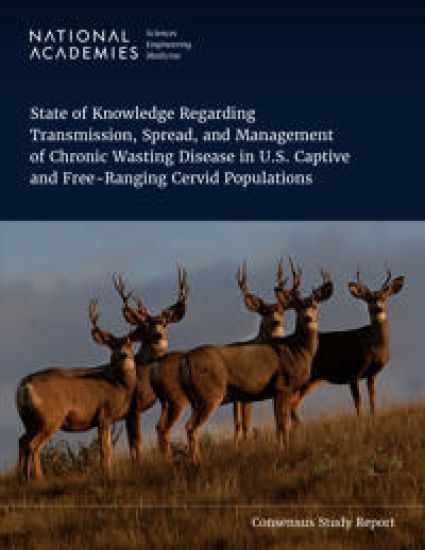
State of Knowledge Regarding Transmission, Spread, and Management of Chronic Wasting Disease in U.S. Captive and Free-Ranging Cervid Populations

State of Knowledge Regarding Transmission, Spread, and Management of Chronic Wasting Disease in U.S. Captive and Free-Ranging Cervid Populations

National Academies of Sciences Engineeri; Division on Earth and Life Studies; Board on Animal Health Sciences Conserva

National Academies Press
2025
nidottu
Chronic wasting disease (CWD) is a fatal, infectious prion disease affecting the central nervous system of some species of Cervidae-animals such as deer, elk, and moose. Recognized as a disease in the 1980s but suspected to have been present in the United States for decades longer, CWD affects both captive and free-ranging cervids and has been reported in 35 states and five Canadian provinces of North America as of August 1, 2024. The potential ramifications of the increasing spread of CWD are serious, and include negative impacts on ecosystems, and large economic costs for agencies with management responsibilities related to cervids and for industries that depend on cervids or cervid products. Cultural and food security impacts for communities with traditions tied to cervid hunting are also impacted. In 2020, Congress passed America's Conservation Enhancement (ACE) Act (P.L. 116-188), directing the U.S. Fish and Wildlife Service to lead a task force for addressing CWD in the United States drawing on a study commissioned from the National Academies. This report will assist the task force in prioritizing research and developing future CWD management strategies. It describes the state of knowledge regarding how CWD is transmitted among cervids, the current distribution of disease outbreaks, and the effectiveness of current diagnostic, prevention, and control methods available to limit the spread of the disease.
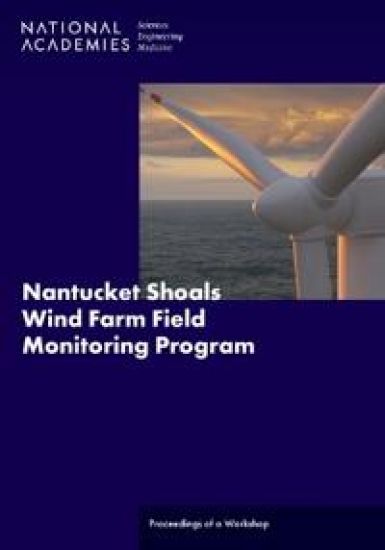
Nantucket Shoals Wind Farm Field Monitoring Program

Nantucket Shoals Wind Farm Field Monitoring Program

National Academies of Sciences Engineeri; Division on Earth and Life Studies; Ocean Studies Board

National Academies Press
2025
nidottu
A 2024 consensus report of the National Academies of Sciences, Engineering, and Medicine titled Potential Hydrodynamic Impacts of Offshore Wind Energy on Nantucket Shoals Regional Ecology: An Evaluation from Wind to Whales, examined the potential for offshore wind farms in the Nantucket Shoals region to affect oceanic physical processes and in turn impact ecosystem dynamics, including zooplankton productivity and aggregations relevant to right whale foraging and population health. Among other recommendations, the report outlined the need for observational and modeling efforts to fill knowledge gaps and inform decision-making regarding wind energy development and operations in the region. To delve further into specifically what observational and monitoring activities could best meet these needs, the National Academies hosted a follow-on workshop, entitled Field Monitoring Program to Evaluate Hydrodynamic Impacts of Offshore Wind Energy on Nantucket Shoals Regional Ecology: A Workshop, July 9-10, 2024 in Washington, DC. The workshop brought together participants from academia, government, and the offshore wind industry to explore examples of observational needs and discuss components of a field monitoring program that could help to advance models for elucidating the potential effects of wind energy development on Nantucket Shoals ecology. This Proceedings of a Workshop was prepared by rapporteurs as a high-level summary of what occurred at the workshop.
Advancing Risk Communication with Decision-Makers for Extreme Tropical Cyclones and Other Atypical Climate Events: Proceedings of a Workshop

Advancing Risk Communication with Decision-Makers for Extreme Tropical Cyclones and Other Atypical Climate Events: Proceedings of a Workshop

National Academies of Sciences Engineeri; Division of Behavioral and Social Scienc; Division on Earth and Life Studies

National Academies Press
2025
nidottu
Atypical weather events, such as extreme tropical cyclones, pose substantial threats to life, property and livelihoods in the U.S. and worldwide. Despite major advances in forecasting capabilities, communicating about extreme weather events with decision-makers and the public carries considerable challenges but also provides opportunities for innovation. Decisions surrounding extreme weather events often involve making tradeoffs between different degrees and varieties of risks. For example, deciding whether or when to issue an evacuation order ahead of a tropical cyclone entails tradeoffs between the risks to lives posed by the event and the risks to livelihoods posed by the financial costs of evacuations or relocations. In early 2024, the National Academies held a workshop on risk communication around extreme tropical cyclones and other atypical climate events. Participants aimed to identify opportunities and challenges for risk communication as well as lessons about community engagement and communication concerning other climate events. Over the course of the workshop, participants addressed various facets of risk communication, including the importance and difficulty of clearly communicating uncertainty to the general public; the importance of understanding the needs of various audiences in the context of effective communication; preparedness as a critical component of an effective response; and the often-profound ways that strong partnerships and relationships across sectors and offices can impact and improve risk communication.
Advancing Vineyard Health: Insights and Innovations for Combating Grapevine Red Blotch and Leafroll Diseases

Advancing Vineyard Health: Insights and Innovations for Combating Grapevine Red Blotch and Leafroll Diseases

National Academies of Sciences Engineeri; Division on Earth and Life Studies; Board on Agriculture and Natural Resourc

National Academies Press
2025
nidottu
Grapevine red blotch disease (GRBD) and grapevine leafroll disease (GLD) are growing threats to the California wine and wine grape sector, which contributes $73 billion annually to the state's economy. These viral diseases not only reduce grape yield and the productive lifespan of vineyards but also affect sugars and other aspects of fruit quality that are relevant to wine flavor profiles. Due to the complexity of the processing and aging winemaking involves, it can take years for the full impact of both diseases on the quality of the final product to become apparent. At the request of the California Department of Food and Agriculture, this report reviews the current state of GRBD and GLD knowledge, identifies knowledge gaps, and proposes key research and actions that could help reduce the spread and economic impact of these diseases. The report sets out guidance that could help improve GRBD and GLD management and offers strategies that may yield promising solutions for managing these diseases.
Potential Environmental Effects of Nuclear War

Potential Environmental Effects of Nuclear War

National Academies of Sciences Engineeri; Division on Earth and Life Studies; Nuclear and Radiation Studies Board

National Academies Press
2025
nidottu
In response to the buildup of U.S. and Russian nuclear arsenals during the Cold War, a series of major scientific studies conducted in the 1980s issued warnings about the potential for a "nuclear winter" scenario - the possibility that a large-scale nuclear exchange could inject massive amounts of soot and particulates into the upper atmosphere that would block incoming solar radiation and cause major ecosystem and societal disruptions. In the decades since that concept emerged, profound military, political, and technological changes have reshaped the nuclear landscape, while scientific advances have deepened the understanding of, and ability to model, Earth system processes. It is in this context that the U.S. Congress asked for this report to re-examine the potential environmental, social, and economic effects that could unfold over the weeks to decades after a nuclear war. The effects of any given nuclear exchange would depend on key processes and interactions along a causal pathway with six stages: weapon employment scenarios and effects; fire dynamics and emissions; plume rise, fate, and transport; physical Earth system impacts; ecosystem impacts; and socioeconomic impacts. Impacts of radioactive fallout were not included in the assessment. Potential Environmental Effects of Nuclear War identifies major uncertainties and data gaps at each stage of the causal pathway that currently limit researchers' ability to understand and model the effects of a nuclear war. This report recommends that relevant U.S. agencies coordinate the development of and support for a suite of model intercomparison projects to organize and assess models to reduce uncertainties in projections of the climatic and environment effects of nuclear war.
Practices and Standards for Plugging Orphaned and Abandoned Hydrocarbon Wells: Proceedings of a Workshop

Practices and Standards for Plugging Orphaned and Abandoned Hydrocarbon Wells: Proceedings of a Workshop

National Academies of Sciences Engineeri; Division on Engineering and Physical Sci; Division on Earth and Life Studies

National Academies Press
2025
nidottu
When oil and gas production began in the 19th century in North America, standards and regulations for the drilling and plugging of wells had not yet been developed. Over time, many of these and other wells were abandoned - unplugged, or not plugged to modern standards, and have sat idle for an extended, possibly unknown, period of time. These wells might not have been originally operated and maintained in accordance with existing statutes and regulations and, due to degradation over time and potential improper prior operations, they can emit methane, contaminate groundwater, and impact ecosystems, creating risks for both the environment and the public. To explore and share the variety of existing procedures and standards for plugging orphaned and abandoned wells, including current best practices for well-plugging technologies, the National Academies of Sciences, Engineering, and Medicine convened a workshop on July 18-19, 2024. Sponsored by the Department of the Interior's Orphaned Wells Program Office, the workshop included members of the federal government, state leaders, tribal representatives, industry experts, and other affected parties. This proceedings summarizes the presentation and discussion of the workshop.
Strategic Report on Research and Development in Biotechnology for Defense Innovation

Strategic Report on Research and Development in Biotechnology for Defense Innovation

National Academies of Sciences Engineeri; Division on Earth and Life Studies; Board on Life Sciences

National Academies Press
2025
nidottu
At the request of the National Security Commission on Emerging Biotechnology, Strategic Report on Research and Development in Biotechnology for Defense Innovation provides an overview of the current landscape of artificial intelligence and machine learning (AI/ML)-enabled biotechnology, the opportunities it presents, and the challenges it poses. This report offers a strategic vision for connecting scientists and technologists to build on, leverage, and tailor advances at the intersection of AI/ML, automated experimentation, and biotechnology to drive innovation in defense-related biotechnologies. Strategic Report on Research and Development in Biotechnology for Defense Innovation makes recommendations to address long-standing challenges that have limited research, development, prototyping, testing and evaluation, and eventual use of biotechnologies. Addressing these challenges will help to advance U.S. national security and defense by improving the performance of existing capabilities, enabling the creation of domestic supply chains of valuable products, reducing reliance on processes and chemicals that are harmful to the environment, and/or adding new capabilities not currently possible with established technologies.
A Vision for Continental-Scale Biology: Research Across Multiple Scales

A Vision for Continental-Scale Biology: Research Across Multiple Scales

National Academies of Sciences Engineeri; Division on Earth and Life Studies; Board on Life Sciences

National Academies Press
2025
nidottu
Our planet is facing many complex environmental challenges, including the loss of biodiversity and rapidly changing climate conditions, driven by intensifying human-nature interactions worldwide. Dramatic advances in the biological sciences over recent years are made possible by new tools to study life at many scales, from identifying mutations in a single gene to monitoring changes in plants, animals, and microbes over an entire continent. These tools have the potential to usher in a new era of continental-scale biology (CSB) in which researchers can combine data from various realms across organizational, spatial, and temporal scales, addressing questions on biological processes and patterns that cannot be answered by observations at either small or large scales alone. This report, prepared at the request of the National Science Foundation, sets out a vision for the development of CSB and identifies the research areas that could most benefit from multi-scale approaches. Advancing the use of CSB to address a wide range of biological and societal challenges will require the development of integrated conceptual frameworks and theories to guide research, deployment of emerging technologies, and development of a skilled workforce to synthesize the vast amounts of data from various sources.
Social-Ecological Consequences of Future Wildfires and Smoke in the West: Proceedings of a Workshop

Social-Ecological Consequences of Future Wildfires and Smoke in the West: Proceedings of a Workshop

National Academies of Sciences Engineeri; Division on Earth and Life Studies; Division of Behavioral and Social Scienc

National Academies Press
2025
nidottu
Over the past two decades, wildfires in western North America have greatly increased in frequency, magnitude and severity. Scientists have documented three main causes - a century of suppression and inadequate forest management that has led to overly dense, fuel-rich forests; climate change, turning woodlands and grasslands into hot, dry tinder boxes; and the spread of urbanization, increasing the probability of man-made ignitions. Less well known are the environmental and social implications associated with the acceleration of these trends. To explore these concerns and to identify possible policy responses, the National Academies of Sciences, Engineering, and Medicine's Board on Environmental Change and Society, in partnership with the Royal Society of Canada, convened a workshop in June 2024, "The Social and Ecological Consequences of Future Wildfire in the West". Over two days, two dozen wildfire experts and a hybrid audience of over 200 participants explored the history, current state, and anticipated future of wildfire science and policy across the western United States and Canada. This publication summarizes the presentations and discussions of the workshop.
Climate Change and Human Migration: An Earth Systems Science Perspective: Proceedings of a Workshop

Climate Change and Human Migration: An Earth Systems Science Perspective: Proceedings of a Workshop

National Academies of Sciences Engineeri; Division on Earth and Life Studies; Water Science and Technology Board

National Academies Press
2025
nidottu
Earth systems science aims to discover and integrate knowledge on the structure, nature, and scales of interactions among natural (e.g., physical, chemical, and biological) and social (e.g., cultural, socioeconomic, and geopolitical) processes. Climate-related migration can be temporary or permanent, can involve internal displacement within countries or crossing international borders, and can involve a broad array of other direct and indirect drivers. To explore how an Earth systems science approach may be used to address climate change impacts and the consequent influence on human migration, the National Academies hosted a workshop, Climate Change and Human Migration: An Earth Systems Science Perspective, on March 18-19, 2024. Workshop presentations focused on the data, methods, and research strategies relevant to understanding climate-related migration. This publication summarizes the presentations and discussion of the workshop.
Carbon Utilization Infrastructure, Markets, and Research and Development: A Final Report

Carbon Utilization Infrastructure, Markets, and Research and Development: A Final Report

National Academies of Sciences Engineeri; Division on Earth and Life Studies; Division on Engineering and Physical Sci

National Academies Press
2025
nidottu
National and international plans for halting and reversing climate change focus on reducing and eventually ending the largest source of greenhouse gas emissions: carbon dioxide (CO2) released by fossil fuel combustion. However, as the nation moves towards replacing many fossil CO2-emitting processes with zero- or low-carbon-emission alternatives, special attention is needed to eliminate net carbon emissions from the systems that cannot be fully "decarbonized", such as the production of aviation fuel, chemicals, plastics, and construction materials. For these systems, carbon will need to be managed and utilized effectively, in a way that either prevents CO2 from entering the atmosphere or reuses it through circular processes that do not contribute additional emissions. Carbon Utilization Infrastructure, Markets, and Research and Development: A Final Report is the second report of a two-part study. The study's first report assessed the state of infrastructure for CO2 transportation, use, and storage, highlighting priority opportunities for further investment. This second report identifies potential markets and commercialization opportunities for CO2- and coal waste-derived products, examines economic, environmental, and climate impacts of CO2 utilization infrastructure, and puts forward a comprehensive research agenda for carbon utilization technologies.