
Kirjailija
Dmitry Ivanov
Kirjat ja teokset yhdessä paikassa: 14 kirjaa, julkaisuja vuosilta 2009-2026, suosituimpien joukossa The Viable Supply Chain. Vertaile teosten hintoja ja tarkista saatavuus suomalaisista kirjakaupoista.
14 kirjaa
Kirjojen julkaisuhaarukka 2009-2026.
Introduction to Supply Chain Digital Twins and AI
Dmitry Ivanov
Springer Nature Switzerland AG
2026
sidottu

Global Supply Chain and Operations Management
Dmitry Ivanov; Alexander Tsipoulanidis; Jörn Schönberger
Springer International Publishing AG
2025
sidottu
The fourth edition of this textbook offers a structured introduction to global supply chain and operations management (SCOM), combining value creation networks and operational processes. It explains quantitative and organizational methods for planning and control of material, information, and financial flows in supply chains. Each chapter begins with an introductory case study, while numerous examples from various industries and services help to illustrate the key concepts. The book explains how to design operations and supply networks and collaborate with suppliers and customers. It shows how to balance supply and demand, a core aspect of tactical planning, before turning to the allocation of resources to meet customer needs. In addition, the book covers some advanced topics in SCOM, such as supply chain resilience, sustainability, Industry 4.0, artificial intelligence, and digital twins. Providing readers with a working knowledge of global supply chain and operations management, with a focus on bridging the gap between theory and practice, this textbook can be used in core, specialized, and advanced classes alike. It is intended for a broad range of students and professionals in supply chain and operations management.
Introduction to Operations and Supply Chain Simulation with AnyLogic
Dmitry Ivanov; William P. Millhiser; Phu Nguyen
Springer International Publishing AG
2025
sidottu
This textbook introduces readers to the principles of business process and supply chain simulation modeling using the AnyLogic multimethod simulation software. However, the book is not a software manual; instead, it reinforces the fundamental concepts of process analysis and supply chain management through simulation models while simultaneously teaching the process of simulation modeling. Complex statistical and mathematical derivations are kept to a minimum, while managerial decision-making is emphasized. Simulation games are introduced as an engaging way to comprehend system structures. The book is divided into four parts, each with the same format: presenting a motivating case study, developing technical models, providing step-by-step instructions for building AnyLogic simulation models and KPI dashboard design, using the models for classroom games and decision-making, and discussing possible extensions for assignments or advanced studies. The book is intended for undergraduate and master’s students in supply chain and operations management, as well as their instructors. Although some mathematical notation is necessary, the content has been carefully selected for readers without an engineering or mathematics background. Readers are encouraged to build models while reading, with the models becoming increasingly complex. Upon completing the book, readers will have learned how to create their own simulation models using popular software, gained a deeper understanding of operational and supply chain management concepts, and attained the proficiency needed to apply key performance metrics for managerial decision-making.
Introduction to Supply Chain Analytics
Dmitry Ivanov
Springer International Publishing AG
2024
sidottu
The book offers a concise yet comprehensive introduction to supply chain analytics covering management, modeling, and technology perspectives. Designed to accompany the textbook “Global Supply Chain and Operations Management”, it addresses the topics of supply chain analytics in more depth. The book describes descriptive, predictive, and prescriptive supply chain analytics explaining methodologies, illustrating method applications with the use of training exercises, and providing numerous examples in AnyLogic and anyLogistix software. Throughout the book, numerous practical examples and short case studies are given to illustrate theoretical concepts. Along with AnyLogic and anyLogistix model development guidelines and examples, the book has two other distinct features. First, it reviews and explains novel frameworks and concepts related to data-driven decision-making and digital twins. Second, it shows how to use analytics to improve supply chain resilience.Without relying heavily on mathematical derivations, the book offers a structured presentation and explanation of major supply chain analytics techniques and principles in a simple, predictable format to make it easy to understand for students and professionals with both management and engineering backgrounds. Graduate/Ph.D. students and supply chain professionals alike would benefit from a structured and didactically-oriented concise presentation of the concepts, principles, and methods of supply chain analytics. Providing graduate students and supply chain managers with working knowledge of basic and advanced supply chain analytics, this book contributes to improving knowledge-awareness of decision-making in increasingly data-driven and digital environments. The book is supplemented by a companion website offering interactive exercises with the use of AnyLogic and anyLogistix software as well as Spreadsheet Modeling.
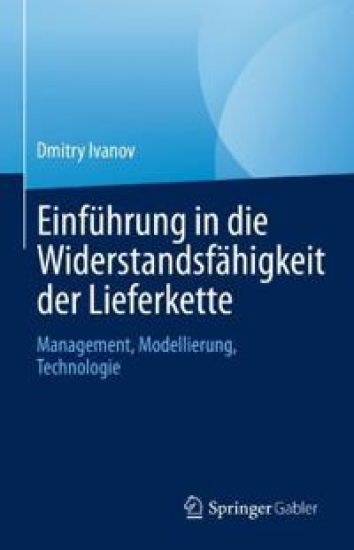
Einführung in die Widerstandsfähigkeit der Lieferkette
Dmitry Ivanov
Springer-Verlag Berlin and Heidelberg GmbH Co. KG
2023
sidottu
Dieses Buch bietet eine prägnante und dennoch umfassende Einführung in die Resilienz von Lieferketten, die Management-, Modellierungs- und Technologieperspektiven abdeckt. Es wurde als Begleitlektüre zum Lehrbuch "Global Supply Chain and Operations Management" konzipiert und befasst sich eingehender mit den Themen Risiken und Widerstandsfähigkeit von Lieferketten, beschreibt die wichtigsten Merkmale der Widerstandsfähigkeit von Lieferketten und erläutert Methoden zur Abschwächung von Unterbrechungen der Lieferkette und zur Wiederherstellung. Zur Veranschaulichung der theoretischen Konzepte werden zahlreiche praktische Beispiele und kurze Fallstudien angeführt. Ohne sich stark auf mathematische Ableitungen zu stützen, erklärt das Buch die wichtigsten Konzepte und Methoden zum Aufbau und zur Verbesserung der Widerstandsfähigkeit von Lieferketten und zur Bewältigung von Risiken bei Unterbrechungen der Lieferkette in einem einfachen, einheitlichen Format, das Studenten und Fachleuten mit Management- und Ingenieurhintergrund das Verständnis erleichtert. Doktoranden und Supply-Chain-Fachleute profitieren gleichermaßen von der strukturierten, didaktisch orientierten und prägnanten Darstellung der Konzepte, Prinzipien und Methoden des Supply-Chain-Resilience-Managements, der Modellierung und der technologischen Umsetzung.
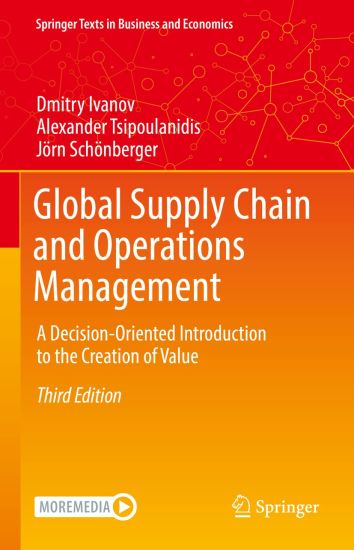
Global Supply Chain and Operations Management
Dmitry Ivanov; Alexander Tsipoulanidis; Jörn Schönberger
Springer Nature Switzerland AG
2021
sidottu
The third edition of this textbook comprehensively discusses global supply chain and operations management (SCOM), combining value creation networks and interacting processes. It focuses on operational roles within networks and presents the quantitative and organizational methods needed to plan and control the material, information, and financial flows in supply chains. Each chapter begins with an introductory case study, while numerous examples from various industries and services help to illustrate the key concepts. The book explains how to design operations and supply networks and how to incorporate suppliers and customers. It examines how to balance supply and demand, a core aspect of tactical planning, before turning to the allocation of resources to meet customer needs. In addition, the book presents state-of-the-art research reflecting the lessons learned from the COVID-19 pandemic, and emerging, fast-paced developments in the digitalization of supply chain and operations management. Providing readers with a working knowledge of global supply chain and operations management, with a focus on bridging the gap between theory and practice, this textbook can be used in core, specialized, and advanced classes alike. It is intended for a broad range of students and professionals in supply chain and operations management.
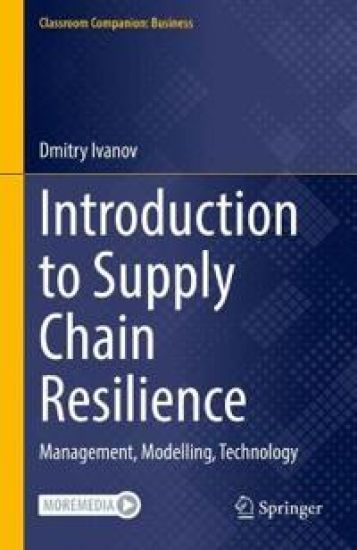
This book offers a concise yet comprehensive introduction to supply chain resilience, covering management, modeling and technology perspectives. Designed to accompany the textbook “Global Supply Chain and Operations Management” it addresses the topics of supply chain risks and resilience in more depth, describing the major features of supply chain resilience and explaining methodologies to mitigate supply chain disruptions and recover. Numerous practical examples and short case studies are provided to illustrate theoretical concepts. Without relying heavily on mathematical derivations, the book explains major concepts and methods to build and improve supply chain resilience and tackle supply chain disruption risks in a simple, uniform format to make it easy to understand for students and professionals with both management and engineering backgrounds. Graduate/PhD students and supply chain professionals alike will benefit from the structured, didactically oriented and concise presentation of the concepts, principles and methods of supply chain resilience management, modeling, and technological implementation.
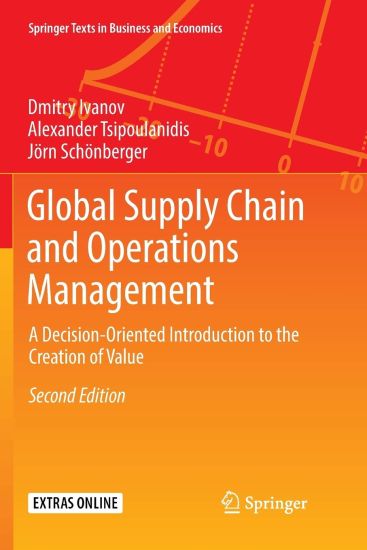
Global Supply Chain and Operations Management
Dmitry Ivanov; Alexander Tsipoulanidis; Jörn Schönberger
Springer Nature Switzerland AG
2018
nidottu
The second edition of this textbook comprehensively discusses global supply-chain and operations management, combining value creation networks and interacting processes. It focuses on the operational roles in the networks and presents the quantitative and organizational methods needed to plan and control the material, information and financial flows in the supply chain. Each chapter starts with an introductory case study, and numerous examples from various industries and services help to illustrate the key concepts. The book explains how to design operations and supply networks and how to incorporate suppliers and customers. It also examines matching supply and demand, which is a core aspect of tactical planning, before turning to the allocation of resources for fulfilling customer demands. This second edition features three new chapters: “Supply Chain Risk Management and Resilience”, “Digital Supply Chain, Smart Operations, and Industry 4.0”, and “Pricing and Revenue-Oriented Capacity Allocation”. These new chapters provide the structured knowledge on the principles, models, and technologies for managing the supply-chain risks and improving supply-chain and operations performance with the help of digital technologies such as Industry 4.0, additive manufacturing, Internet-of-Things, advanced optimization methods and predictive analytics. The existing chapters have been updated and new case studies have been included. In addition, the preface provides guidelines for instructors on how to use the material for different courses in supply-chain and operations management and at different educational levels, such as general undergraduate, specialized undergraduate, and graduate courses. The companion website www.global-supply-chain-management.de has also been updated accordingly. In addition, the book is now supported by e-manuals for supply-chain and operations simulation and optimization in AnyLogic and anyLogistix. Providing readers with a working knowledge of global supply-chain and operations management, with a focus on bridging the gap between theory and practice, this textbook can be used in core, special and advanced classes. It is intended for broad range of students and professionals involved in supply-chain and operations management.
Structural Dynamics and Resilience in Supply Chain Risk Management
Dmitry Ivanov
Springer International Publishing AG
2018
nidottu
This book offers an introduction to structural dynamics, ripple effect and resilience in supply chain disruption risk management for larger audiences. In the management section, without relying heavily on mathematical derivations, the book offers state-of-the-art concepts and methods to tackle supply chain disruption risks and designing resilient supply chains in a simple, predictable format to make it easy to understand for students and professionals with both management and engineering background. In the technical section, the book constitutes structural dynamics control methods for supply chain management. Real-life problems are modelled and solved with the help of mathematical programming, discrete-event simulation, optimal control theory, and fuzzy logic. The book derives practical recommendations for management decision-making with disruption risk in the following areas: How to estimate the impact of possible disruptions on performance in the pro-active stage?How to generate efficient and effective stabilization and recovery policies?When does one failure trigger an adjacent set of failures?Which supply chain structures are particular sensitive to ripple effect?How to measure the disruption risks in the supply chain?
Structural Dynamics and Resilience in Supply Chain Risk Management
Dmitry Ivanov
Springer International Publishing AG
2017
sidottu
This book offers an introduction to structural dynamics, ripple effect and resilience in supply chain disruption risk management for larger audiences. In the management section, without relying heavily on mathematical derivations, the book offers state-of-the-art concepts and methods to tackle supply chain disruption risks and designing resilient supply chains in a simple, predictable format to make it easy to understand for students and professionals with both management and engineering background. In the technical section, the book constitutes structural dynamics control methods for supply chain management. Real-life problems are modelled and solved with the help of mathematical programming, discrete-event simulation, optimal control theory, and fuzzy logic. The book derives practical recommendations for management decision-making with disruption risk in the following areas: How to estimate the impact of possible disruptions on performance in the pro-active stage?How to generate efficient and effective stabilization and recovery policies?When does one failure trigger an adjacent set of failures?Which supply chain structures are particular sensitive to ripple effect?How to measure the disruption risks in the supply chain?
Adaptive Supply Chain Management develops new viewpoints on the SCM goal paradigm, problem semantics, and decision-making support. Drawing upon years of research and practical experience, and using numerous examples, the authors unite conceptual considerations of supply chains with a constructive level of engineering and solutions to real-world problems. Adaptive Supply Chain Management provides advanced insights into dynamics, complexity, and uncertainty in supply chains from the perspectives of systems analysis, control theory, and operations research. It also considers supply chain adaptability, stability, and crisis-resistance. Providing readers with a comprehensive view of advanced SCM concepts, constructive mathematical techniques and models, Adaptive Supply Chain Management is an invaluable text for practitioners and researchers who specialize in SCM and operations.
Dynamics and Sustainability in International Logistics and Supply Chain Management
Dmitry Ivanov; Herbert Kopfer; Hans-Dietrich Haasis
Cuvillier
2011
nidottu
Adaptive Supply Chain Management develops new viewpoints on the SCM goal paradigm, problem semantics, and decision-making support. Drawing upon years of research and practical experience, and using numerous examples, the authors unite conceptual considerations of supply chains with a constructive level of engineering and solutions to real-world problems. Adaptive Supply Chain Management provides advanced insights into dynamics, complexity, and uncertainty in supply chains from the perspectives of systems analysis, control theory, and operations research. It also considers supply chain adaptability, stability, and crisis-resistance. Providing readers with a comprehensive view of advanced SCM concepts, constructive mathematical techniques and models, Adaptive Supply Chain Management is an invaluable text for practitioners and researchers who specialize in SCM and operations.