
Kirjailija
Dmitry Vostokov
Kirjat ja teokset yhdessä paikassa: 74 kirjaa, julkaisuja vuosilta 2008-2025, suosituimpien joukossa The Tablet. Vertaile teosten hintoja ja tarkista saatavuus suomalaisista kirjakaupoista.
74 kirjaa
Kirjojen julkaisuhaarukka 2008-2025.


This reference volume consists of revised, edited, cross-referenced, and thematically organized selected articles from Software Diagnostics and Observability Institute (DumpAnalysis.org + TraceAnalysis.org) and Software Diagnostics Library (former Crash Dump Analysis blog, DumpAnalysis.org/blog) about software diagnostics, root cause analysis, debugging, crash and hang dump analysis, software trace and log analysis written from 15 April 2024 to 14 November 2025 for software engineers developing and maintaining products on Windows platforms, quality assurance engineers testing software, technical support, DevOps and DevSecOps, escalation and site reliability engineers dealing with complex software issues, security and vulnerability researchers, reverse engineers, malware and memory forensics analysts, data science and ML/AI researchers and engineers. This volume is fully cross-referenced with volumes 1 - 16 and features: - 6 new crash dump analysis patterns - 11 new software trace and log analysis patterns - Introduction to pattern-oriented observability - Introduction to software morphology - Introduction to geometric theory of traces and logs - Introduction to pattern-oriented intelligence and AI - Introduction to agentic narratology and workflow diagnostic pattern language - Introduction to algebra of prompting and context management pattern language - Logics of memory dump and trace analysis - Introduction to pattern-oriented system logic - Introduction to ontological diagnostics - Machine learning as memory dump analysis - The stomach metaphor for AI and pattern metabolism - OS internals and category theory - Introduction to pattern category theory - Meta-diagnostic and categorical unification of software diagnostics and digital pathology - A Lego model as an autoencoder and Lego disassembly as tokenization - Memoidealism as a post-computational philosophy of AI - Lists of recommended books The primary audience for Memory Dump Analysis Anthology reference volumes (Diagnomicon) is software engineers developing and maintaining products on Windows and Linux platforms, technical support, escalation, and site reliability engineers dealing with complex software issues, quality assurance engineers testing software, security and vulnerability researchers, reverse engineers, malware and memory forensics analysts, data scientists, ML and AI researchers and engineers.
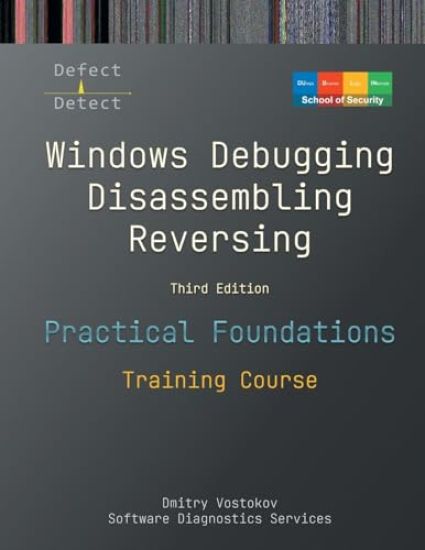
Practical Foundations of Windows Debugging, Disassembling, Reversing
Dmitry Vostokov
OPENTASK
2025
pokkari



The full transcript of Software Diagnostics Services training with more than 20 step-by-step exercises using WSL and Hyper-V environments, notes, and source code of specially created modeling applications in C, C++, and Rust. Learn live local and remote debugging techniques in the kernel, user process, and managed spaces using WinDbg, GDB, LLDB, rr, and KDB, KGDB debuggers. The unique and innovative course teaches unified debugging patterns applied to real problems from complex software environments. A necessary x64 and ARM64 review is also included.Prerequisites: Working knowledge of one of these languages: C, C++, Rust. Operating system internals and assembly language concepts are explained when necessary.Audience: Software engineers, software maintenance engineers, escalation engineers, SRE, DevOps and DevSecOps, cloud engineers, security and vulnerability researchers, malware and memory forensics analysts who want to learn live memory inspection techniques.
The book contains the full Software Diagnostics Services training transcript and 10 step-by-step exercises and covers dozens of crash dump analysis patterns from the x64 process and complete (physical) memory dumps. Learn how to analyze Rust application crashes and freezes, navigate through memory dump space, and diagnose heap corruption, memory leaks, CPU spikes, blocked threads, deadlocks, wait chains, and much more with the WinDbg debugger. The training uses a unique and innovative pattern-oriented analysis approach developed by the Software Diagnostics Institute to speed up the learning curve, and it is structurally based on the latest 6th revised edition of the bestselling Accelerated Windows Memory Dump Analysis book with the focus on safe and unsafe Rust code and its interfacing with the Windows OS. The training is useful whether you come to Rust from C and C++ or interpreted languages like Python, and facilitates memory thinking when programming in Rust.Prerequisites: Basic Windows troubleshooting and working knowledge of Rust.Audience: Software technical support and escalation engineers, system administrators, security and vulnerability researchers, reverse engineers, malware and memory forensics analysts, DevSecOps and SRE, software developers, system programmers, and quality assurance engineers.

The book contains the full transcript of Software Diagnostics Services training. Learn disassembly, execution history reconstruction, and binary reversing techniques for better software diagnostics, troubleshooting, debugging, memory forensics, vulnerability, and malware analysis on x64 Windows platforms. The course uses a unique and innovative pattern-oriented analysis approach to speed up the learning curve. The training consists of practical, step-by-step, hands-on exercises using WinDbg and memory dumps. Covered more than 25 ADDR patterns, and many concepts are illustrated with Memory Cell Diagrams. The prerequisites for this training are a working knowledge of C and C++ programming languages. Operating system internals and assembly language concepts are explained when necessary. The primary audience for this training is software technical support and escalation engineers who analyze memory dumps from complex software environments and need to go deeper in their analysis of abnormal software structure and behavior. The course is also useful for software engineers, quality assurance and software maintenance engineers who debug software running on diverse computer environments, security researchers, malware, and memory forensics analysts who have never used WinDbg for analysis of computer memory. The third edition includes the x64 disassembly review and internals of C++ virtual function calls.

The full transcript of the Software Diagnostics Services training course with 16 step-by-step exercises, notes, and selected questions and answers. Learn how to navigate through memory dump space and Windows data structures to diagnose, troubleshoot, and debug complex software incidents. The training uses a unique and innovative pattern-oriented analysis approach to speed up the learning curve. It consists of practical step-by-step exercises using WinDbg to diagnose structural and behavioral patterns in the 64-bit kernel and complete (physical) memory dumps. Additional topics include memory search, kernel linked list navigation, practical WinDbg scripting, registry, system variables and objects, device drivers, and I/O. Prerequisites are basic and intermediate level Windows memory dump analysis: the ability to list processors, processes, threads, modules, apply symbols, walk through stack traces and raw stack data, diagnose patterns such as heap corruption, CPU spike, memory leaks, access violation, wait chains, and deadlocks. If you are uncomfortable with prerequisites, the Accelerated Windows Memory Dump Analysis training book is recommended before purchasing and reading this course. Audience: Software technical support and escalation engineers, system administrators, security researchers, reverse engineers, malware and memory forensics analysts, software developers, and quality assurance engineers. The fifth edition uses the latest WinDbg, includes the relevant Unified Modeling Language tutorial, revised and extended existing exercises, and adds an exercise that demonstrates the use of a Generative AI LLM assistant.
The full transcript of Software Diagnostics Services training with 16 step-by-step exercises, notes, and source code of specially created modeling applications. Learn live local and remote debugging techniques in the kernel, user process, and managed .NET spaces using the WinDbg debugger. The unique and innovative course teaches unified debugging patterns applied to real problems from complex software environments. The fourth edition was fully reworked and updated to use the latest WinDbg, added x64 disassembly review and Rust language to the existing and improved C/C++ and C# exercises.Prerequisites: Working knowledge of one of these languages: C, C++, C#, Rust. Operating system internals and assembly language concepts are explained when necessary.Audience: Software engineers, software maintenance engineers, escalation engineers, security and vulnerability researchers, malware and memory forensics analysts who want to learn live memory inspection techniques.
The book contains the full transcript of Software Diagnostics Services training with 10 hands-on exercises on various topics related to Windows API.Knowledge of Windows API is necessary for: DevelopmentMalware analysisVulnerability analysis and exploitationReversingDiagnosticsDebuggingMemory forensicsCrash and hang analysisSecure codingStatic code analysisTrace and log analysisThe training uses a unique and innovative pattern-oriented analysis approach and provides: OverviewClassificationPatternsInternalsDevelopment examplesAnalysis examplesThe second edition includes the relevant x64 disassembly overview and additional topics.

The book contains the full Software Diagnostics Services training transcript with 25 hands-on exercises. This training course extends pattern-oriented analysis introduced in Accelerated Windows Memory Dump Analysis, Accelerated .NET Core Memory Dump Analysis, and Advanced Windows Memory Dump Analysis with Data Structures courses with: Surveying the current landscape of WinDbg extensions with analysis pattern mappingsWriting WinDbg extensions in C, C++, and Rust (new)Connecting WinDbg to NoSQL databasesConnecting WinDbg to streaming and log processing platformsQuerying and visualizing WinDbg output dataUsing Data Science, Machine Learning, and Gen AI for diagnostics and postmortem debugging (new)The new edition of the training updates existing exercises and includes new ones.Prerequisites: Working knowledge of WinDbg. Working knowledge of C, C++, or Rust is optional (required only for some exercises). Other concepts are explained when necessary.Audience: Software developers, software maintenance engineers, escalation engineers, quality assurance engineers, security and vulnerability researchers, malware and memory forensics analysts who want to build memory analysis pipelines.