Kirjojen hintavertailu. Mukana 12 459 402 kirjaa ja 12 kauppaa.

Kirjailija

Dominik Stoffel

Kirjat ja teokset yhdessä paikassa: 3 kirjaa, julkaisuja vuosilta 1997-2024, suosituimpien joukossa QED and Symbolic QED. Vertaile teosten hintoja ja tarkista saatavuus suomalaisista kirjakaupoista.

3 kirjaa

Kirjojen julkaisuhaarukka 1997-2024.

QED and Symbolic QED

QED and Symbolic QED

Keerthikumara Devarajegowda; Florian Lonsing; Mohammad R. Fadiheh; Saranyu Chattopadhyay; David Lin; Srinivas Shashank Nuthakki; Eshan Singh; Clark Barrett; Wolfgang Ecker; Wolfgang Kunz; Yanjing Li; Dominik Stoffel; Subhasish Mitra

Now Publishers Inc
2024
sidottu
System-on-Chips (SoCs) are an integral part of our lives. The complexity of SoCs requires sophisticated tools and methods for ensuring functional correctness, especially in critical domains such as automotive and healthcare applications. In addition, the prevalence of security features in SoCs and emerging threats such as Spectre and Meltdown underscore the need for advanced verification techniques to combat security vulnerabilities. Existing verification approaches consume over 50% of development effort. Pre-silicon verification ensures functional correctness before chip fabrication, while post-silicon validation detects bugs that escape pre-silicon verification. Existing pre-silicon and post-silicon approaches are inadequate resulting in skyrocketing bug escapes and respins. To address these challenges, this book presents pre-silicon verification and post-silicon validation methods based on Quick Error Detection (QED) principles: self-consistency checking to detect and localize design bugs. Symbolic QED combines QED principles with model checking (a formal verification technique) for pre-silicon verification. Many studies, including industrial case studies, have demonstrated the effectiveness and practicality of Symbolic QED. QED-based methods for post-silicon validation significantly reduce the error detection latency (the time elapsed between the occurrence of a bug and its manifestation as an observable failure) by several orders of magnitude, addressing the limitations of existing validation and debug approaches. This book also discusses Unique Program Execution Checking (UPEC), a hardware security verification technique inspired by QED principles. Beyond the specific QED techniques described here, a new pre-silicon verification approach called G-QED (Generalized Quick Error Detection) is already demonstrating significant drastic benefits for pre-silicon verification of a wide variety of designs.
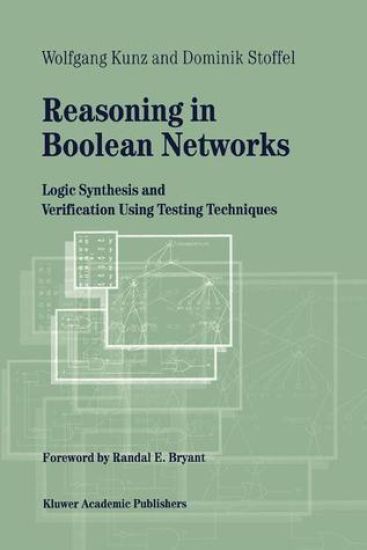
Reasoning in Boolean Networks

Reasoning in Boolean Networks

Wolfgang Kunz; Dominik Stoffel

Springer-Verlag New York Inc.
2010
nidottu
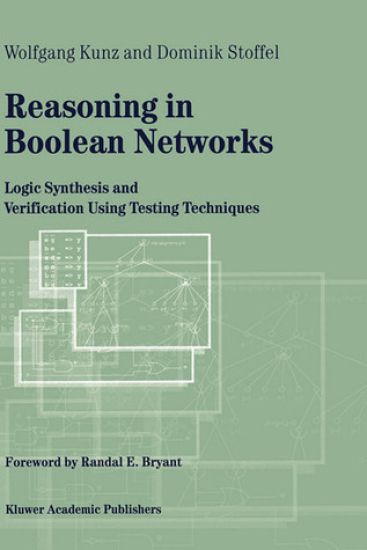
Reasoning in Boolean Networks provides a detailed treatment of recent research advances in algorithmic techniques for logic synthesis, test generation and formal verification of digital circuits. The book presents the central idea of approaching design automation problems for logic-level circuits by specific Boolean reasoning techniques. While Boolean reasoning techniques have been a central element of two-level circuit theory for many decades Reasoning in Boolean Networks describes a basic reasoning methodology for multi-level circuits. This leads to a unified view on two-level and multi-level logic synthesis. The presented reasoning techniques are applied to various CAD-problems to demonstrate their usefulness for today's industrially relevant problems. Reasoning in Boolean Networks provides lucid descriptions of basic algorithmic concepts in automatic test pattern generation, logic synthesis and verification and elaborates their intimate relationship to provide further intuition and insight into the subject. Numerous examples are provide for ease in understanding the material. Reasoning in Boolean Networks is intended for researchers in logic synthesis, VLSI testing and formal verification as well as for integrated circuit designers who want to enhance their understanding of basic CAD methodologies.
Reasoning in Boolean Networks

Reasoning in Boolean Networks

Wolfgang Kunz; Dominik Stoffel

Springer
1997
sidottu
Reasoning in Boolean Networks provides a detailed treatment of recent research advances in algorithmic techniques for logic synthesis, test generation and formal verification of digital circuits. The book presents the central idea of approaching design automation problems for logic-level circuits by specific Boolean reasoning techniques. While Boolean reasoning techniques have been a central element of two-level circuit theory for many decades Reasoning in Boolean Networks describes a basic reasoning methodology for multi-level circuits. This leads to a unified view on two-level and multi-level logic synthesis. The presented reasoning techniques are applied to various CAD-problems to demonstrate their usefulness for today's industrially relevant problems. Reasoning in Boolean Networks provides lucid descriptions of basic algorithmic concepts in automatic test pattern generation, logic synthesis and verification and elaborates their intimate relationship to provide further intuition and insight into the subject. Numerous examples are provide for ease in understanding the material. Reasoning in Boolean Networks is intended for researchers in logic synthesis, VLSI testing and formal verification as well as for integrated circuit designers who want to enhance their understanding of basic CAD methodologies.