

Kirjailija
Don Ross
Kirjat ja teokset yhdessä paikassa: 20 kirjaa, julkaisuja vuosilta 2004-2026, suosituimpien joukossa Gambling Animal. Vertaile teosten hintoja ja tarkista saatavuus suomalaisista kirjakaupoista.
20 kirjaa
Kirjojen julkaisuhaarukka 2004-2026.
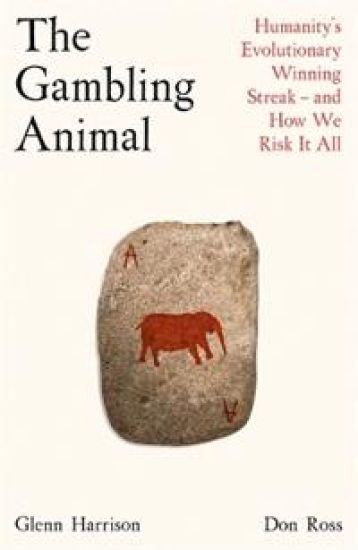

Humanity's unique relationship with risk has driven us to defy the evolutionary odds - but as the stakes keep mounting, how long will our winning streak continue?

Nutrition Essentials: Practical Applications
Dr. Paul Insel; Don Ross; Kimberley McMahon; Melissa Bernstein
JONES AND BARTLETT PUBLISHERS, INC
2022
nidottu
Perfect for the introductory, non-majors course, Nutrition Essentials: Practical Applications, equips students with the knowledge and know-how to navigate the wealth of health and nutritional information (an misinformation) available to them, and determine how to incorporate it into their everyday lives. Throughout the text, this acclaimed author team delivers current, science-based information in a format accessible to all students, while urging them to take responsibility for their nutrition, health, and overall well-being. With a wealth of teaching and learning tools incorporated throughout the text, Nutrition Essentials empowers readers to monitor, understand, and affect their own nutritional behaviors!
Nutrition
Dr. Paul Insel; Don Ross; Kimberley McMahon; Melissa Bernstein
JONES AND BARTLETT PUBLISHERS, INC
2022
nidottu
Written for major and advanced non-major course offerings, Nutrition, Seventh Edition provides students with a comprehensive, current, and science-based introduction to nutrition concepts, guidelines, and functions. It's student-focused approach provides information about topics and issues that concern them -- a balanced diet, nutritional supplements, weight management, exercise, and much more. Throughout each chapter readers will engage with the latest dietary guidelines, scientific evidence, and national standards to help individuals follow a healthy dietary pattern at every life stage.- Provides updated content reflects the Dietary Guidelines for Americans, 22 2 -2 25 released in December of 2 2 .- Includes updated Getting Personal features which encourage students to apply their nutritional knowledge to understanding their own diets.- Incorporates revised food source charts in the vitamins and minerals chapters which more clearly convey common sources for vitamins and minerals.- Includes revised statistics and data throughout that reflects the current state of nutrition in America and the world.- Provides the updated Position Statement from the Academy of Nutrition and Dietetics, the American Heart Association, and other organizations.- Includes new and updated FYI, Going Green, and Quick Bites features which provide in-depth discussions of controversial issues and topics for classroom discussion.
Discovering Nutrition
Paul Insel; Don Ross; Kimberley McMahon; Melissa Bernstein
Jones and Bartlett Publishers, Inc
2018
sidottu
Each new print copy includes Navigate 2 Advantage Access that unlocks a comprehensive and interactive eBook, animations, student practice activities and assessments, a full suite of instructor resources, and learning analytics reporting tools. Written with non-majors in mind, Discovering Nutrition, Sixth Edition introduces students to the fundamentals of nutrition with an engaging and personalized approach. The text focuses on teaching behavior change and personal decision making with an emphasis on how our nutritional behaviors influence lifelong personal health and wellness, while also presenting up-to-date scientific concepts in a number of innovative ways. Students will learn practical consumer-based nutrition information using the features highlighted throughout the text, including For Your Information boxes presenting controversial topics, Quick Bites offering fun facts, and the NEW feature Why Is This Important? opens each section and identifies the importance of each subject to the field. New & Key Features of the Sixth Edition: NEW - Why Is This Important? feature found within the margin of each section, describes the importance of each subject to the field and the general population in practical terms UPDATED - The Spotlight on Eating Disorders has been heavily revised and modernized to speak to today's students UPDATED - Revised to reflect the 2015-2020 Dietary Guidelines for Americans, as well as the new Nutrition Facts label introduced in May 2016. NEW - The new Getting Personal feature, found in the Learning Portfolio at the end of each chapter, encourages students to apply learned concepts to their own lives

Happy Hypnosis & the 12 Steps: An Easier, Softer Way for All 12 Step Programs
Don Ross
Createspace Independent Publishing Platform
2017
nidottu
The book describes in general terms the author's story, how he used hypnosis and the 12 Steps to recover from being a blackout drunk and suicidal on two antidepressant medications, to being clean and sober without medications, reasonably happy most of the time, with a private hypnosis practice and author of a best-selling book.The book includes: *free access to two recorded hypnosis sessions designed to soothe frazzled nerves.*seven scripts for hypnosis sessions that can be recorded by the reader to help themselves or others through the 12 Step recovery process."I've read to page 33, in the first reading Great book....get it published, this will help many people Thank you for sharing this with me I love it "Elizabeth Pett

Happy Hypnosis & The 12 Steps: An easier, softer way for all 12 step programs
Don Ross
Createspace Independent Publishing Platform
2017
nidottu

Nutrition
Paul Insel; Don Ross; Kimberley McMahon; Melissa Bernstein
Jones and Bartlett Publishers, Inc
2016
sidottu
Each new print copy includes Navigate 2 Advantage Access that unlocks a comprehensive and interactive eBook, animations, student practice activities and assessments, a full suite of instructor resources, and learning analytics reporting tools. Written for majors and advanced non-majors, the Sixth Edition of Nutrition provides a modern, comprehensive introduction to nutrition concepts, guidelines, and functions. Its student-focused approach provides readers with the knowledge they need to make informed decisions about their overall nutrition. New & Key Features: - NEW - This text is among the first to highlight the findings and recommendations put forth in the 2015 Dietary Guidelines for Americans - UPDATED - Going Green and FYI boxes incorporate the latest nutrition-related research and news - NEW - The new Getting Personal feature encourages students to apply concepts to their own lives - NEW - Animations within the Navigate 2 eBook help simplify difficult concepts
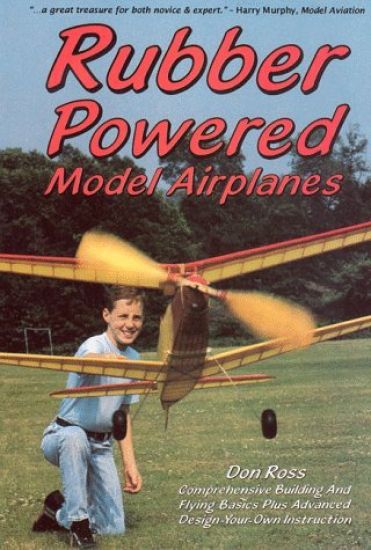
Rubber Powered Model Airplanes: Comprehensive Building & Flying Basics, Plus Advanced Design-Your-Own Instruction
Don Ross
Aeronautical Publishers
2016
nidottu
This comprehensive manual covers rubber powered model airplanes from a beginner's simple trainer through gradually more complex designs, including winning scale and duration fliers. Even if you've never built a model, the simple line drawings and detailed photos give you the tools and techniques to build light, sturdy models that will surprise and delight you with their sustained flights. Some Important Topics Covered Include... -Plans for two all-sheet balsa models that can be built in hours and are capable of flights exceeding one minute indoors or out. -Plans for stick and tissue models that gradually introduce the builder to more complex projects. -Many techniques that can be used to simplify construction, add strength, and reduce weight. -Propeller construction and design simplified so every novice can build and even design contest winning props. -The secrets of flight trimming as the experts do it. -Numerous ideas on how to add terrific scale details. -The ABC's of how to design your own models including Canards, Bi-planes, and Flying Wings. It's all here...the models, materials, and methods. Learn how to work with the various materials and adhesives and how to choose the right ones for every type of model. This book shows you the difference between kits and "scratch building," and how to modify any kit for better endurance and appearance. Don started building models in 1942. His designs have appeared in magazines and his "Fledgling" classes have added scores of young and "retread" modelers to the active scene. Don specializes in "synthesizing" difficult technical information into simple, straightforward how-to basics that make experts out of rank beginners. Rubber Powered Model Airplanes takes the "mystery" out of building successful free flight models. Whether you're thinking of building a kit, or considering an original design; whether you build for fun or competition...this book's for you "THE book I would recommend to anyone, of any age, starting out in free flight." -National Free Flight Digest "A tool to bring aeromodeling to the public." -Flying Models Magazine "Universal. Good value for the bookshelf." -Aero Modeller Magazine
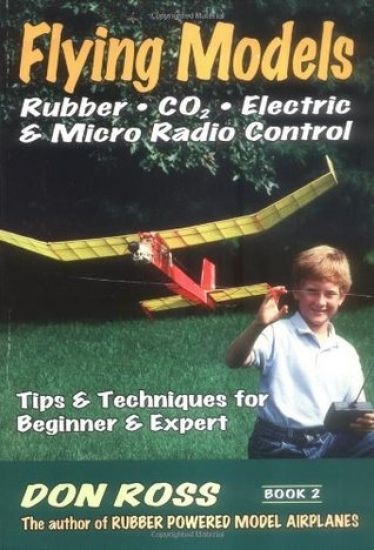
Flying Models: Rubber, CO2, Electric & Micro Radio Control: Tips & Techinques for Beginner & Expert
Don Ross
Aeronautical Publishers
2015
nidottu
This companion to Don Ross's immensely popular Rubber Powered Model Airplanes now opens the world of Electric Power, CO2, Micro R/C, and even Compressed Air, to beginner and expert alike. With explanations and graphics that break complex processes into simple steps, anyone can become a better than average builder, flyer, and competitor. This book will lead you from simple tools and techniques right through to state-of-the-art" materials that will enhance your model's appearance and increase its flight time 25-40% or more Some of the key topics covered include... -ELECTRIC POWER-Charging, Assembling, Adjusting, and Flight Trimming. Make an electric Power Module that can convert rubber power in minutes, right at the field. -EVOLVE from a simple 28-inch span rubber model through Competition Rubber, Free Flight Electric, and finally...Micro R/C. -NEW COVERING MATERIALS that are as light as tissue but much stronger, along with techniques that make them easier to apply. -NEW SCALE TECHNIQUES that can give your model that "professional" appearance so admired at contests. Make your own markings and decals and size and color. Create camouflage or lozenge patterns with plain tissue. -FOAM SHEET and block construction methods for scale models. -NEW RUBBER TORQUE AND TURNS formulas that need only two stokes on your calculator to predict rubber performance. -BUILD LIGHTER to reduce weight without reducing strength-a really simple way to get longer flights and stronger models. -LOST MODEL LOCATORS-what to buy-how they work. -GEARS-Do they help? A plan for Rubber Powered Contra-Rotating Props...AND MUCH, MUCH MORE
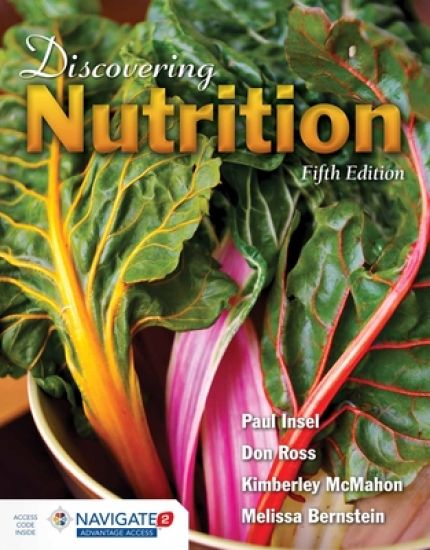
Discovering Nutrition
Paul Insel; Don Ross; Melissa Bernstein; Kimberley McMahon
Jones and Bartlett Publishers, Inc
2015
sidottu
Written for non-majors, Discovering Nutrition, Fifth Edition introduces students to the fundamentals of nutrition with an engaging and personalized approach. The text focuses on teaching behavioral change, personal decision making, and up-to-date scientific concepts in a number of innovative ways. Students will learn practical consumer-based nutrition information using the robust, interactive learning tools and study aids highlighted throughout the text. The Fifth Edition incorporates a new feature, Culture Corner, which introduces individuals within a variety of cultures, and discusses their nutritional customs and behaviors. It also examines the latest discoveries and dietary guidelines and empahsises how our nutritional behaviors influence lifelong personal health and wellness.

It is widely believed that economic development in much of the world is not happening quickly enough. Indeed, the standard of living in some parts of the world has actually been declining. Many experts now doubt that the solution can be purely technical and economic; it must also be political and moral.This book brings together contributions from leading authorities, such as Joseph Stiglitz, Jean-Jacques Laffont and Daniel Hausman, on economics and political philosophy to survey current barriers to growth, including problems with policy and problems with concepts and thinking. Getting policies right, the contributors stress, is a complicated task in itself, but it also may not be enough; instead, people in both the developed and developing worlds may also need to reconsider basic and time-worn beliefs about facts, values, the measurement of data, rights, needs and the nature of government.Of interest to economics and policy makers, Development Dilemmas is a long-awaited addition to the debate over economics and political philosophy in the developing world.


Every Thing Must Go
James Ladyman; Don Ross; David Spurrett; John Collier
Oxford University Press
2009
nidottu
Every Thing Must Go argues that the only kind of metaphysics that can contribute to objective knowledge is one based specifically on contemporary science as it really is, and not on philosophers' a priori intuitions, common sense, or simplifications of science. In addition to showing how recent metaphysics has drifted away from connection with all other serious scholarly inquiry as a result of not heeding this restriction, they demonstrate how to build a metaphysics compatible with current fundamental physics ('ontic structural realism'), which, when combined with their metaphysics of the special sciences ('rainforest realism'), can be used to unify physics with the other sciences without reducing these sciences to physics itself. Taking science metaphysically seriously, Ladyman and Ross argue, means that metaphysicians must abandon the picture of the world as composed of self-subsistent individual objects, and the paradigm of causation as the collision of such objects. Every Thing Must Go also assesses the role of information theory and complex systems theory in attempts to explain the relationship between the special sciences and physics, treading a middle road between the grand synthesis of thermodynamics and information, and eliminativism about information. The consequences of the author's metaphysical theory for central issues in the philosophy of science are explored, including the implications for the realism vs. empiricism debate, the role of causation in scientific explanations, the nature of causation and laws, the status of abstract and virtual objects, and the objective reality of natural kinds.

Every Thing Must Go argues that the only kind of metaphysics that can contribute to objective knowledge is one based specifically on contemporary science as it really is, and not on philosophers' a priori intuitions, common sense, or simplifications of science. In addition to showing how recent metaphysics has drifted away from connection with all other serious scholarly inquiry as a result of not heeding this restriction, they demonstrate how to build a metaphysics compatible with current fundamental physics ('ontic structural realism'), which, when combined with their metaphysics of the special sciences ('rainforest realism'), can be used to unify physics with the other sciences without reducing these sciences to physics itself. Taking science metaphysically seriously, Ladyman and Ross argue, means that metaphysicians must abandon the picture of the world as composed of self-subsistent individual objects, and the paradigm of causation as the collision of such objects. Everything Must Go also assesses the role of information theory and complex systems theory in attempts to explain the relationship between the special sciences and physics, treading a middle road between the grand synthesis of thermodynamics and information, and eliminativism about information. The consequences of the author's metaphysical theory for central issues in the philosophy of science are explored, including the implications for the realism vs. empiricism debate, the role of causation in scientific explanations, the nature of causation and laws, the status of abstract and virtual objects, and the objective reality of natural kinds.

In this study, Don Ross explores the relationship of economics to other branches of behavioral science, asking, in the course of his analysis, under what interpretation economics is a sound empirical science. The book explores the relationships between economic theory and the theoretical foundations of related disciplines that are relevant to the day-to-day work of economics-the cognitive and behavioral sciences. It asks whether the increasingly sophisticated techniques of microeconomic analysis have revealed any deep empirical regularities-whether technical improvement represents improvement in any other sense. Casting Daniel Dennett and Kenneth Binmore as its intellectual heroes, the book proposes a comprehensive model of economic theory that, Ross argues, does not supplant, but recovers the core neoclassical insights, and counters the caricaturish conception of neoclassicism so derided by advocates of behavioral or evolutionary economics.Because he approaches his topic from the viewpoint of the philosophy of science, Ross devotes one chapter to the philosophical theory and terminology on which his argument depends and another to related philosophical issues. Two chapters provide the theoretical background in economics, one covering developments in neoclassical microeconomics and the other treating behavioral and experimental economics and evolutionary game theory. The three chapters at the heart of the argument then apply theses from the philosophy of cognitive science to foundational problems for economic theory. In these chapters, economists will find a genuinely new way of thinking about the implications of cognitive science for economics, and cognitive scientists will find in economic behavior, a new testing site for the explanations of cognitive science.

It is widely believed that economic development in much of the world is not happening quickly enough. Indeed, the standard of living in some parts of the world has actually been declining. Many experts now doubt that the solution can be purely technical and economic; it must also be political and moral.This book brings together contributions from leading authorities, such as Joseph Stiglitz, Jean-Jacques Laffont and Daniel Hausman, on economics and political philosophy to survey current barriers to growth, including problems with policy and problems with concepts and thinking. Getting policies right, the contributors stress, is a complicated task in itself, but it also may not be enough; instead, people in both the developed and developing worlds may also need to reconsider basic and time-worn beliefs about facts, values, the measurement of data, rights, needs and the nature of government.Of interest to economics and policy makers, Development Dilemmas is a long-awaited addition to the debate over economics and political philosophy in the developing world.