Kirjojen hintavertailu. Mukana 12 290 406 kirjaa ja 12 kauppaa.

Kirjailija

Donal O'Shea

Kirjat ja teokset yhdessä paikassa: 6 kirjaa, julkaisuja vuosilta 2005-2025, suosituimpien joukossa Ideals, Varieties, and Algorithms. Vertaile teosten hintoja ja tarkista saatavuus suomalaisista kirjakaupoista.

6 kirjaa

Kirjojen julkaisuhaarukka 2005-2025.

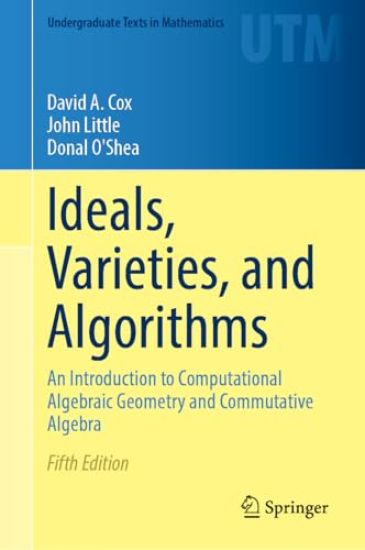
Ideals, Varieties, and Algorithms

Ideals, Varieties, and Algorithms

David A. Cox; John Little; Donal O'Shea

Springer International Publishing AG
2025
sidottu
This text covers topics in algebraic geometry and commutative algebra with careful attention to their practical and computational aspects. The first four chapters form the core of the book. A comprehensive chart in the Preface illustrates a variety of ways to proceed with the material once these chapters are covered. In addition to the fundamentals of algebraic geometry—the elimination theorem, the extension theorem, the closure theorem and the Nullstellensatz—there are chapters on polynomial and rational functions between varieties, robotics and geometric theorem proving, invariant theory of finite groups, projective algebraic geometry, dimension theory, and progress made over the last decades in computing Gröbner bases. The fifth edition builds on the fourth edition in two main ways. First, a number of typographical errors, found by readers and by the authors since 2018, have been corrected. Second, new material on toric varieties, monomial curves, and other topics of current interest in algebraic geometry has been added. This enhances the opportunities for active learning through new examples, new exercises, and new projects in Appendix D, all supplemented by additional references. The book also includes updated computer algebra material in Appendix C. The book may be used for a first or second course in undergraduate abstract algebra and, with some augmentation perhaps, for beginning graduate courses in algebraic geometry or computational commutative algebra. Prerequisites for the reader include linear algebra and a proof-oriented course. It is assumed that the reader has access to a computer algebra system. Appendix C describes features of Maple™, Mathematica® and SageMath, as well as other systems that are most relevant to the text. Pseudocode is used in the text; Appendix B carefully describes the pseudocode used. From the reviews of previous editions: “…The book gives an introduction to Buchberger’s algorithm with applications to syzygies, Hilbert polynomials, primary decompositions. There is an introduction to classical algebraic geometry with applications to the ideal membership problem, solving polynomial equations and elimination theory. …The book is well-written. …The reviewer is sure that it will be an excellent guide to introduce further undergraduates in the algorithmic aspect of commutative algebra and algebraic geometry.” —Peter Schenzel, zbMATH, 2007 “I consider the book to be wonderful. … The exposition is very clear, there are many helpful pictures and there are a great many instructive exercises, some quite challenging … offers the heart and soul of modern commutative and algebraic geometry.” —The American Mathematical Monthly
Ideals, Varieties, and Algorithms

Ideals, Varieties, and Algorithms

David A. Cox; John Little; Donal O'Shea

Springer International Publishing AG
2016
nidottu
This text covers topics in algebraic geometry and commutative algebra with a strong perspective toward practical and computational aspects. The first four chapters form the core of the book. A comprehensive chart in the Preface illustrates a variety of ways to proceed with the material once these chapters are covered. In addition to the fundamentals of algebraic geometry—the elimination theorem, the extension theorem, the closure theorem and the Nullstellensatz—this new edition incorporates several substantial changes, all of which are listed in the Preface. The largest revision incorporates a new Chapter (ten), which presents some of the essentials of progress made over the last decades in computing Gröbner bases. The book also includes current computer algebra material in Appendix C and updated independent projects (Appendix D).The book may serve as a first or second course in undergraduate abstract algebra and with some supplementation perhaps, for beginning graduate levelcourses in algebraic geometry or computational algebra. Prerequisites for the reader include linear algebra and a proof-oriented course. It is assumed that the reader has access to a computer algebra system. Appendix C describes features of Maple™, Mathematica® and Sage, as well as other systems that are most relevant to the text. Pseudocode is used in the text; Appendix B carefully describes the pseudocode used.Readers who are teaching from Ideals, Varieties, and Algorithms, or are studying the book on their own, may obtain a copy of the solutions manual by sending an email to [email protected] the reviews of previous editions: “…The book gives an introduction to Buchberger’s algorithm with applications to syzygies, Hilbert polynomials, primary decompositions. There is an introduction to classical algebraic geometry with applications to the ideal membership problem, solving polynomial equations and elimination theory. …The book is well-written. …The reviewer is sure that it will be an excellent guide to introduce further undergraduates in the algorithmic aspect of commutative algebra and algebraic geometry.” —Peter Schenzel, zbMATH, 2007 “I consider the book to be wonderful. ... The exposition is very clear, there are many helpful pictures and there are a great many instructive exercises, some quite challenging ... offers the heart and soul of modern commutative and algebraic geometry.” —The American Mathematical Monthly
Ideals, Varieties, and Algorithms

Ideals, Varieties, and Algorithms

David A. Cox; John Little; Donal O'Shea

Springer International Publishing AG
2015
sidottu
This text covers topics in algebraic geometry and commutative algebra with a strong perspective toward practical and computational aspects. The first four chapters form the core of the book. A comprehensive chart in the Preface illustrates a variety of ways to proceed with the material once these chapters are covered. In addition to the fundamentals of algebraic geometry—the elimination theorem, the extension theorem, the closure theorem and the Nullstellensatz—this new edition incorporates several substantial changes, all of which are listed in the Preface. The largest revision incorporates a new Chapter (ten), which presents some of the essentials of progress made over the last decades in computing Gröbner bases. The book also includes current computer algebra material in Appendix C and updated independent projects (Appendix D).The book may serve as a first or second course in undergraduate abstract algebra and with some supplementation perhaps, for beginning graduate levelcourses in algebraic geometry or computational algebra. Prerequisites for the reader include linear algebra and a proof-oriented course. It is assumed that the reader has access to a computer algebra system. Appendix C describes features of Maple™, Mathematica® and Sage, as well as other systems that are most relevant to the text. Pseudocode is used in the text; Appendix B carefully describes the pseudocode used.Readers who are teaching from Ideals, Varieties, and Algorithms, or are studying the book on their own, may obtain a copy of the solutions manual by sending an email to [email protected] the reviews of previous editions: “…The book gives an introduction to Buchberger’s algorithm with applications to syzygies, Hilbert polynomials, primary decompositions. There is an introduction to classical algebraic geometry with applications to the ideal membership problem, solving polynomial equations and elimination theory. …The book is well-written. …The reviewer is sure that it will be an excellent guide to introduce further undergraduates in the algorithmic aspect of commutative algebra and algebraic geometry.” —Peter Schenzel, zbMATH, 2007 “I consider the book to be wonderful. ... The exposition is very clear, there are many helpful pictures and there are a great many instructive exercises, some quite challenging ... offers the heart and soul of modern commutative and algebraic geometry.” —The American Mathematical Monthly

Poincaren konjektuuri

Poincaren konjektuuri

Donal O'Shea

Terra Cognita
2012
nidottu
Henri Poincare esitti maailmankaikkeuden rakennetta koskevan oletuksensa vuonna 1904 ja sitä pidettiin yhtenä matematiikan tärkeimmistä ratkaimattomista ongelmista 2000-öuvun alkuun saakka, jolloin nuori venäläinen matemaatikko Grigori Perelman todisti sen.Matematiikan professori Donal O'Shea esittelee tässä teoksessa sekä Poincaren konjektuurin että sitä tutkineiden matemaatikoiden persoonallisuudet, myös Perelmanin, joka kieltaytyi työstään myönnetystä Fieldsin mitalista, matemaatikoiden suurimmasta kunnianosoituksesta.
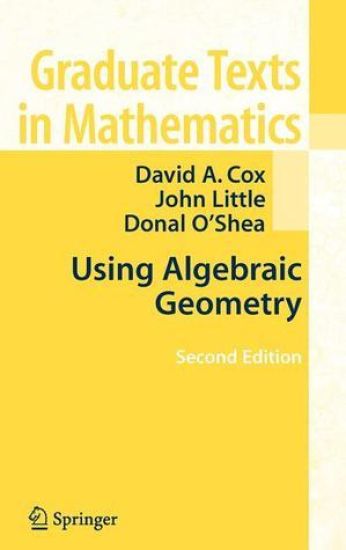
Using Algebraic Geometry

Using Algebraic Geometry

David A. Cox; John Little; Donal O'Shea

Springer-Verlag New York Inc.
2005
nidottu
In recent years, the discovery of new algorithms for dealing with polynomial equations, coupled with their implementation on fast inexpensive computers, has sparked a minor revolution in the study and practice of algebraic geometry. These algorithmic methods have also given rise to some exciting new applications of algebraic geometry. This book illustrates the many uses of algebraic geometry, highlighting some of the more recent applications of Gröbner bases and resultants. In order to do this, the authors provide an introduction to some algebraic objects and techniques which are more advanced than one typically encounters in a first course, but nonetheless of great utility. The book is written for nonspecialists and for readers with a diverse range of backgrounds. It assumes knowledge of the material covered in a standard undergraduate course in abstract algebra, and it would help to have some previous exposure to Gröbner bases. The book does not assume the reader is familiar with more advanced concepts such as modules. For this new edition the authors added two new sections and a new chapter, updated the references and made numerous minor improvements throughout the text.
Using Algebraic Geometry

Using Algebraic Geometry

David A. Cox; John Little; Donal O'Shea

Springer-Verlag New York Inc.
2005
sidottu
In recent years, the discovery of new algorithms for dealing with polynomial equations, coupled with their implementation on fast inexpensive computers, has sparked a minor revolution in the study and practice of algebraic geometry. These algorithmic methods have also given rise to some exciting new applications of algebraic geometry. This book illustrates the many uses of algebraic geometry, highlighting some of the more recent applications of Gröbner bases and resultants. In order to do this, the authors provide an introduction to some algebraic objects and techniques which are more advanced than one typically encounters in a first course, but nonetheless of great utility. The book is written for nonspecialists and for readers with a diverse range of backgrounds. It assumes knowledge of the material covered in a standard undergraduate course in abstract algebra, and it would help to have some previous exposure to Gröbner bases. The book does not assume the reader is familiar with more advanced concepts such as modules. For this new edition the authors added two new sections and a new chapter, updated the references and made numerous minor improvements throughout the text.