Kirjojen hintavertailu. Mukana 12 390 323 kirjaa ja 12 kauppaa.
Kirjailija
Donald B. Rubin
Kirjat ja teokset yhdessä paikassa: 9 kirjaa, julkaisuja vuosilta 1999-2026, suosituimpien joukossa Introduction to Modern Randomization-Based Design and Analysis for Causal Inference. Vertaile teosten hintoja ja tarkista saatavuus suomalaisista kirjakaupoista.
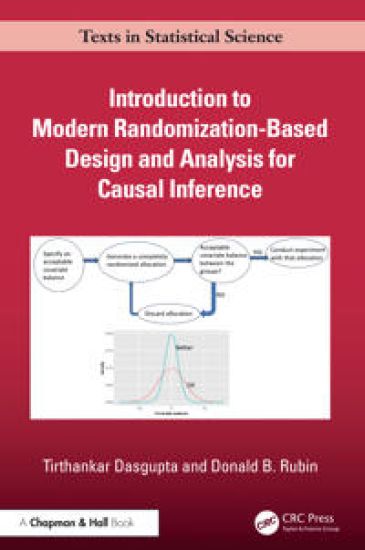
Design of experiments is, in essence, a disciplined way to learn about cause and effect. Modern experiments can involve a few to millions of units and hundreds or thousands of covariates. These settings demand tools that are flexible, transparent, and faithful to the underlying design in order reach reliable conclusions about which interventions work and which ones do not. This book provides a modern, accessible, and computationally supported introduction to experimental design grounded firmly in randomization and the formulation of ideas and methods in terms of potential outcomes. Instead of prescribing a model for each design, we begin with the treatment assignment mechanism and link it directly to the observed outcomes through the potential outcomes framework. This formulation illuminates how changing the design changes the analysis, and it naturally distinguishes finite-population inference from super-population modeling. The book also incorporates new developments at the interface of causal inference and experimental design, many stemming from the authors’ recent collaborative research efforts. Key Features: Strengthens the link between design and analysis, enabling students to see immediately how the structure of an experiment shapes the exact tools used to analyze it. Teaches foundational concepts without assuming linear-model assumptions. Equips readers with the tools needed to analyze non-standard and complex experiments, whose randomization mechanisms fall outside the scope of traditional textbooks. Support students with limited programming experience by providing algorithms and code throughout the book, enabling them to implement randomization-based methods easily and efficiently. This book is a textbook for one/two semester course on introductory experimental design.
An up-to-date, comprehensive treatment of a classic text on missing data in statisticsThe topic of missing data has gained considerable attention in recent decades. This new edition by two acknowledged experts on the subject offers an up-to-date account of practical methodology for handling missing data problems. Blending theory and application, authors Roderick Little and Donald Rubin review historical approaches to the subject and describe simple methods for multivariate analysis with missing values. They then provide a coherent theory for analysis of problems based on likelihoods derived from statistical models for the data and the missing data mechanism, and then they apply the theory to a wide range of important missing data problems.Statistical Analysis with Missing Data, Third Edition starts by introducing readers to the subject and approaches toward solving it. It looks at the patterns and mechanisms that create the missing data, as well as a taxonomy of missing data. It then goes on to examine missing data in experiments, before discussing complete-case and available-case analysis, including weighting methods. The new edition expands its coverage to include recent work on topics such as nonresponse in sample surveys, causal inference, diagnostic methods, and sensitivity analysis, among a host of other topics. An updated “classic” written by renowned authorities on the subjectFeatures over 150 exercises (including many new ones)Covers recent work on important methods like multiple imputation, robust alternatives to weighting, and Bayesian methodsRevises previous topics based on past student feedback and class experienceContains an updated and expanded bibliography The authors were awarded The Karl Pearson Prize in 2017 by the International Statistical Institute, for a research contribution that has had profound influence on statistical theory, methodology or applications. Their work "has been no less than defining and transforming." (ISI)Statistical Analysis with Missing Data, Third Edition is an ideal textbook for upper undergraduate and/or beginning graduate level students of the subject. It is also an excellent source of information for applied statisticians and practitioners in government and industry.
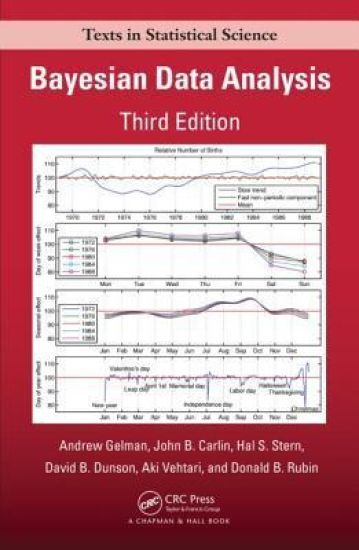
Winner of the 2016 De Groot Prize from the International Society for Bayesian AnalysisNow in its third edition, this classic book is widely considered the leading text on Bayesian methods, lauded for its accessible, practical approach to analyzing data and solving research problems. Bayesian Data Analysis, Third Edition continues to take an applied approach to analysis using up-to-date Bayesian methods. The authors—all leaders in the statistics community—introduce basic concepts from a data-analytic perspective before presenting advanced methods. Throughout the text, numerous worked examples drawn from real applications and research emphasize the use of Bayesian inference in practice.New to the Third Edition Four new chapters on nonparametric modelingCoverage of weakly informative priors and boundary-avoiding priorsUpdated discussion of cross-validation and predictive information criteriaImproved convergence monitoring and effective sample size calculations for iterative simulationPresentations of Hamiltonian Monte Carlo, variational Bayes, and expectation propagationNew and revised software codeThe book can be used in three different ways. For undergraduate students, it introduces Bayesian inference starting from first principles. For graduate students, the text presents effective current approaches to Bayesian modeling and computation in statistics and related fields. For researchers, it provides an assortment of Bayesian methods in applied statistics. Additional materials, including data sets used in the examples, solutions to selected exercises, and software instructions, are available on the book’s web page.
"It is a book for manufacturing companies that are fighting desperately for survival and that will go to any length to improve their factories and overcome the obstacles to success. One could even call this book a ‘bible’ for corporate survival."—Hiroyuki Hirano Known as the JIT bible in Japan, JIT Implementation Manual — The Complete Guide to Just-in-Time Manufacturing presents the genius of Hiroyuki Hirano, a top international consultant with vast experience throughout Asia and the West. Encyclopedic in scope, this six-volume practical reference provides unparalleled information on every aspect of JIT— the waste-eliminating, market-oriented production system. This historic, yet timeless classic is just as crucial in today’s fast-changing global marketplace as when it was first published in Japan 20 years ago.Volume 4: Leveling — Changeover and Quality Assurance provides essential background on the core concept of level production in a JIT, or lean, manufacturing system and the implementation techniques. It also discusses changeover and the rules and procedures for changeover improvement and covers quality assurance in the context of level production, including how to recognize structures that create defects, plan for achieving zero defects, and make use of mistake-proofing devices.
Matched sampling is often used to help assess the causal effect of some exposure or intervention, typically when randomized experiments are not available or cannot be conducted. This book presents a selection of Donald B. Rubin's research articles on matched sampling, from the early 1970s, when the author was one of the major researchers involved in establishing the field, to recent contributions to this now extremely active area. The articles include fundamental theoretical studies that have become classics, important extensions, and real applications that range from breast cancer treatments to tobacco litigation to studies of criminal tendencies. They are organized into seven parts, each with an introduction by the author that provides historical and personal context and discusses the relevance of the work today. A concluding essay offers advice to investigators designing observational studies. The book provides an accessible introduction to the study of matched sampling and will be an indispensable reference for students and researchers.
The Wiley Classics Library consists of selected books that have become recognized classics in their respective fields. With these new unabridged and inexpensive editions, Wiley hopes to extend the life of these important works by making them available to future generations of mathematicians and scientists.
Contrasts are statistical procedures for asking focused questions of data. Compared to diffuse or omnibus questions, focused questions are characterized by greater conceptual clarity and greater statistical power when examining those focused questions. If an effect truly exists, we are more likely to discover it and to believe it to be real when asking focused questions rather than omnibus ones. Researchers, teachers of research methods and graduate students will be familiar with the principles and procedures of contrast analysis, but will also be introduced to a series of newly developed concepts, measures, and indices that permit a wider and more useful application of contrast analysis. This volume takes on this new approach by introducing a family of correlational effect size estimates.