Kirjojen hintavertailu. Mukana 12 595 353 kirjaa ja 12 kauppaa.

Kirjailija

Donald E. Pease

Kirjat ja teokset yhdessä paikassa: 6 kirjaa, julkaisuja vuosilta 1987-2016, suosituimpien joukossa Theodor Geisel. Vertaile teosten hintoja ja tarkista saatavuus suomalaisista kirjakaupoista.

6 kirjaa

Kirjojen julkaisuhaarukka 1987-2016.

Theodor Geisel

Theodor Geisel

Donald E. Pease

Oxford University Press Inc
2016
nidottu
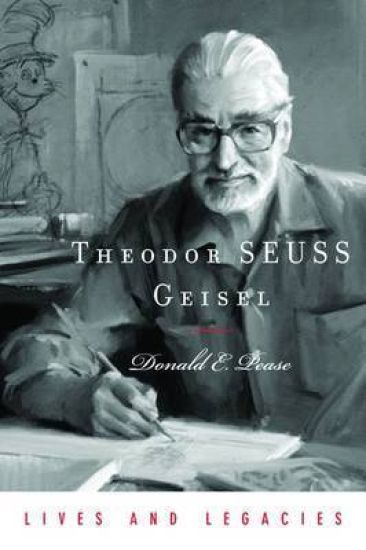
Dr. Seuss's infectious rhymes, fanciful creatures, and roundabout plots not only changed the way children read but imagined the world. And to Think That I Saw It On Mulberry Street, Green Eggs and Ham,The Cat and the Hat, these and other classics have sold hundreds of millions of copies and entertained children and adults for decades. After graduating from Dartmouth, Theodor Geisel used his talents as an ad-man, political provocateur, and social satirist, gradually but irrevocably turning to children's books. Theodor SEUSS Geisel tells the unlikely story of this remarkable transformation. In this compact and engrossing biography, Donald Pease reveals the evolution of Dr. Seuss's creative persona while offering an honest appraisal of his life. The book also features many of Dr. Seuss's lesser-known illustrations, including college drawings, insecticide ads, and wartime political cartoons-all of which offer a glimpse of his early artistic style and the visual origins of the more famous creatures that later populated his children's books. As Pease traces the full arc of Dr. Seuss's prolific career, he combines close textual readings of many of Dr. Seuss's works with a unique look at their genesis to shed new light on the enduring legacy of America's favorite children's book author.
Theodor SEUSS Geisel

Theodor SEUSS Geisel

Donald E. Pease

Oxford University Press Inc
2010
sidottu
Dr. Seuss' infectious rhymes, his blue-tufted, strong-willed creatures, and his knack for pithy, roundabout plots have been entertaining children and adults for decades. And as Donald Pease shows in this marvelous biography, the seemingly haphazard trajectory of Theodor Geisel's life bears a close resemblance to the zigzag plot lines of his children's books. Here is an engaging look at a man who indeed lived a zigzag life, by turns a cartoonist, ad agency artist (for Flit bug killer), author, caricaturist, documentary-film writer and producer, political cartoonist, and editor. Pease follows Geisel's life from his childhood in Massachusetts, to his sacking from the editorship of Dartmouth's humor magazine, to the publication of And to Think That I Saw It on Mulberry Street--after 17 rejections--which finally launched him on the career for which he is best known. It was a career marked by whimsy. Geisel began work on Green Eggs and Ham, for instance, only after Bennett Cerf, his editor at Random House, wagered that he could not write a children's book that used no more than fifty different words. Geisel won, and the result was a series of works over the next ten years--How the Grinch Stole Christmas!, Yertle the Turtle, The Sneetches and Other Stories, Hop on Pop--that changed the way children everywhere learned to read. Given unprecedented access to Dartmouth's extensive Geisel holdings, Pease captures this life in full as he offers fresh insights into the sources of Geisel's creativity, from his surreal images to his anti-authoritarian stance and slapstick humor. Readers are treated to many lesser-known illustrations, such as his censored creations during college, insecticide ads, and wartime political cartoons--all of which offer a glimpse of his early artistic style and the visual origins of the more famous creatures that later populated his children's books.
Redeemer Nation in the Interregnum

Redeemer Nation in the Interregnum

William V. Spanos; Donald E. Pease

Fordham University Press
2016
pokkari
Redeemer Nation in the Interregnum interrogates the polyvalent role that American exceptionalism continues to play after 9/11. Whereas American exceptionalism is often construed as a discredited Cold War–era belief structure, Spanos persuasively demonstrates how it operationalizes an apparatus of biopolitical capture that saturates the American body politic down to its capillaries. The exceptionalism that Redeemer Nation in the Interregnum renders starkly visible is not a corrigible ideological screen. It is a deeply structured ethos that functions simultaneously on ontological, moral, economic, racial, gendered, and political registers as the American Calling. Precisely by refusing to answer the American Calling, by rendering inoperative (in Agamben's sense) its covenantal summons, Spanos enables us to imagine an alternative America. At once timely and personal, Spanos's meditation acknowledges the priority of being. He emphasizes the dignity not simply of humanity but of all phenomena on the continuum of being, "the groundless ground of any political formation that would claim the name of democracy."
The New American Exceptionalism

The New American Exceptionalism

Donald E. Pease

University of Minnesota Press
2009
nidottu
For a half century following the end of World War II, the seemingly permanent cold war provided the United States with an organizing logic that governed nearly every aspect of American society and culture, giving rise to an unwavering belief in the nation's exceptionalism in global affairs and world history. After the collapse of the Soviet Union, this cold war paradigm was replaced by a series of new ideological narratives that ultimately resulted in the establishment of another potentially endless war: the global war on terror.In The New American Exceptionalism, pioneering scholar Donald E. Pease traces the evolution of these state fantasies and shows how they have shaped U.S. national identity since the end of the cold war, uncovering the ideological and cultural work required to convince Americans to surrender their civil liberties in exchange for the illusion of security. His argument follows the chronology of the transitions between paradigms from the inauguration of the New World Order under George H. W. Bush to the homeland security state that George W. Bush's administration installed in the wake of 9/11. Providing clear and convincing arguments about how the concept of American exceptionalism was reformulated and redeployed in this era, Pease examines a wide range of cultural works and political spectacles, including the exorcism of the Vietnam syndrome through victory in the Persian Gulf War and the creation of Islamic extremism as an official state enemy.At the same time, Pease notes that state fantasies cannot altogether conceal the inconsistencies they mask, showing how such events as the revelations of prisoner abuse at Abu Ghraib and the exposure of government incompetence after Hurricane Katrina opened fissures in the myth of exceptionalism, allowing Barack Obama to challenge the homeland security paradigm with an alternative state fantasy that privileges fairness, inclusion, and justice.
Redeemer Nation in the Interregnum

Redeemer Nation in the Interregnum

William V. Spanos; Donald E. Pease

Fordham University Press
2016
sidottu
Redeemer Nation in the Interregnum interrogates the polyvalent role that American exceptionalism continues to play after 9/11. Whereas American exceptionalism is often construed as a discredited Cold War–era belief structure, Spanos persuasively demonstrates how it operationalizes an apparatus of biopolitical capture that saturates the American body politic down to its capillaries. The exceptionalism that Redeemer Nation in the Interregnum renders starkly visible is not a corrigible ideological screen. It is a deeply structured ethos that functions simultaneously on ontological, moral, economic, racial, gendered, and political registers as the American Calling. Precisely by refusing to answer the American Calling, by rendering inoperative (in Agamben's sense) its covenantal summons, Spanos enables us to imagine an alternative America. At once timely and personal, Spanos's meditation acknowledges the priority of being. He emphasizes the dignity not simply of humanity but of all phenomena on the continuum of being, "the groundless ground of any political formation that would claim the name of democracy."