Kirjojen hintavertailu. Mukana 12 595 353 kirjaa ja 12 kauppaa.

Kirjailija

Donald Grier Stephenson

Kirjat ja teokset yhdessä paikassa: 4 kirjaa, julkaisuja vuosilta 1991-2011, suosituimpien joukossa American Constitutional Law. Vertaile teosten hintoja ja tarkista saatavuus suomalaisista kirjakaupoista.

4 kirjaa

Kirjojen julkaisuhaarukka 1991-2011.

American Constitutional Law

American Constitutional Law

Alpheus Thomas Mason; Donald Grier Stephenson

Routledge Member of the Taylor and Francis Group
2011
nidottu
Updated in its 16th edition, American Constitutional Law: Introductory Essays and Selected Cases is a classic collection of carefully selected and edited Supreme Court case excerpts and comprehensive background essays that explores constitutional law and the role of the Supreme Court in its development and interpretation. Well-grounded in both theory and politics, it endeavors to heighten understanding of and interest in these critical areas of our governmental system.
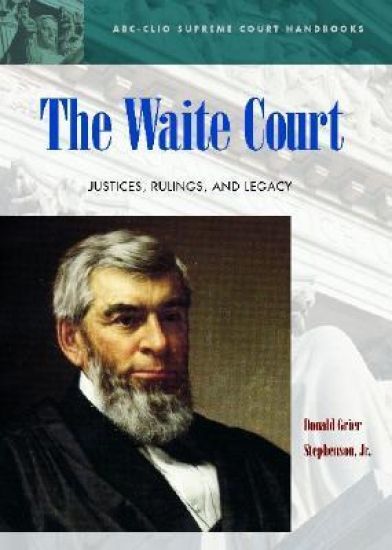
The Waite Court

The Waite Court

Donald Grier Stephenson

ABC-CLIO
2003
sidottu
An extensive exploration of the major decisions and personalities of the Supreme Court during the 14-year tenure of Chief Justice Morrison Remick Waite.The Waite Court: Justices, Rulings, and Legacy presents a fresh interpretation of the Supreme Court under the tenure of Chief Justice Morrison Remick Waite (1874–1888). An in-depth analysis of key decisions demonstrates how the Waite Court confronted such profound issues as the post-Civil War rights of African Americans and state regulations intended to cope with rampant industrialization.Highlighting the Court's most famous decision, Munn v. Illinois, which upheld legislation regulating railroad and grain elevator rates, this careful analysis also reviews the Court's unique involvement in the 1876 presidential election electoral predicament. Profiles of the 15 justices who served on the Waite Court include extensive descriptions of the five that rank among the most outstanding justices ever to serve on the Supreme Court.A–Z entries on key people, laws, cases, events, and concepts that were relevant during the Waite Court era, including the growing volume of state economic regulations enacted to cope with industrial expansion and urban growth fueled by the Civil War and by a nationwide rail network for people and goodsAn appendix including a timeline of important events for the years 1865 through 1890, plus excerpts from other important source materials, such as landmark decisions of the Waite Court
An Essential Safeguard

An Essential Safeguard

Donald Grier Stephenson

Praeger Publishers Inc
1991
sidottu
This timely collection examines the record of current and recent justices in fashioning the Constitution and looks at the larger political context in which their work has occurred. The eight essays, written by distinguished scholars of the Supreme Court, review the achievements of current Justices O'Connor and Rehnquist as well as recent justices Douglas, Black, and Harlan. The essay on Justice O'Connor is one of the first overall assessments of her record to appear in print. Editor D. Grier Stephenson, Jr.'s introductory chapter presents an insightful overview of the Supreme Court's role in American government today. Collectively these chapters make a rich contribution to an understanding of constitutional government and render a complex subject both accessible to general readers and interesting to experts.Following editor Stephenson's cogent introduction, Henry Abraham's Can Presidents Really Pack the Supreme Court? focuses on the political and intellectual environments within which the Supreme Court functions and on the candidates selected by presidents to sit on the High Bench. In Chapter Three, former solicitor general Rex E. Lee zeroes on a central aspect of, and a key player in, the judicial process. Leadership and the relationships among the justices are the subject of Chapter Four. Harold J. Spaeth's essay on Justice Sandra Day O'Connor emphasizes personality as an element contributing to the Court's decisions. The legacy of Justice William O. Douglas and the impact of the Court's past on its present decisions are both examined by Walter Murphy. Similarly, the next chapter's study of Justice John Marshall Harlan shows the importance of the Constitutional legacy in understanding the Supreme Court. Affirmative Action and the Supreme Court reviews the responses of current members of the Court to one of the most divisive and significant policy questions of our time. The concluding essay surveys Chief Justice Rehnquist and the Future of the Supreme Court. This volume is important reading for students of law, history, and political science.