Kirjojen hintavertailu. Mukana 12 390 323 kirjaa ja 12 kauppaa.

Kirjailija

Donald Harman Akenson

Kirjat ja teokset yhdessä paikassa: 9 kirjaa, julkaisuja vuosilta 1991-2026, suosituimpien joukossa Saint Saul: A Skeleton Key to the Historical Jesus. Vertaile teosten hintoja ja tarkista saatavuus suomalaisista kirjakaupoista.

9 kirjaa

Kirjojen julkaisuhaarukka 1991-2026.

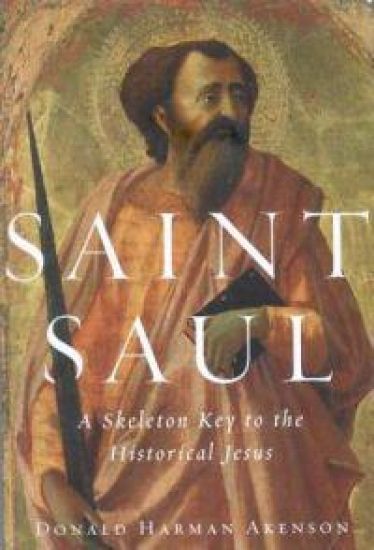
Saint Saul: A Skeleton Key to the Historical Jesus

Saint Saul: A Skeleton Key to the Historical Jesus

Donald Akenson; Donald Harman Akenson; Don Akenson

CARLETON UNIVERSITY PRESS
2000
sidottu
In this follow-up to his acclaimed Surpassing Wonder, Akenson recreates the world of Christ, a time rich with ideas, prophets, factions, priests, savants, and god-drunk fanatics. Saint Saul sheds light on Yeshua's birth and his relationship to his family, clarifies Yeshua's views on issues such as divorce and resurrection, and examines his sense of himself as Messiah. Throughout Saint Saul Akenson insistently stresses the Jewishness of Yeshua. He dismisses the traditional way of searching for facts about him by looking for parallels among the four gospels, arguing that the gospels were handed down as a unit by a later generation. In contrast Saul, although he did not know Yeshua personally, knew his most important followers and wrote immediately after his death. Saul's teachings were approved, though sometimes reluctantly, by Yeshua's brothers and other early leaders. Akenson sifts and probes the evidence for and against the historical status of Saul and Yeshua, a mystery as fascinating as a good detective story and one where readers must come to their own conclusions about the circumstances and texts that gave rise to two great world-faiths, Christianity and Rabbinic Judaism.
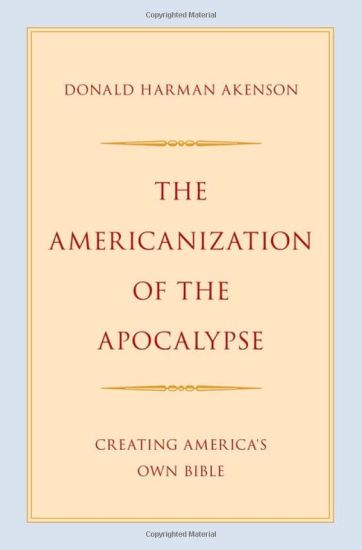
The Americanization of the Apocalypse

The Americanization of the Apocalypse

Donald Harman Akenson

OXFORD UNIVERSITY PRESS INC
2026
nidottu
In the early twentieth century, a new, American scripture appeared on the scene. It was the product of a school of theological thinking known as Dispensationalism, which offered a striking new way of reading the Bible, one that focused attention squarely on the end-times. That scripture, The Scofield Reference Bible, would become the ur-text of American apocalyptic evangelicalism, and later, a core text of America's white Christian nationalism. In The Americanization of the Apocalypse: Creating America's Own Bible Donald Harman Akenson examines the creation and spread of Dispensationalism. The story is a transnational one: created in southern Ireland by evangelical Anglicans, who were terrified by the rise of Catholicism, then transferred to England, where it was expanded upon and next carried to British North America by "Brethren" missionaries and then subsequently embraced by American evangelicals. Akenson combines a respect for individual human agency with an equal recognition of the complex and persuasive ideational system that apocalyptic Dispensationalism presented. For believers, the system explained the world and its future. For the wider culture, the product of this rich evolution was a series of concepts that became part of the everyday vocabulary of American life: end-times, apocalypse, Second Coming, Rapture, and millennium. The Americanization of the Apocalypse is the first book to document, using direct archival evidence, the invention of the epochal Scofield Reference Bible, and thus the provenance of modern American evangelicalism.
The Americanization of the Apocalypse

The Americanization of the Apocalypse

Donald Harman Akenson

OXFORD UNIVERSITY PRESS INC
2023
sidottu
In the early twentieth century, a new, American scripture appeared on the scene. It was the product of a school of theological thinking known as Dispensationalism, which offered a striking new way of reading the Bible, one that focused attention squarely on the end-times. That scripture, The Scofield Reference Bible, would become the ur-text of American apocalyptic evangelicalism, and later, a core text of America's white Christian nationalism. In The Americanization of the Apocalypse: Creating America's Own Bible Donald Harman Akenson examines the creation and spread of Dispensationalism. The story is a transnational one: created in southern Ireland by evangelical Anglicans, who were terrified by the rise of Catholicism, then transferred to England, where it was expanded upon and next carried to British North America by "Brethren" missionaries and then subsequently embraced by American evangelicals. Akenson combines a respect for individual human agency with an equal recognition of the complex and persuasive ideational system that apocalyptic Dispensationalism presented. For believers, the system explained the world and its future. For the wider culture, the product of this rich evolution was a series of concepts that became part of the everyday vocabulary of American life: end-times, apocalypse, Second Coming, Rapture, and millennium. The Americanization of the Apocalypse is the first book to document, using direct archival evidence, the invention of the epochal Scofield Reference Bible, and thus the provenance of modern American evangelicalism.
Exporting the Rapture

Exporting the Rapture

Donald Harman Akenson

Oxford University Press Inc
2018
sidottu
Apocalyptic millennialism is one of the most powerful strands in evangelical Christianity. It is not a single belief, but across many powerful evangelical groups there is general adhesion to faith in the physical return of Jesus in the Second Coming, the affirmation of a Rapture heavenward of "saved" believers, a millennium of peace under the rule of Jesus and his saints and, eventually, a final judgement and entry into deep eternity. In Discovering the End of Time (2016) Donald Harman Akenson traced the emergence of the primary packaging of modern apocalyptic millennialism back to southern Ireland in the 1820s and '30s. In Exporting the Rapture, he documents for the first time how the complex theological construction that has come to dominate modern evangelical thought was enhulled in an organizational system that made it exportable from the British Isles to North America-- and subsequently around the world. A key figure in this process was John Nelson Darby who was at first a formative influence on evangelical apocalypticism in Ireland; then the volatile central figure in Brethren apocalypticism throughout the British Isles; and also a crusty but ultimately very successful missionary to the United States and Canada. Akenson emphasizes that, as strong a personality as John Nelson Darby was, the real story is that he became a vector for the transmission of a terrifically complex and highly seductive ideological system from the old world to the new. So beguiling, adaptable, and compelling was the new Dispensational system that Darby injected into North-American evangelicalism that it continued to spread logarithmically after his death. By the 1920s, the system had become the doctrinal template of the fundamentalist branch of North-American evangelicalism and the distinguishing characteristic of the bestselling Scofield Bible.
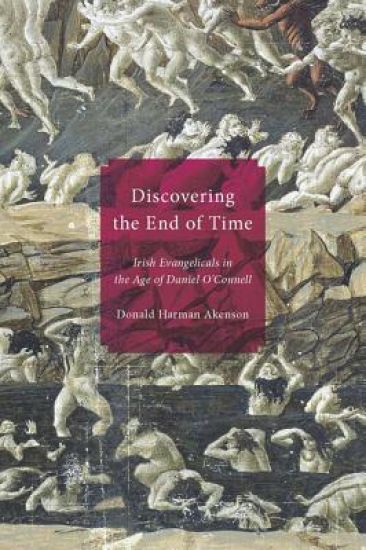
Discovering the End of Time

Discovering the End of Time

Donald Harman Akenson

McGill-Queen's University Press
2016
sidottu
Apocalyptic millennialism is embraced by the most powerful strands of evangelical Christianity. The followers of these groups believe in the physical return of Jesus to Earth in the Second Coming, the affirmation of a Rapture, a millennium of peace under the rule of Jesus and his saints, and, at last, final judgment and deep eternity. In Discovering the End of Time, Donald Akenson traces the primary vector of apocalyptic millennialism to southern Ireland in the 1820s and '30s. Surprisingly, these apocalyptic concepts - which many scholars associate with the poor, the ill-educated, and the desperate - were articulated most forcefully by a rich, well-educated coterie of Irish Protestants. Drawing a striking portrait of John Nelson Darby, the major figure in the evolution of evangelical dispensationalism, Akenson demonstrates Darby's formative influence on ideas that later came to have a foundational impact on American evangelicalism in general and on Christian fundamentalism in particular. Careful to emphasize that recognizing the origins of apocalyptic millennialism in no way implies a judgment on the validity of its constructs, Akenson draws on a deep knowledge of early nineteenth-century history and theology to deliver a powerful history of an Irish religious elite and a major intersection in the evolution of modern Christianity. Opening the door into an Ireland that was hiding in plain sight, Discovering the End of Time tells a remarkable story, at once erudite, conversational, and humorous, and characterized by an impressive range and depth of research.
Saint Saul

Saint Saul

Donald Harman Akenson

McGill-Queen's University Press
2002
pokkari
In Saint Saul Donald Harman Akenson shows that the answer to the most persistent question in Christianity - What do we know about the historical Jesus? - is best found in the writings of a caustic itinerant preacher named Saul. Saul, the author of the Epistles and known to Christians as Saint Paul, is the closest thing we have to a direct witness and our only opportunity to encounter Yeshua, as Jesus was known in his time, in something approaching the original. Recreating a time rich with prophets, savants, and god-drunk fanatics, Akenson sifts the evidence for and against the historical status of Saul and Yeshua and illuminates the circumstances that gave rise to Christianity and Rabbinic Judaism.
The Irish in Ontario

The Irish in Ontario

Donald Harman Akenson

McGill-Queen's University Press
1999
nidottu
This study presents a general discussion of the Irish in Ontario during the 19th century and a close analysis of the process of settlement and adaptation by the Irish in Leeds and Lansdowne township.
At Face Value

At Face Value

Donald Harman Akenson

McGill-Queen's University Press
1992
nidottu
In a parish register in Ireland, Akenson discovered a record naming an Eliza McCormack White as John's sister. Employing imaginative reconstruction, he proposes that Eliza McCormack, a transvestite prostitute who was in central Canada at the time John White arrived on the Canadian scene, was actually John's sister. Further, he suggests that John White can be best understood by recognizing that he was in fact Eliza!
Small Differences

Small Differences

Donald Harman Akenson

McGill-Queen's University Press
1991
nidottu
The assumption that Irish Protestants and Irish Catholics are fundamentally different is central to modern Irish history. There are hundreds of books and thousands of articles that either presuppose the existence of Irish Catholic-Protestant differences or amplify the theme by illustration and anecdote. Small Differences examines what scholars have so far taken for granted.