Kirjojen hintavertailu. Mukana 12 590 193 kirjaa ja 12 kauppaa.

Kirjailija

Donald M. Snow

Kirjat ja teokset yhdessä paikassa: 30 kirjaa, julkaisuja vuosilta 1988-2025, suosituimpien joukossa Regional Cases in U.S. Foreign Policy. Vertaile teosten hintoja ja tarkista saatavuus suomalaisista kirjakaupoista.

Mukana myös kirjoitusasut: Donald M Snow

30 kirjaa

Kirjojen julkaisuhaarukka 1988-2025.

When Should America Fight?

When Should America Fight?

Donald M. Snow

BLOOMSBURY PUBLISHING PLC
2023
nidottu
Donald M. Snow invites readers to consider what criteria should be evaluated when considering whether the United States should engage in military action across the globe: when its vital interests are at stake and when the endeavor can reasonably be considered feasible, what Snow refers to as the “IF factor.” It is hard to justify promoting an application of American military force to a situation where its use will not succeed or where US interests are not clearly vital, but, Snow argues, that is exactly what has happened frequently since Vietnam. The book is organized into three sections, examining a historical overview of how the United States became involved in intervening in asymmetrical warfare, the problem of internal war in the developing world, and future American military involvement, particularly in conflicts in the Global South and Ukraine.
When Should America Fight?

When Should America Fight?

Donald M. Snow

BLOOMSBURY PUBLISHING PLC
2023
sidottu
Donald M. Snow invites readers to consider what criteria should be evaluated when considering whether the United States should engage in military action across the globe: when its vital interests are at stake and when the endeavor can reasonably be considered feasible, what Snow refers to as the “IF factor.” It is hard to justify promoting an application of American military force to a situation where its use will not succeed or where US interests are not clearly vital, but, Snow argues, that is exactly what has happened frequently since Vietnam. The book is organized into three sections, examining a historical overview of how the United States became involved in intervening in asymmetrical warfare, the problem of internal war in the developing world, and future American military involvement, particularly in conflicts in the Global South and Ukraine.
Cases in International Relations

Cases in International Relations

Donald M. Snow

BLOOMSBURY PUBLISHING PLC
2022
sidottu
Designed to complement the main themes of any introductory course, Snow’s bestselling text presents original case studies that survey the state of the international system and look in-depth at issues of current interest. The cases are extremely timely, geopolitically diverse, accessibly written, and of high interest and salience amidst today’s headlines. New examples include the pandemic, racial inequality, foreign interference in elections, cyberwar, and global warming.
Cases in International Relations

Cases in International Relations

Donald M. Snow

BLOOMSBURY PUBLISHING PLC
2022
nidottu
Designed to complement the main themes of any introductory course, Snow’s bestselling text presents original case studies that survey the state of the international system and look in-depth at issues of current interest. The cases are extremely timely, geopolitically diverse, accessibly written, and of high interest and salience amidst today’s headlines. New examples include the pandemic, racial inequality, foreign interference in elections, cyberwar, and global warming.
National Security

National Security

Donald M. Snow

Routledge
2019
nidottu
The seventh edition of this highly successful textbook analyzes the history, evolution, and processes of national security policies. It examines national security from two fundamental fault lines - the end of the Cold War and the evolution of contemporary terrorism dating from the 9/11 terrorist attacks - and traces their path up to ISIS and beyond. The book considers how the resulting era of globalization and geopolitics guides policy. Placing these trends in conceptual and historical context and following them through military, semimilitary, and nonmilitary concerns, National Security treats its subject as a nuanced and subtle phenomenon that encompasses everything from the global to the individual with the nation at its core.New to the Seventh Edition An assessment of the impact of the Trump presidency on national security and relevant domestic policies, including border security and energy security matters. The continuing impact and evolution of terrorism as a security problem, with notable emphasis on the decline of the Islamic State (IS) and what terrorist threats are likely to succeed it. A description of the cyber security problem with an emphasis on Russian efforts to interfere with the 2016 US presidential election and beyond. A revised delineation of the geographic and substantive challenges facing the United States in the form of a chapter on "lethal landscapes," emphasizing the rise of China as a global rival and opponent in Asia and an attempt to deal with state aspirants like the Kurds. This book will continue to be highly beneficial to students and scholars working and studying in security studies, military and strategic studies, defense studies, foreign policy, US politics and international relations.
National Security

National Security

Donald M. Snow

Routledge
2019
sidottu
The seventh edition of this highly successful textbook analyzes the history, evolution, and processes of national security policies. It examines national security from two fundamental fault lines - the end of the Cold War and the evolution of contemporary terrorism dating from the 9/11 terrorist attacks - and traces their path up to ISIS and beyond. The book considers how the resulting era of globalization and geopolitics guides policy. Placing these trends in conceptual and historical context and following them through military, semimilitary, and nonmilitary concerns, National Security treats its subject as a nuanced and subtle phenomenon that encompasses everything from the global to the individual with the nation at its core.New to the Seventh Edition An assessment of the impact of the Trump presidency on national security and relevant domestic policies, including border security and energy security matters. The continuing impact and evolution of terrorism as a security problem, with notable emphasis on the decline of the Islamic State (IS) and what terrorist threats are likely to succeed it. A description of the cyber security problem with an emphasis on Russian efforts to interfere with the 2016 US presidential election and beyond. A revised delineation of the geographic and substantive challenges facing the United States in the form of a chapter on "lethal landscapes," emphasizing the rise of China as a global rival and opponent in Asia and an attempt to deal with state aspirants like the Kurds. This book will continue to be highly beneficial to students and scholars working and studying in security studies, military and strategic studies, defense studies, foreign policy, US politics and international relations.

Cases in U.S. National Security

Cases in U.S. National Security

Donald M. Snow

Rowman Littlefield
2019
nidottu
Modeled after his successful Cases in International Relations, now in its seventh edition, revered author and scholar, Don Snow, presents an engaging and novel approach to national security. A series of brief case studies representing current and controversial policy problems facilitates deliberation and debate about competing policy ideas, and encourages undergraduate students to think critically about issues of national security. Cases include new strategies for containing the terrorist threat, implications of President Trump’s withdrawal from the Iran Nuclear Agreement, and the increasingly adversarial relations with Russia, focusing on Russian expansionism in its geographical domain and interference in the 2016 American presidential election as national security problems for America.
U.S. Foreign Policy

U.S. Foreign Policy

Donald M. Snow; Patrick J. Haney

Rowman Littlefield
2017
nidottu
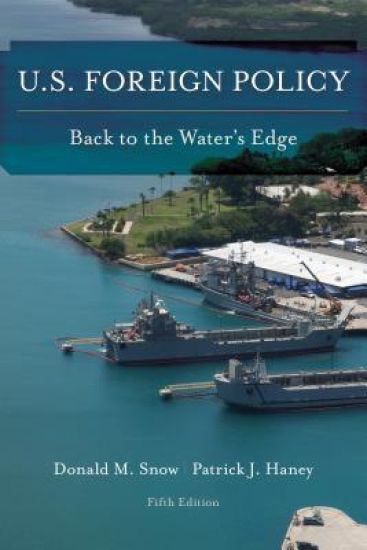
U.S. Foreign Policy: Back to the Water’s Edge is based on the old idea that despite domestic differences and party politics, Americans should unite “at the water’s edge” and present a cohesive front to a hostile world. The fifth edition explores this theme through coverage of the Trump administration, its early policies, and how Trump’s initiatives fit into the broader historical patterns of foreign policy in the United States. More compact than most of its competitors, the fifth edition packs necessary information and concepts into a lean but readable format. It contains rich historical content, providing the reader with snapshots of some of the truly classic highlights—and lowlights—of America’s record in foreign affairs. Written with the student reader in mind, each chapter offers several pedagogical aids designed to reinforce and extend comprehension of the material. This text is also accompanied by a companion reader. Regional Cases in Foreign Policy, Second Edition, was written by Don Snow with the specific intention of providing material and perspectives not contained in the text. The reader contains fourteen mini-cases that can accompany classroom discussions or lectures on subjects as diverse as relations with Russia, Israel, or the Islamic State; specific questions like the border fence with Mexico; U.S.-Cuban relations; or the British withdrawal from the European Union (Brexit). Case examples are drawn from all parts of the world.
Regional Cases in U.S. Foreign Policy

Regional Cases in U.S. Foreign Policy

Donald M. Snow

Rowman Littlefield
2017
nidottu
Regional Cases in U.S. Foreign Policy is the perfect accompaniment to U.S. Foreign Policy: Back to the Water's Edge. It provides micro-level bilateral interactions among specific states—material that is often ignored or downplayed in more general treatments of the subject. Each of the seven chapters is devoted to a region of the world in which the United States conducts significant foreign policy. Each chapter features case studies of American interaction with two different countries in that region, allowing students the opportunity to compare policy interactions across—as well as within—particular regions.
The Middle East, Oil, and the U.S. National Security Policy
Three interrelated subject areas are at the heart of the current foreign and national security dilemma. One is the Middle East, which has been the epicenter of most U.S. policy activity for over a third of a century. The second is energy policy, particularly as it is affected by the development and exploitation of shale oil and gas reserves in the United States. This is linked to the Middle East because it has been American dependence on Middle East petroleum that has created the interest the U.S. has in this region. The third area is military manpower policy and two simultaneous wars in the new century have raised questions about the all-volunteer force policy in place since 1972. It is increasingly evident that foreign and defense policy are strained and in need of fresh conceptualization. The three areas identified are the most obvious examples of policy dysfunction. The key area is the Middle East region. As long as the United States remains heavily committed to this part of the world, especially with military force and essentially because of its energy needs, there will be strains on manpower resources that could force a reexamination of the all-volunteer concept. At the same time, the reduction of U.S. dependence on Middle Eastern oil loosens the bonds that seem to impel American activism in the region. The result could be true opportunities for a less confrontational, adversary-driven foreign and defense posture.
The Middle East, Oil, and the U.S. National Security Policy
Three interrelated subject areas are at the heart of the current foreign and national security dilemma. One is the Middle East, which has been the epicenter of most U.S. policy activity for over a third of a century. The second is energy policy, particularly as it is affected by the development and exploitation of shale oil and gas reserves in the United States. This is linked to the Middle East because it has been American dependence on Middle East petroleum that has created the interest the U.S. has in this region. The third area is military manpower policy and two simultaneous wars in the new century have raised questions about the all-volunteer force policy in place since 1972. It is increasingly evident that foreign and defense policy are strained and in need of fresh conceptualization. The three areas identified are the most obvious examples of policy dysfunction. The key area is the Middle East region. As long as the United States remains heavily committed to this part of the world, especially with military force and essentially because of its energy needs, there will be strains on manpower resources that could force a reexamination of the all-volunteer concept. At the same time, the reduction of U.S. dependence on Middle Eastern oil loosens the bonds that seem to impel American activism in the region. The result could be true opportunities for a less confrontational, adversary-driven foreign and defense posture.
From Lexington to Baghdad and Beyond

From Lexington to Baghdad and Beyond

Donald M Snow; Dennis M. Drew

Routledge
2009
sidottu
Decisions about when, where, and why to commit the United States to the use of force, and how to conduct warfare and ultimately end it, are hotly debated not only contemporaneously but also for decades afterward. We are engaged in such a debate today, quite often without a solid grounding in the country's experience of war, both political and military. This book, by a political scientist and a career military officer and historian, is premised on the view that we cannot afford that kind of innocence. Updated and revised with new chapters on the Afghan and Iraq wars, the book systematically examines twelve U.S. wars from the revolution to the present day. For each conflict the authors review underlying issues and events; political objectives; military objectives and strategy; political considerations; military technology and technique; military conduct, and 'the better state of the peace', that is, the ultimate disposition of the original political goals.
From Lexington to Baghdad and Beyond

From Lexington to Baghdad and Beyond

Donald M Snow; Dennis M. Drew

Routledge
2009
nidottu
Decisions about when, where, and why to commit the United States to the use of force, and how to conduct warfare and ultimately end it, are hotly debated not only contemporaneously but also for decades afterward. We are engaged in such a debate today, quite often without a solid grounding in the country's experience of war, both political and military. This book, by a political scientist and a career military officer and historian, is premised on the view that we cannot afford that kind of innocence. Updated and revised with new chapters on the Afghan and Iraq wars, the book systematically examines twelve U.S. wars from the revolution to the present day. For each conflict the authors review underlying issues and events; political objectives; military objectives and strategy; political considerations; military technology and technique; military conduct, and 'the better state of the peace', that is, the ultimate disposition of the original political goals.