Kirjojen hintavertailu. Mukana 12 305 335 kirjaa ja 12 kauppaa.

Kirjailija

Donald T. Critchlow

Kirjat ja teokset yhdessä paikassa: 13 kirjaa, julkaisuja vuosilta 2003-2021, suosituimpien joukossa Revolutionary Monsters. Vertaile teosten hintoja ja tarkista saatavuus suomalaisista kirjakaupoista.

13 kirjaa

Kirjojen julkaisuhaarukka 2003-2021.

Revolutionary Monsters

Revolutionary Monsters

Donald T. Critchlow

Regnery History
2021
sidottu
Lenin. Mao. Castro. Mugabe. Khomeini. All sparked movements in the name of liberating their people from their oppressors—capitalists, foreign imperialists, or dictators in their own country. These revolutionaries rallied the masses in the name of freedom, only to become more tyrannical than those they replaced. Much has been written about the anatomy of revolution from Edmund Burke to Crane Brinton Crane, Franz Fanon, and contemporary theorists of revolution found in the modern academy. Yet what is missing is a dissection of the revolutionary minds that destroyed the old for the creation of a more harmful new. Revolutionary Monsters presents a collective biography of five modern day revolutionaries who came into power calling for the liberation of the people only to end up killing millions of people in the name of revolution: Lenin (Russia), Mao (China), Castro (Cuba), Mugabe (Zimbabwe), and Khomeini (Iran). Revolutionary Monsters explores basic questions about the revolutionary personality, and examines how these revolutionaries came to envision themselves as prophets of a new age.
In Defense of Populism

In Defense of Populism

Donald T. Critchlow

University of Pennsylvania Press
2020
sidottu
Contrary to warnings about the dangers of populism, Donald F. Critchlow argues that grassroots activism is essential to party renewal within a democratic system. Grassroots activism, presenting a cacophony of voices calling for reform of various sorts without programmatic coherence, is often derided as populist and distrusted by both political parties and voters. But according to Donald T. Critchlow, grassroots movements are actually responsible for political party transformation, both Democratic and Republic, into instruments of reform that reflect the interests, concerns, and anxieties of the electorate. Contrary to popular discourse warning about the dangers of populism, Critchlow argues that grassroots activism is essential to party renewal within a democratic system. In Defense of Populism examines movements that influenced Republican, Democratic, and third-party politics-from the Progressives and their influence on Teddy Roosevelt, to New Dealers and FDR, to the civil rights, feminist, and environmental movements and their impact on the Democratic Party, to the Reagan Revolution and the Tea Party. In each case, Critchlow narrates representative biographies of activists, party leaders, and presidents to show how movements become viable calls for reform that get translated into policy positions. Social tensions and political polarization continue to be prevalent today. Increased social disorder and populist outcry are expected whenever political elites and distant bureaucratic government are challenged. In Defense of Populism shows how, as a result of grassroots activism and political-party reform, policy advances are made, a sense of national confidence is restored, and the belief that American democracy works in the midst of crisis is affirmed.
Republican Character

Republican Character

Donald T. Critchlow

University of Pennsylvania Press
2020
pokkari
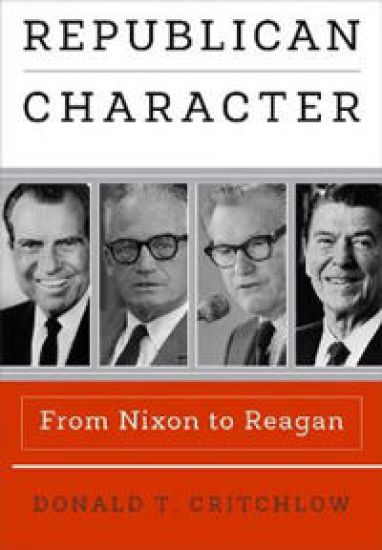
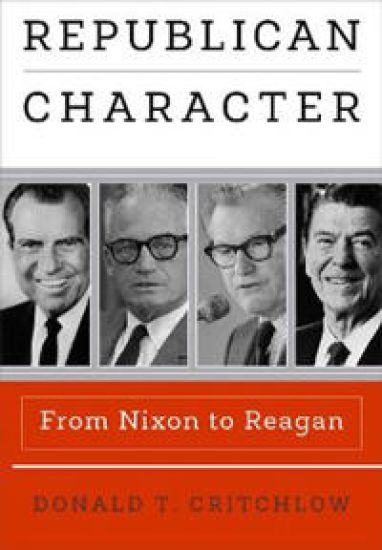
"Politics makes for strange bedfellows," the old saying goes. Americans, however, often forget the obvious lesson underlying this adage: politics is about winning elections and governing once in office. Voters of all stripes seem put off by the rough-and-tumble horse-trading and deal-making of politics, viewing its practitioners as self-serving and without principle or conviction. Because of these perspectives, the scholarly and popular narrative of American politics has come to focus on ideology over all else. But as Donald T. Critchlow demonstrates in his riveting new book, this obsession obscures the important role of temperament, character, and leadership ability in political success. Critchlow looks at four leading Republican presidential contenders-Richard Nixon, Nelson Rockefeller, Barry Goldwater, and Ronald Reagan-to show that, behind the scenes, ideology mattered less than principled pragmatism and the ability to build coalitions toward electoral and legislative victory. Drawing on new archival material, Critchlow lifts the curtain on the lives of these political rivals and what went on behind the scenes of their campaigns. He reveals unusual relationships between these men: Nixon making deals with Rockefeller, while Rockefeller courted Goldwater and Reagan, who themselves became political rivals despite their shared conservatism. The result is a book sure to fascinate anyone wondering what it takes to win the presidency of the United States-and to govern effectively.
Republican Character

Republican Character

Donald T. Critchlow

University of Pennsylvania Press
2018
sidottu
"Politics makes for strange bedfellows," the old saying goes. Americans, however, often forget the obvious lesson underlying this adage: politics is about winning elections and governing once in office. Voters of all stripes seem put off by the rough-and-tumble horse-trading and deal-making of politics, viewing its practitioners as self-serving and without principle or conviction. Because of these perspectives, the scholarly and popular narrative of American politics has come to focus on ideology over all else. But as Donald T. Critchlow demonstrates in his riveting new book, this obsession obscures the important role of temperament, character, and leadership ability in political success. Critchlow looks at four leading Republican presidential contenders-Richard Nixon, Nelson Rockefeller, Barry Goldwater, and Ronald Reagan-to show that, behind the scenes, ideology mattered less than principled pragmatism and the ability to build coalitions toward electoral and legislative victory. Drawing on new archival material, Critchlow lifts the curtain on the lives of these political rivals and what went on behind the scenes of their campaigns. He reveals unusual relationships between these men: Nixon making deals with Rockefeller, while Rockefeller courted Goldwater and Reagan, who themselves became political rivals despite their shared conservatism. The result is a book sure to fascinate anyone wondering what it takes to win the presidency of the United States-and to govern effectively.
Future Right: Forging a New Republican Majority

Future Right: Forging a New Republican Majority

Donald T. Critchlow

St. Martin's Press
2016
sidottu
Contrary to those who argue that demographics are political destiny, social trends are transforming identity categories of race, gender, and youth - all of which provide rich opportunities for Republicans to create a new majority. To accomplish this, Republicans will need imagination and political acumen if they are to win over those constituencies that have become the base of the Democratic Party: minorities, young women, and millennials. Behind the reality of current voting patterns, which without doubt presents a gloomy future for the Republican Party, social trends and a deeper analysis of political attitudes reveal there is much room for Republican optimism. In this critical, data-driven book, Future Right, Donald Critchlow explores strategies for the right that will help them succeed where Democrats are floundering: how to speak to the new population of a rising and successful minority class and how to reform the salacious alliance between the government and the one percent. It is time for Republicans to adapt to societal trends for the creation of a new, transformative politics that will not only help them win the future elections, but revive a system long overrun by outmoded, top-heavy politics.
When Hollywood Was Right

When Hollywood Was Right

Donald T. Critchlow

Cambridge University Press
2013
sidottu
Hollywood was not always a bastion of liberalism. Following World War II, an informal alliance of movie stars, studio moguls and Southern California business interests formed to revitalize a factionalized Republican Party. Coming together were stars such as John Wayne, Robert Taylor, George Murphy and many others, who joined studio heads Cecil B. DeMille, Louis B. Mayer, Walt Disney and Jack Warner to rebuild the Republican Party. They found support among a large group of business leaders who poured money and skills into this effort, which paid off with the election of George Murphy to the US Senate and of Richard Nixon and Ronald Reagan to the highest office in the nation. This is an exciting story based on extensive new research that will forever change how we think of Hollywood politics.
The Conservative Ascendancy

The Conservative Ascendancy

Donald T. Critchlow

University Press of Kansas
2011
nidottu
Hailed as "perhaps the best scholarly overview of the conservative movement in print" (American Conservative), Donald Critchlow's The Conservative Ascendancy has depicted, as no other book has, the wild ride of the Republican Right. Newly updated and available for the first time in paperback, it continues to offer the best account of the conservative struggle to reverse the momentum of the New Deal.In tracing the conservative revival, Critchlow chronicles how conservative beliefs were translated into political power. He shows how conservatives, from think tank theorists to grassroots mobilizers, gained control of the Republican party by defeating its liberal eastern wing only to find that the welfare state was not so easily dismantled. Looking back at the 1964 Goldwater debacle and the scandal-plagued Nixon years, he then revisits the triumph of the Reagan presidency and describes how George W. Bush injected into American politics a level of partisanship not seen since the nineteenth century.Critchlow recounts the conflict between purity of principle and political practice for conservatives, and the dilemma of maintaining an anti-statist ideology in an era of mass democracy and Cold War hostilities. Throughout he delineates the intellectual foundations of the Right's positions—including the ongoing schism that separates social conservatives from libertarians—while plumbing America's increasing ideological divide.This updated edition not only features a new preface and conclusion but also boasts an entirely new chapter covering the 2008 presidential election, the 2008 financial meltdown, the first two years of Obama's presidency, the emergence of the Tea Party, the 2010 midterms, and ongoing economic problems. Here Critchlow foresees a new epoch in which the old conservative-progressive divide is unable to address the problems caused by national debt, entitlement deficits, and a new global economy—a new reality sure to transform both parties.As conservatives continue to wave the banners of limited government, individual responsibility, and free enterprise, Critchlow's book provides a clear guide to the country's most dynamic political movement and is essential reading for students and citizens alike as the political center continues to tack to the right.
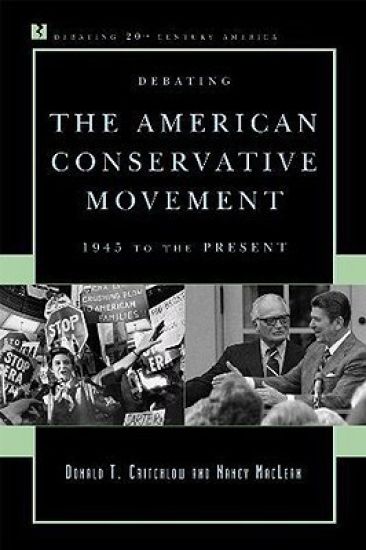
Debating the American Conservative Movement

Debating the American Conservative Movement

Donald T. Critchlow; Nancy MacLean

Rowman Littlefield Publishers
2009
sidottu
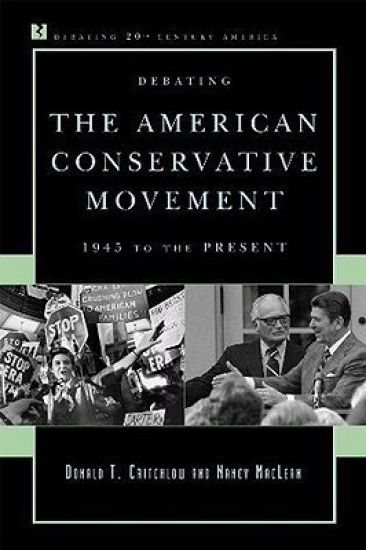
Debating the American Conservative Movement chronicles one of the most dramatic stories of modern American political history. The authors describe how a small band of conservatives in the immediate aftermath of the Second World War launched a revolution that shifted American politics to the right, challenged the New Deal order, transformed the Republican party into a voice of conservatism, and set the terms of debate in American politics as the country entered the new millennium. Historians Donald T. Critchlow and Nancy MacLean frame two opposing perspectives of how the history of conservatism in modern America can be understood, but readers are encouraged to reach their own conclusions through reading engaging primary documents.
Debating the American Conservative Movement

Debating the American Conservative Movement

Donald T. Critchlow; Nancy MacLean

Rowman Littlefield Publishers
2009
nidottu
Debating the American Conservative Movement chronicles one of the most dramatic stories of modern American political history. The authors describe how a small band of conservatives in the immediate aftermath of the Second World War launched a revolution that shifted American politics to the right, challenged the New Deal order, transformed the Republican party into a voice of conservatism, and set the terms of debate in American politics as the country entered the new millennium. Historians Donald T. Critchlow and Nancy MacLean frame two opposing perspectives of how the history of conservatism in modern America can be understood, but readers are encouraged to reach their own conclusions through reading engaging primary documents.
Phyllis Schlafly and Grassroots Conservatism

Phyllis Schlafly and Grassroots Conservatism

Donald T. Critchlow

Princeton University Press
2008
pokkari
Longtime activist, author, and antifeminist leader Phyllis Schlafly is for many the symbol of the conservative movement in America. In this provocative new book, historian Donald T. Critchlow sheds new light on Schlafly's life and on the unappreciated role her grassroots activism played in transforming America's political landscape. Based on exclusive and unrestricted access to Schlafly's papers as well as sixty other archival collections, the book reveals for the first time the inside story of this Missouri-born mother of six who became one of the most controversial forces in modern political history. It takes us from Schlafly's political beginnings in the Republican Right after the World War II through her years as an anticommunist crusader to her more recent efforts to thwart same-sex marriage and stem the flow of illegal immigrants. Schlafly's political career took off after her book A Choice Not an Echo helped secure Barry Goldwater's nomination. With sales of more than 3 million copies, the book established her as a national voice within the conservative movement. But it was Schlafly's bid to defeat the Equal Rights Amendment that gained her a grassroots following. Her anti-ERA crusade attracted hundreds of thousands of women into the conservative fold and earned her a name as feminism's most ardent opponent. In the 1970s, Schlafly founded the Eagle Forum, a Washington-based conservative policy organization that today claims a membership of 50,000 women. Filled with fresh insights into these and other initiatives, Phyllis Schlafly and Grassroots Conservatism provides a telling profile of one of the most influential activists in recent history. Sure to invite spirited debate, it casts new light on a major shift in American politics, the emergence of the Republican Right.
America's Promise

America's Promise

William J. Rorabaugh; Donald T. Critchlow; Paula Baker

Rowman Littlefield Publishers
2004
nidottu
America's Promise is a concise, highly readable introduction to American History. Designed to clearly explain major themes and events, it also captures the rich and often amusing character of the American people. The strong narrative emphasizes public life and how individuals constructed public structures in which they lived and worked. Including the latest scholarship in social, cultural, and political history, the work integrates the history and importance of women and minorities. To aid students in learning and reviewing, each chapter begins with a preview of the main ideas that will be discussed and ends with a conclusion that reinforces the key concepts. Rather than being simply declaratory signposts, section headings highlight main ideas and help carry along the narrative. A glossary defines main terms, and a timeline helps students keep track of events. Selected readings are also included to encourage further reading and study. Finally, carefully selected illustrations and maps portray, pinpoint, and illuminate important episodes in American history. The most concise and competitively priced book available, America's Promise is a breath of fresh air in the introductory market.
America's Promise

America's Promise

William J. Rorabaugh; Donald T. Critchlow; Paula Baker

Rowman Littlefield Publishers
2004
nidottu
America's Promise is a concise, highly readable introduction to American History. Designed to clearly explain major themes and events, it also captures the rich and often amusing character of the American people. The strong narrative emphasizes public life and how individuals constructed public structures in which they lived and worked. Including the latest scholarship in social, cultural, and political history, the work integrates the history and importance of women and minorities. To aid students in learning and reviewing, each chapter begins with a preview of the main ideas that will be discussed and ends with a conclusion that reinforces the key concepts. Rather than being simply declaratory signposts, section headings highlight main ideas and help carry along the narrative. A glossary defines main terms, and a timeline helps students keep track of events. Selected readings are also included to encourage further reading and study. Finally, carefully selected illustrations and maps portray, pinpoint, and illuminate important episodes in American history. The most concise and competitively priced book available, America's Promise is a breath of fresh air in the introductory market.
Enemies of the State

Enemies of the State

Donald T. Critchlow; Agnieszka Critchlow

Ivan R Dee, Inc
2003
pokkari
Long before Alexander Solzhenitsyn’s One Day in the Life of Ivan Denisovich (1962) shocked the Western world with its frightening description of a typical day in a forced-labor camp during the Stalin era, some readers in the West already knew of prison life in the Soviet Union, the Eastern bloc, and other Communist countries. A powerful genre of gulag literature had emerged in the late 1930s and developed throughout the cold war. Books by survivors revealed in graphic detail the systematic implementation of a totalitarian police state that induced terror in its citizens through torture, imprisonment in slave labor camps, and death. In Enemies of the State, Donald and Agnieszka Critchlow have selected excerpts from nine of the most widely read books from this gulag literature. The stories are riveting and inspiring. They are dramatic by their nature and illustrate humanity at its heroic best. But they have historical value too, because in addition to providing a ghastly record of Communist terror, they also explain why Western readers developed such deep mistrust of “peaceful coexistence” with any Communist nation. Memoirs from survivors of Communist prisons confirmed beliefs that the Communists could not be trusted. They told readers that Communist regimes operated through deception and denial, and that sympathetic visitors to the Soviet Union, China, North Vietnam, and Cuba were too often misled by the carefully staged performances of Communist officials. In short, gulag literature reinforced among American anti-Communists the idea of an apocalyptic struggle between communism and Western Christendom.