Kirjojen hintavertailu. Mukana 12 390 323 kirjaa ja 12 kauppaa.

Kirjailija

Donna J. Haraway

Kirjat ja teokset yhdessä paikassa: 16 kirjaa, julkaisuja vuosilta 1990-2025, suosituimpien joukossa Frø fra andre verdener. Vertaile teosten hintoja ja tarkista saatavuus suomalaisista kirjakaupoista.

16 kirjaa

Kirjojen julkaisuhaarukka 1990-2025.

Frø fra andre verdener

Frø fra andre verdener

Donna J. Haraway

Cappelen Damm akademisk
2025
nidottu
Donna Haraway er spesielt berømt for sin utradisjonelle sammenstilling av populærkultur og teori, og aller mest kjent er begrepene kyborg, en figur for overskridelse av etablerte kategorier og ledsagerarter, en betegnelse på menneskets relasjoner til andre arter. Hennes tenkning beveger seg mellom fagfelt som vitenskapsteori, idéhistorie, teknovitenskap, kjønnsforskning og naturvitenskap. I Frø fra andre verdener er det samlet et utvalg av essay av Haraway som tidligere ikke har vært oversatt til norsk. I sine arbeider viser hun en tydelig kobling mellom vår tids klimakrise og etablerte maktstrukturer, og argumenterer for nye måter å tenke bærekraftige fremtider for mennesker og andre arter. For Haraway er det et viktig poeng at kunnskap om verden produseres fra steder, kropper, kulturer, normer og strukturer, og aldri er nøytral. I den nye rekken av Cappelens upopulære skrifter kommer Frø fra andre verdener av Donna Haraway som nr. 91. Oversatt av Lene Auestad og Anders Dunker. Forord og utvalg ved Ingvil F. Hellstrand.
Informatics of Domination

Informatics of Domination

Donna J. Haraway

DUKE UNIVERSITY PRESS
2025
sidottu
Informatics of Domination is an experimental collection addressing formations of power that manifest through technical systems and white capitalist patriarchy in the twenty-first century. The volume takes its name from a chart in Donna J. Haraway’s canonical 1985 essay “A Manifesto for Cyborgs.” Haraway theorizes the informatics of domination as a feminist, diagrammatic concept for situating power and a world system from which the figure of the cyborg emerges. Informatics of Domination builds on Haraway’s chart as an open structure for thought, inviting fifty scholars, artists, and creative writers to unfold new perspectives. Their writings take on a variety of forms, such as essays on artificial intelligence, disability and protest, and transpacific imaginaries; conversations with an AI trained on Black oral history; a three-dimensional response to Mexico-US border tensions; hand-drawn images on queer autotheory; ecological fictions about gut microbiomes and wet markets; and more. Together, the writings take up the unfinished structure of the chart in order to proliferate critiques of white capitalist patriarchal power with the study of information systems, networks, and computation today. This volume includes an afterword by Haraway. Contributors. Dalida María Benfield, Zach Blas, Ama Josephine Budge Johnstone, micha cárdenas, Amy Sara Carroll, Shu Lea Cheang, Jian Neo Chen, Heather Dewey-Hagborg, Ranjodh Singh Dhaliwal, Stephanie Dinkins, Ricardo Dominguez, Ashley Ferro-Murray, Matthew Fuller, Jacob Gaboury, Jennifer Gabrys, Alexander R. Galloway, Jennifer Mae Hamilton, Donna J. Haraway, Eva Hayward, Stefan Helmreich, Kathy High, Leon J. Hilton, Ho Rui An, Hi'ilei Julia Kawehipuaakahaopulani Hobart, Tung-Hui Hu, Caroline A. Jones, Melody Jue, Homay King, Larissa Lai, Lawrence Lek, Esther Leslie, Alexis Lothian, Isadora Neves Marques, Radha May (Elisa Giardina-Papa, Nupur Mathur, and Bathsheba Okwenje), Shaka McGlotten, Mahan Moalemi, madison moore, Astrida Neimanis, Bahar Noorizadeh, Luciana Parisi, Thao Phan, Ana Teixeira Pinto, Luiza Prado de O. Martins, Rita Raley, Patricia Reed, Jennifer Rhee, Bassem Saad, Ashkan Sepahvand, Justin Talplacido Shoulder, Lucy Suchman, Ollie Zhang
Informatics of Domination

Informatics of Domination

Donna J. Haraway

DUKE UNIVERSITY PRESS
2025
pokkari
Informatics of Domination is an experimental collection addressing formations of power that manifest through technical systems and white capitalist patriarchy in the twenty-first century. The volume takes its name from a chart in Donna J. Haraway’s canonical 1985 essay “A Manifesto for Cyborgs.” Haraway theorizes the informatics of domination as a feminist, diagrammatic concept for situating power and a world system from which the figure of the cyborg emerges. Informatics of Domination builds on Haraway’s chart as an open structure for thought, inviting fifty scholars, artists, and creative writers to unfold new perspectives. Their writings take on a variety of forms, such as essays on artificial intelligence, disability and protest, and transpacific imaginaries; conversations with an AI trained on Black oral history; a three-dimensional response to Mexico-US border tensions; hand-drawn images on queer autotheory; ecological fictions about gut microbiomes and wet markets; and more. Together, the writings take up the unfinished structure of the chart in order to proliferate critiques of white capitalist patriarchal power with the study of information systems, networks, and computation today. This volume includes an afterword by Haraway. Contributors. Dalida María Benfield, Zach Blas, Ama Josephine Budge Johnstone, micha cárdenas, Amy Sara Carroll, Shu Lea Cheang, Jian Neo Chen, Heather Dewey-Hagborg, Ranjodh Singh Dhaliwal, Stephanie Dinkins, Ricardo Dominguez, Ashley Ferro-Murray, Matthew Fuller, Jacob Gaboury, Jennifer Gabrys, Alexander R. Galloway, Jennifer Mae Hamilton, Donna J. Haraway, Eva Hayward, Stefan Helmreich, Kathy High, Leon J. Hilton, Ho Rui An, Hi'ilei Julia Kawehipuaakahaopulani Hobart, Tung-Hui Hu, Caroline A. Jones, Melody Jue, Homay King, Larissa Lai, Lawrence Lek, Esther Leslie, Alexis Lothian, Isadora Neves Marques, Radha May (Elisa Giardina-Papa, Nupur Mathur, and Bathsheba Okwenje), Shaka McGlotten, Mahan Moalemi, madison moore, Astrida Neimanis, Bahar Noorizadeh, Luciana Parisi, Thao Phan, Ana Teixeira Pinto, Luiza Prado de O. Martins, Rita Raley, Patricia Reed, Jennifer Rhee, Bassem Saad, Ashkan Sepahvand, Justin Talplacido Shoulder, Lucy Suchman, Ollie Zhang

At blive i besværet

At blive i besværet

Donna J. Haraway

Forlaget Mindspace
2021
pokkari
Befolkningstilvækst, klimaforandringerne og Jordens sjette masseuddøen er brændende spørgsmål for den, der vil blive i besværet med at fortsætte det jordiske liv. Der er behov for at tænke sammen på ny, på tværs af forskelle mellem historiske positioner og videns- og ekspertformer. Haraway viser os en anden måde at fortælle videnskab på, billed- og metaforrig, til tider underholderholdende, sprogligt sprudlende og altid dybt seriøs. Haraway kalder sin teoretisk og metodiske tilgang SF – snorefigur, science fiction, science fact, spekulativ feminisme, spekulativ fabulering og so far. Mennesket er ikke centrum for alting. Chthulucæn fordrer sym-poiesis, at vi skaber-med, tænker-med og bliver-til-med. Filosoffen, feministen og biologen Donna J. Haraway har brugt det meste af sit voksne liv på at skabe alternative perspektiver på de accepterede ideologier, der giver form til vores videnskabelige fortællinger om mennesker og natur. "At blive i besværet er en vidtfavnende bog, hvis gennemgående bestræbelse er at ruske op i vores forestillinger om verdens beskaffenhed, forstyrre vores tænkemønstre og skabe uro i vores forståelser af klodens tilstand og vores overlevelsesmuligheder på en skadet planet på måder, der befordrer nye og anderledes overlevelsesfortællinger. Formålet er ikke en dommedagsprofeti - om end den aktuelle destruktion af arter og livsgrundlag for jordens mangfoldighed af liv er bogens omdrejningspunkt - men at finde redskaber og begreber, sprog og fortællinger, der kan skærpe opmærksomheden og åbne for anderledes måder at skabe verdener på.” - Fra det danske forord ved Lis Højgaard
Making Kin not Population – Reconceiving Generations

Making Kin not Population – Reconceiving Generations

Adele Clarke; Donna J. Haraway; Donna Haraway

Prickly Paradigm Press, LLC
2018
nidottu
As the planet’s human numbers grow and environmental concerns proliferate, natural scientists, economists, and policy-makers are increasingly turning to new and old questions about families and kinship as matters of concern. From government programs designed to fight declining birth rates in Europe and East Asia, to controversial policies seeking to curb population growth in countries where birth rates remain high, to increasing income inequality transnationally, issues of reproduction introduce new and complicated moral and political quandaries.Making Kin Not Population ends the silence on these issues with essays from leading anti-racist, ecologically-concerned, feminist scholars. Though not always in accord, these contributors provide bold analyses of complex issues of intimacy and kinship, from reproductive justice to environmental justice, and from human and nonhuman genocides to new practices for making families and kin. This timely work offers vital proposals for forging innovative personal and public connections in the contemporary world.
Modest_Witness@Second_Millennium. FemaleMan_Meets_OncoMouse

Modest_Witness@Second_Millennium. FemaleMan_Meets_OncoMouse

Donna J. Haraway; Thyrza Goodeve

Routledge
2018
nidottu
One of the founders of the posthumanities, Donna J. Haraway is professor in the History of Consciousness program at the University of California, Santa Cruz. Author of many books and widely read essays, including the now-classic essay "The Cyborg Manifesto," she received the J.D. Bernal Prize in 2000, a lifetime achievement award from the Society for Social Studies in Science.Thyrza Nicholas Goodeve is a professor of Art History at the School of Visual Arts.
Modest_Witness@Second_Millennium. FemaleMan_Meets_OncoMouse

Modest_Witness@Second_Millennium. FemaleMan_Meets_OncoMouse

Donna J. Haraway; Thyrza Goodeve

Routledge
2018
sidottu
One of the founders of the posthumanities, Donna J. Haraway is professor in the History of Consciousness program at the University of California, Santa Cruz. Author of many books and widely read essays, including the now-classic essay "The Cyborg Manifesto," she received the J.D. Bernal Prize in 2000, a lifetime achievement award from the Society for Social Studies in Science.Thyrza Nicholas Goodeve is a professor of Art History at the School of Visual Arts.
Staying with the Trouble

Staying with the Trouble

Donna J. Haraway

Duke University Press
2016
pokkari
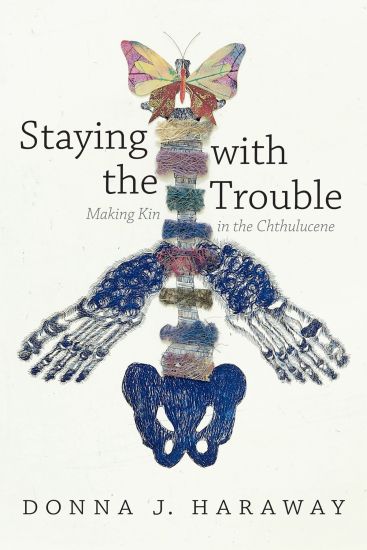
In the midst of spiraling ecological devastation, multispecies feminist theorist Donna J. Haraway offers provocative new ways to reconfigure our relations to the earth and all its inhabitants. She eschews referring to our current epoch as the Anthropocene, preferring to conceptualize it as what she calls the Chthulucene, as it more aptly and fully describes our epoch as one in which the human and nonhuman are inextricably linked in tentacular practices. The Chthulucene, Haraway explains, requires sym-poiesis, or making-with, rather than auto-poiesis, or self-making. Learning to stay with the trouble of living and dying together on a damaged earth will prove more conducive to the kind of thinking that would provide the means to building more livable futures. Theoretically and methodologically driven by the signifier SF-string figures, science fact, science fiction, speculative feminism, speculative fabulation, so far-Staying with the Trouble further cements Haraway's reputation as one of the most daring and original thinkers of our time.
Staying with the Trouble

Staying with the Trouble

Donna J. Haraway

Duke University Press
2016
sidottu
In the midst of spiraling ecological devastation, multispecies feminist theorist Donna J. Haraway offers provocative new ways to reconfigure our relations to the earth and all its inhabitants. She eschews referring to our current epoch as the Anthropocene, preferring to conceptualize it as what she calls the Chthulucene, as it more aptly and fully describes our epoch as one in which the human and nonhuman are inextricably linked in tentacular practices. The Chthulucene, Haraway explains, requires sym-poiesis, or making-with, rather than auto-poiesis, or self-making. Learning to stay with the trouble of living and dying together on a damaged earth will prove more conducive to the kind of thinking that would provide the means to building more livable futures. Theoretically and methodologically driven by the signifier SF-string figures, science fact, science fiction, speculative feminism, speculative fabulation, so far-Staying with the Trouble further cements Haraway's reputation as one of the most daring and original thinkers of our time.
Manifestly Haraway

Manifestly Haraway

Donna J. Haraway

University of Minnesota Press
2016
nidottu
Electrifying, provocative, and controversial when first published thirty years ago, Donna Haraway’s “Cyborg Manifesto” is even more relevant today, when the divisions that she so eloquently challenges-of human and machine but also of gender, class, race, ethnicity, sexuality, and location-are increasingly complex. The subsequent “Companion Species Manifesto,” which further questions the human–nonhuman disjunction, is no less urgently needed in our time of environmental crisis and profound polarization.Manifestly Haraway brings together these momentous manifestos to expose the continuity and ramifying force of Haraway’s thought, whose significance emerges with engaging immediacy in a sustained conversation between the author and her long-term friend and colleague Cary Wolfe. Reading cyborgs and companion species through and with each other, Haraway and Wolfe join in a wide-ranging exchange on the history and meaning of the manifestos in the context of biopolitics, feminism, Marxism, human–nonhuman relationships, making kin, literary tropes, material semiotics, the negative way of knowing, secular Catholicism, and more.The conversation ends by revealing the early stages of Haraway’s “Chthulucene Manifesto,” in tension with the teleologies of the doleful Anthropocene and the exterminationist Capitalocene. Deeply dedicated to a diverse and robust earthly flourishing, Manifestly Haraway promises to reignite needed discussion in and out of the academy about biologies, technologies, histories, and still possible futures.
Manifestly Haraway

Manifestly Haraway

Donna J. Haraway

University of Minnesota Press
2016
sidottu
Electrifying, provocative, and controversial when first published thirty years ago, Donna Haraway’s “Cyborg Manifesto” is even more relevant today, when the divisions that she so eloquently challenges-of human and machine but also of gender, class, race, ethnicity, sexuality, and location-are increasingly complex. The subsequent “Companion Species Manifesto,” which further questions the human–nonhuman disjunction, is no less urgently needed in our time of environmental crisis and profound polarization.Manifestly Haraway brings together these momentous manifestos to expose the continuity and ramifying force of Haraway’s thought, whose significance emerges with engaging immediacy in a sustained conversation between the author and her long-term friend and colleague Cary Wolfe. Reading cyborgs and companion species through and with each other, Haraway and Wolfe join in a wide-ranging exchange on the history and meaning of the manifestos in the context of biopolitics, feminism, Marxism, human–nonhuman relationships, making kin, literary tropes, material semiotics, the negative way of knowing, secular Catholicism, and more.The conversation ends by revealing the early stages of Haraway’s “Chthulucene Manifesto,” in tension with the teleologies of the doleful Anthropocene and the exterminationist Capitalocene. Deeply dedicated to a diverse and robust earthly flourishing, Manifestly Haraway promises to reignite needed discussion in and out of the academy about biologies, technologies, histories, and still possible futures.
Primate Visions

Primate Visions

Donna J. Haraway

Routledge
2015
sidottu
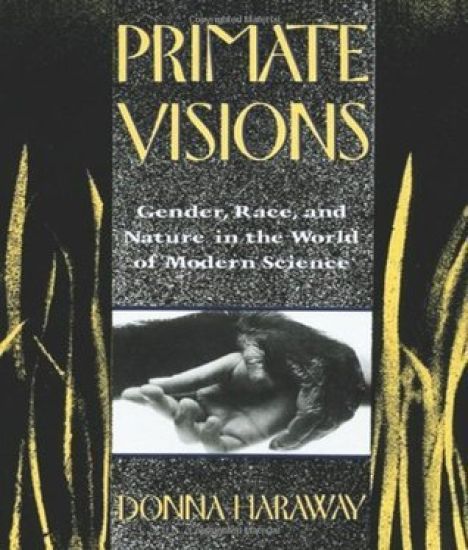
Haraway's discussions of how scientists have perceived the sexual nature of female primates opens a new chapter in feminist theory, raising unsettling questions about models of the family and of heterosexuality in primate research.
When Species Meet

When Species Meet

Donna J. Haraway

University of Minnesota Press
2007
nidottu
“When Species Meet is a breathtaking meditation on the intersection between humankind and dog, philosophy and science, and macro and micro cultures.” -Cameron Woo, Publisher of Bark magazine In 2006, about 69 million U.S. households had pets, giving homes to around 73.9 million dogs, 90.5 million cats, and 16.6 million birds, and spending over $38 billion dollars on companion animals. As never before in history, our pets are truly members of the family. But the notion of “companion species”-knotted from human beings, animals and other organisms, landscapes, and technologies-includes much more than “companion animals.” In When Species Meet, Donna J. Haraway digs into this larger phenomenon to contemplate the interactions of humans with many kinds of critters, especially with those called domestic. At the heart of the book are her experiences in agility training with her dogs Cayenne and Roland, but Haraway’s vision here also encompasses wolves, chickens, cats, baboons, sheep, microorganisms, and whales wearing video cameras. From designer pets to lab animals to trained therapy dogs, she deftly explores philosophical, cultural, and biological aspects of animal-human encounters. In this deeply personal yet intellectually groundbreaking work, Haraway develops the idea of companion species, those who meet and break bread together but not without some indigestion. “A great deal is at stake in such meetings,” she writes, “and outcomes are not guaranteed. There is no assured happy or unhappy ending-socially, ecologically, or scientifically. There is only the chance for getting on together with some grace.” Ultimately, she finds that respect, curiosity, and knowledge spring from animal-human associations and work powerfully against ideas about human exceptionalism. One of the founders of the posthumanities, Donna J. Haraway is professor in the History of Consciousness Department at the University of California, Santa Cruz. Author of many books and widely read essays, including The Companion Species Manifesto: Dogs, People, and Significant Otherness and the now-classic essay “The Cyborg Manifesto,” she received the J. D. Bernal Prize in 2000, a lifetime achievement award from the Society for Social Studies in Science.
The Companion Species Manifesto

The Companion Species Manifesto

Donna J. Haraway

University of Chicago Press
2003
nidottu
"The Companion Species Manifesto" is about the implosion of nature and culture in the joint lives of dogs and people, who are bonded in "significant otherness". In all their historical complexity, Donna Haraway tells us, dogs matter. They are not surrogates for theory, she says; they are not here just to think with. Neither are they just an alibi for other themes; dogs are fleshly material-semiotic presences in the body of technoscience. They are here to live with. Partners in the crime of human evolution, they are in the garden from the get-go, wily as Coyote. This pamphlet is Haraway's answer to her own "Cyborg Manifesto", where the slogan for living on the edge of global war has to be not just "cyborgs for earthly survival", but also, in a more doggish idiom, "shut up and train".
Primate Visions

Primate Visions

Donna J. Haraway

Routledge
1990
nidottu
Haraway's discussions of how scientists have perceived the sexual nature of female primates opens a new chapter in feminist theory, raising unsettling questions about models of the family and of heterosexuality in primate research.