Kirjojen hintavertailu. Mukana 12 390 323 kirjaa ja 12 kauppaa.

Kirjailija

Donna Y. Ford

Kirjat ja teokset yhdessä paikassa: 6 kirjaa, julkaisuja vuosilta 2010-2021, suosituimpien joukossa Black Boys are Lit. Vertaile teosten hintoja ja tarkista saatavuus suomalaisista kirjakaupoista.

6 kirjaa

Kirjojen julkaisuhaarukka 2010-2021.

Black Boys are Lit

Black Boys are Lit

Brian L. Wright; Donna Y. Ford; James L. Moore III

Emerald Publishing Inc
2021
sidottu
This book of matrices with Black boys as the main character is designed to help gifted and talented education teachers leverage Black boys’ identities to inform and shape how they plan and deliver curriculum and instruction and manage the multicultural, democratic, and culturally responsive classroom. Ford and colleagues (2005) spoke to the notion of and need for ‘self-reflective instruction.’ We argue that all teachers must want to and learn how to legitimize the “everyday” experiences that are learned and cultivated in the homes and communities of Black boys, and how these experiences shape their self-identities and contribute to agency (Wright, Counsell, & Tate 2015). We, therefore, advocate for the rethinking of literacies by repositioning White-centered texts that often reflect and represent power and privilege toward centering the brilliance of Black identities of Black children in general, Black boys in particular.Black boys (of all ages) want to and need to physically see positive images of themselves in books reflected at them. This representation, we argue, has the potential to become an example of a compelling counter-narrative to the history of the “all-White world” (Larrick, 1965) of children’s books that only presented Black characters as “objects of ridicule and generally inferior beings” (Sims Bishop 2012, p. 6). When Black boys see themselves portrayed visually, textually, and realistically in children’s books, vital messages of recognition, value, affirmation, and validation are conveyed. Recognition of the sociocultural contexts in which they live is celebrated.Books for and about Black boys must be rigorous, authentic, multicultural, and developmentally appropriate to allow them to synthesize what they have read, heard, and seen during literacy instruction in authentic and meaningful ways. Multicultural books must introduce children to information about the values of justice, fairness, and equity. Developmentally appropriate books should vary with and adapt to the age, experience, and interests of gifted and talented Black boys to allow them the opportunity to demonstrate critical thinking, textual analysis skills and convey conceptual knowledge. These stories must expose Black boys to culturally relevant counter stories -- stories that counteract the dominant discourse that has primarily depicted Black boys as “at risk” versus placed at risk; “without hope” versus hopeful; or “out of control and dangerous” (Tatum, 2005, p. 28) versus developing self-control like all other children (Wright et al., 2018).
Black Boys are Lit

Black Boys are Lit

Brian L. Wright; Donna Y. Ford; James L. Moore III

Emerald Publishing Inc
2021
nidottu
This book of matrices with Black boys as the main character is designed to help gifted and talented education teachers leverage Black boys’ identities to inform and shape how they plan and deliver curriculum and instruction and manage the multicultural, democratic, and culturally responsive classroom. Ford and colleagues (2005) spoke to the notion of and need for ‘self-reflective instruction.’ We argue that all teachers must want to and learn how to legitimize the “everyday” experiences that are learned and cultivated in the homes and communities of Black boys, and how these experiences shape their self-identities and contribute to agency (Wright, Counsell, & Tate 2015). We, therefore, advocate for the rethinking of literacies by repositioning White-centered texts that often reflect and represent power and privilege toward centering the brilliance of Black identities of Black children in general, Black boys in particular.Black boys (of all ages) want to and need to physically see positive images of themselves in books reflected at them. This representation, we argue, has the potential to become an example of a compelling counter-narrative to the history of the “all-White world” (Larrick, 1965) of children’s books that only presented Black characters as “objects of ridicule and generally inferior beings” (Sims Bishop 2012, p. 6). When Black boys see themselves portrayed visually, textually, and realistically in children’s books, vital messages of recognition, value, affirmation, and validation are conveyed. Recognition of the sociocultural contexts in which they live is celebrated.Books for and about Black boys must be rigorous, authentic, multicultural, and developmentally appropriate to allow them to synthesize what they have read, heard, and seen during literacy instruction in authentic and meaningful ways. Multicultural books must introduce children to information about the values of justice, fairness, and equity. Developmentally appropriate books should vary with and adapt to the age, experience, and interests of gifted and talented Black boys to allow them the opportunity to demonstrate critical thinking, textual analysis skills and convey conceptual knowledge. These stories must expose Black boys to culturally relevant counter stories -- stories that counteract the dominant discourse that has primarily depicted Black boys as “at risk” versus placed at risk; “without hope” versus hopeful; or “out of control and dangerous” (Tatum, 2005, p. 28) versus developing self-control like all other children (Wright et al., 2018).
Recruiting and Retaining Culturally Different Students in Gifted Education
One pervasive educational issue is the national underrepresentation of Black and Hispanic students in gifted education. Virtually every school district is grappling with having too few students from these groups identified as gifted and served in gifted classes and programs. Recruiting and Retaining Culturally Different Students in Gifted Education addresses this long-standing national problem through the dual lens of recruitment and retention. The focus is on how to equitably recruit (screen, refer, and/or assess) culturally different students and, just as importantly, to retain them. Recruitment and retention require providing academic, cultural, and social supports to culturally different students and ensuring that educators are willing and able to address issues and barriers. No time is better than now to address and correct the underachievement albatross, and the focus on recruitment and retention holds the greatest promise.Nominated for a 2014 NAACP Image Award in the Outstanding Literary Work-Instructional Category
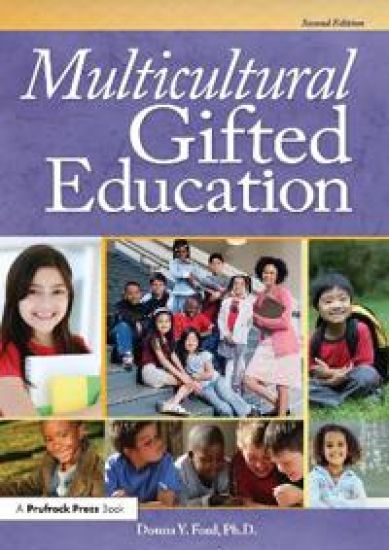
Multicultural Gifted Education

Multicultural Gifted Education

Donna Y. Ford

Prufrock Press
2011
nidottu
Each year, the United States witnesses significant changes in the demographics of its citizens. Accordingly, schools—and the students we teach—are also changing. With such changes come the need, responsibility, and obligation for educators to provide students with an education that is both rigorous and culturally responsive. This book bridges the gap that exists between educating advanced learners and educating culturally different learners. Multicultural Gifted Education, 2nd ed. addresses various topics, including racially and culturally diverse students and families, historical and legal perspectives on educating gifted and minority students, culturally responsive curriculum and assessment, and counseling students from a multicultural perspective.
Reversing Underachievement Among Gifted Black Students
Much has changed (and stayed the same) since the first edition of Reversing Underachievement Among Gifted Black Students was published in 1996. Although our nation and schools have changed racially and culturally, with more Black, Hispanic, and Asian students than ever before, our gifted programs and Advanced Placement (AP) classes remain much the same--primarily White and middle class. Two thorny issues that continue to exist in education are the underrepresentation of Black students in these classes and the persistent underachievement of Black students even when identified as gifted. In this edition, these two issues are addressed, with updated information on key social, familial, educational, and psychological factors that contribute to underachievement and underrepresentation. Underachievement and underrepresentation are placed squarely within the larger context of the achievement gap and deficit thinking. A central proposition is that we cannot close the achievement gap unless we eliminate deficit thinking and desegregate gifted education and AP classes. Reversing Underachievement is a must-have text that affords readers a comprehensive understanding of how schools, families, and the social, cultural, and psychological matrix all interact to affect both achievement and underachievement.
Academically Gifted African American Male College Students

Academically Gifted African American Male College Students

Donna Y. Ford; Fred A. Bonner II; Kofi Lomotey

Praeger Publishers Inc
2010
sidottu
The first-ever study of African American giftedness at the collegiate level, focusing on two extraordinary case studies. At a time when so many studies of African American students focus on the factors of failure, Academically Gifted African American Male College Students fills a conspicuous void in the research literature on post-secondary education by focusing on success. Like no other work before it, this remarkable study goes deep inside the experiences of academically gifted African American men who successfully navigate their way through rigorous college-level programs. At the heart of the unique and long overdue work are two real-life stories of African American male students: one at a Historically Black College and University (HBCU) and the other at a Traditionally White Institution (TWI). In presenting, comparing, and contrasting these two cases, the book identifies a number of personal characteristics and institutional approaches driving their notable achievements. The result is a guidebook both for gifted African American male students and for the institutions looking to strengthen their support for them—particularly in science, technology, engineering, and mathematics (STEM) disciplines.