Kirjojen hintavertailu. Mukana 12 595 353 kirjaa ja 12 kauppaa.

Kirjailija

Doris Marie Provine

Kirjat ja teokset yhdessä paikassa: 4 kirjaa, julkaisuja vuosilta 1996-2016, suosituimpien joukossa Policing Immigrants. Vertaile teosten hintoja ja tarkista saatavuus suomalaisista kirjakaupoista.

4 kirjaa

Kirjojen julkaisuhaarukka 1996-2016.

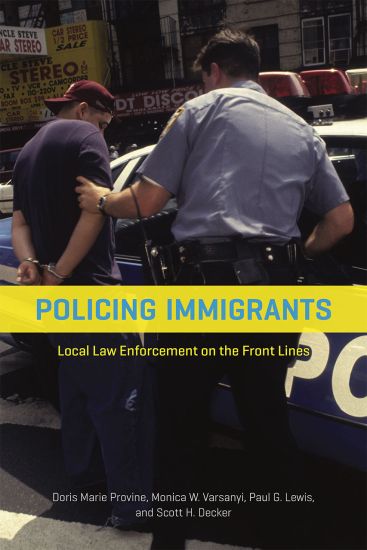
Policing Immigrants

Policing Immigrants

Doris Marie Provine; Monica W. Varsanyi; Paul G. Lewis; Scott H. Decker

University of Chicago Press
2016
nidottu
The United States deported nearly two million illegal immigrants during the first five years of the Obama presidency—more than during any previous administration. President Obama stands accused by activists of being “deporter in chief.” Yet despite efforts to rebuild what many see as a broken system, the president has not yet been able to convince Congress to pass new immigration legislation, and his record remains rooted in a political landscape that was created long before his election. Deportation numbers have actually been on the rise since 1996, when two federal statutes sought to delegate a portion of the responsibilities for immigration enforcement to local authorities.Policing Immigrants traces the transition of immigration enforcement from a traditionally federal power exercised primarily near the US borders to a patchwork system of local policing that extends throughout the country’s interior. Since federal authorities set local law enforcement to the task of bringing suspected illegal immigrants to the federal government’s attention, local responses have varied. While some localities have resisted the work, others have aggressively sought out unauthorized immigrants, often seeking to further their own objectives by putting their own stamp on immigration policing. Tellingly, how a community responds can best be predicted not by conditions like crime rates or the state of the local economy but rather by the level of conservatism among local voters. What has resulted, the authors argue, is a system that is neither just nor effective—one that threatens the core crime-fighting mission of policing by promoting racial profiling, creating fear in immigrant communities, and undermining the critical community-based function of local policing.
Law and the Quest for Justice

Law and the Quest for Justice

Doris Marie Provine; James P. Walsh; Marjorie S. Zatz

Quid Pro, LLC
2013
nidottu
An insightful collection of essays from leading voices on the challenges and promise of justice and law. This new book is accessible and interesting to a wide audience. It features internationally renowned members of the academy, national political figures, Pulitzer Prize-winning journalists, and crusading lawyers. The thought-provoking topics include: Erwin Chemerinsky on reconceptualizing federalism - John Echohawk on Native American rights - Jack Greenberg on Brown v. Board's legacy - Linda Greenhouse on how Supreme Court Justices evolve over time - Lani Guinier on reframing affirmative action - Antonia Hern ndez on what citizenship means after 9/11 - Anthony Lewis on broadening presidential power to fight terrorism - Janet Napolitano on security and rights after 9/11 - Charles Ogletree on achieving racial justice - Robert Reich on the economic inheritance of our children - Judith Resnik on Guant namo, Miranda, and public rights to fairness - Geoffrey Stone on sacrificing civil liberties in wartime. The volume originates from a lecture series honoring legal legend John P. Frank, who represented Ernesto Miranda in the Supreme Court. It is edited and presented by Marjorie S. Zatz and Doris Marie Provine-both professors of Justice & Social Inquiry at Arizona State University-and Arizona attorney James P. Walsh, who was also a law partner to John Frank.
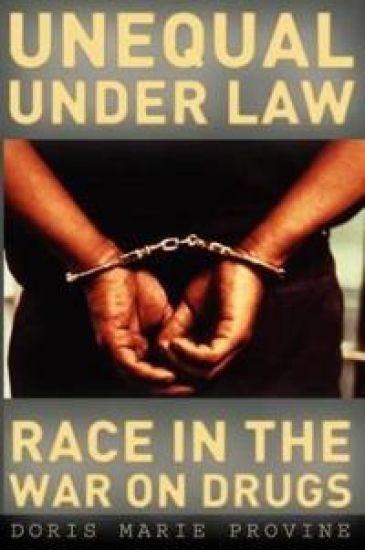
Unequal under Law

Unequal under Law

Doris Marie Provine

University of Chicago Press
2007
nidottu
Race is clearly a factor in government efforts to control dangerous drugs, but the precise ways that race affects drug laws remain difficult to pinpoint. Illuminating this elusive relationship, "Unequal under Law" lays out how decades of both manifest and latent racism helped shape a punitive U.S. drug policy whose onerous impact on racial minorities has been willfully ignored by Congress and the courts. Doris Marie Provine's engaging analysis traces the history of race in anti-drug efforts from the temperance movement of the early 1900s to the crack scare of the late twentieth century, showing how campaigns to criminalize drug use have always conjured images of feared minorities. Explaining how alarm over a threatening black drug trade fueled support in the 1980s for a mandatory minimum sentencing scheme of unprecedented severity, Provine contends that while our drug laws may no longer be racist by design, they remain racist in design. Moreover, their racial origins have long been ignored by every branch of government. This dangerous denial threatens our constitutional guarantee of equal protection of law and mutes a much-needed national discussion about institutionalized racism - a discussion that Unequal under Law promises to initiate.
Courts, Law, and Politics in Comparative Perspective

Courts, Law, and Politics in Comparative Perspective

Herbert Jacob; Erhard Blankenburg; Herbert M. Kritzer; Doris Marie Provine; Joseph Sanders

Yale University Press
1996
pokkari
This comprehensive book compares the intersection of political forces and legal practices in five industrial nations—the United States, England, France, Germany, and Japan. The authors, eminent political scientists and legal scholars, investigate how constitutional courts function in each country, how the adjudication of criminal justice and the processing of civil disputes connect legal systems to politics, and how both ordinary citizens and large corporations use the courts.For each of the five countries, the authors discuss the structure of courts and access to them, the manner in which politics and law are differentiated or amalgamated, whether judicial posts are political prizes or bureaucratic positions, the ways in which courts are perceived as legitimate forms for addressing political conflicts, the degree of legal consciousness among citizens, the kinds of work lawyers do, and the manner in which law and courts are used as social control mechanisms. The authors find that although the extent to which courts participate in policymaking varies dramatically from country to country, judicial responsiveness to perceived public problems is not a uniquely American phenomenon.