Kirjojen hintavertailu. Mukana 12 390 323 kirjaa ja 12 kauppaa.

Kirjailija

Dorothy E. Smith

Kirjat ja teokset yhdessä paikassa: 10 kirjaa, julkaisuja vuosilta 1985-2022, suosituimpien joukossa Manufacturing Meltdown. Vertaile teosten hintoja ja tarkista saatavuus suomalaisista kirjakaupoista.

10 kirjaa

Kirjojen julkaisuhaarukka 1985-2022.

Manufacturing Meltdown

Manufacturing Meltdown

D.W. Livingstone; Dorothy E. Smith; Warren Smith

Fernwood Publishing Co Ltd
2011
nidottu
In the 1980s, following decades of booming business, the global steel industry went into a precipitous decline, which necessitated significant restructuring. Management demanded workers’ increased participation in evermore temporary and insecure labour. Engaging the workers at the flagship Stelco plant in Hamilton, the authors document new management strategies and the responses of unionized workforces to them. These investigations provide valuable insights into the dramatic changes occurring within the Canadian steel industry.
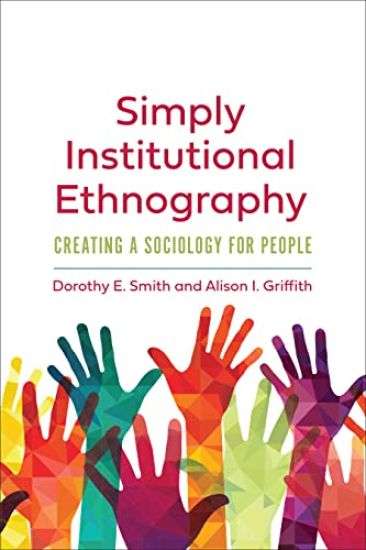
Simply Institutional Ethnography

Simply Institutional Ethnography

Dorothy E. Smith; Alison I. Griffith

UNIVERSITY OF TORONTO PRESS
2022
sidottu
Institutional ethnography (IE) originated as a feminist alternative to sociologies defining people as the objects of study. Instead, IE explores the social relations that dominate the life of the particular subject in focus. Simply Institutional Ethnography is written by two pioneers in the field and grounded in decades of ground-breaking work. Dorothy Smith and Alison Griffith lay out the basics of how institutional ethnography proceeds as a sociology. The book introduces the concepts – Discourse, Work, Text – that institutional ethnographers have found to be key ideas used to organize what they learn from the study of people’s experience. Simply Institutional Ethnography builds an ethnography that makes this material visible as coordinated sequences of social relations that reach beyond the particularities of local experience. In explicating the foundations of IE and its principal concepts, Simply Institutional Ethnography reflects on the ways in which the field may move forward.
Simply Institutional Ethnography

Simply Institutional Ethnography

Dorothy E. Smith; Alison I. Griffith

UNIVERSITY OF TORONTO PRESS
2022
pokkari
Institutional ethnography (IE) originated as a feminist alternative to sociologies defining people as the objects of study. Instead, IE explores the social relations that dominate the life of the particular subject in focus. Simply Institutional Ethnography is written by two pioneers in the field and grounded in decades of ground-breaking work. Dorothy Smith and Alison Griffith lay out the basics of how institutional ethnography proceeds as a sociology. The book introduces the concepts – Discourse, Work, Text – that institutional ethnographers have found to be key ideas used to organize what they learn from the study of people’s experience. Simply Institutional Ethnography builds an ethnography that makes this material visible as coordinated sequences of social relations that reach beyond the particularities of local experience. In explicating the foundations of IE and its principal concepts, Simply Institutional Ethnography reflects on the ways in which the field may move forward.
Texts, Facts and Femininity

Texts, Facts and Femininity

Dorothy E. Smith

Routledge
2016
sidottu
'A crucial book for feminists, for sociology and the new "political anthropological historical school". It informs us how we are differently "situated" in and through social relations, which texts and images mediate, organise and construct.' Philip Corrigan, Professor of Applied Sociology, Exeter University Dorothy E. Smith is Professor of Sociology in Education, Ontario Institute for Studies in Education, Toronto. She is the author of The Everyday World as Problematic: A Feminist Sociology.
Institutional Ethnography

Institutional Ethnography

Dorothy E. Smith

AltaMira Press,U.S.
2005
nidottu
Prominent sociologist Dorothy Smith outlines a method of inquiry that uses everyday experience as a lens to examine social relations and social institutions. Concerned with articulating an inclusive sociology that goes beyond looking at a particular group of people from the detached viewpoint of the researcher, this is a method of inquiry for people, incorporating the expert's research and language into everyday experience to examine social relations and institutions. The book begins by examining the foundations of institutional ethnography in women's movements, differentiating it from other related sociologies; the second part offers an ontology of the social; and the third illustrates this ontology through an array of institutional ethnography examples. This will be a foundational text for classes in sociology, ethnography, and women's studies.
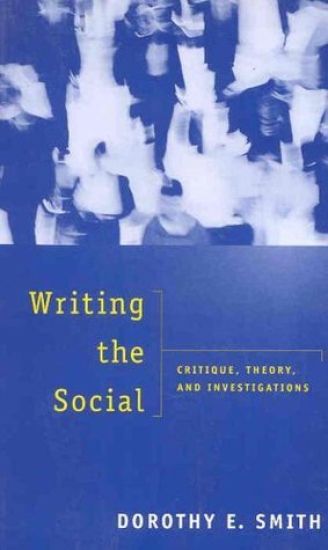
Writing the Social

Writing the Social

Dorothy E. Smith

University of Toronto Press
1999
pokkari
This collection of essays, written by Dorothy Smith over the past eight years, is a long-awaited treasure by one of the world's foremost social thinkers. In it, Smith turns her wit and common sense on the prevailing discourses of sociology, political economy, philosophy, and popular culture, at the same time developing her own sociological and feminist practice in unexpected and remarkable directions. Shedding the idiom of the sociologist, Smith inquires directly into the actualities of peoples' lives. Her critical investigations of postmodernism, political correctness, university politics, and SNAF (the Standard North American Family) draw on metaphors and examples from a stimulating range of autobiographical, theoretical, historical, political, and humorous resources. Out of an abstract encounter with Bakhtin, for example, comes an analysis of a child learning to name a bird, and a new way of seeing the story of Helen Keller. In introducing a radically innovative approach to the sociology of discourse, even the most difficult points are addressed through ordinary scenes of mothers, cats, and birds, as well as scientists, pulsars, and cell microscopes. Smith's engaged, rebel sociology throws light on a remarkable range of issues and authors, forever changing the way the reader experiences the world. This, her signature work, will delight a wide and varied audience, and enliven university courses for years to come.
Texts, Facts and Femininity

Texts, Facts and Femininity

Dorothy E. Smith

Routledge
1993
nidottu
'A crucial book for feminists, for sociology and the new "political anthropological historical school". It informs us how we are differently "situated" in and through social relations, which texts and images mediate, organise and construct.' Philip Corrigan, Professor of Applied Sociology, Exeter University Dorothy E. Smith is Professor of Sociology in Education, Ontario Institute for Studies in Education, Toronto. She is the author of The Everyday World as Problematic: A Feminist Sociology.
The Everyday World As Problematic

The Everyday World As Problematic

Dorothy E. Smith

Northeastern University Press
1989
nidottu
In this collection of essays, sociologist Dorothy E. Smith develops a method for analyzing how women (and men) view contemporary society from specific gendered points of view. She shows how social relations - and the theories that describe them - must express the concrete historical and geographical details of everyday lives. A vital sociology from the standpoint of women, the volume is applicable to a variety of subjects, and will be especially useful in courses in sociological theory and methods.
Women, Class, Family and the State

Women, Class, Family and the State

Varda Burstyn; Dorothy E. Smith

Garamond Press
1985
pokkari
The articles in this book begin from a concern to understand the relation between patriarchy and capitalism and to come to grips with the dissatisfaction many women feel despite the rhetoric of sexual equality which has become commonplace. Dorothy Smith examines the changing relation between the family and the economy in the context of the capitalist mode of production. Varda Burstyn traces the history of the sexual division of labour in pre-capitalist societies and shows how in industrial societies the state becomes the expression and enforcer of masculine domination.