Kirjojen hintavertailu. Mukana 12 595 353 kirjaa ja 12 kauppaa.

Kirjailija

Dorothy L. Hodgson

Kirjat ja teokset yhdessä paikassa: 9 kirjaa, julkaisuja vuosilta 2004-2017, suosituimpien joukossa Being Maasai, Becoming Indigenous. Vertaile teosten hintoja ja tarkista saatavuus suomalaisista kirjakaupoista.

9 kirjaa

Kirjojen julkaisuhaarukka 2004-2017.

Gender, Justice, and the Problem of Culture

Gender, Justice, and the Problem of Culture

Dorothy L. Hodgson

Indiana University Press
2017
pokkari
When, where, why, and by whom is law used to force desired social change in the name of justice? Why has culture come to be seen as inherently oppressive to women? In this finely crafted book, Dorothy L. Hodgson examines the history of legal ideas and institutions in Tanzania – from customary law to human rights – as specific forms of justice that often reflect elite ideas about gender, culture, and social change. Drawing on evidence from Maasai communities, she explores how the legacies of colonial law-making continue to influence contemporary efforts to create laws, codify marriage, criminalize FGM, and contest land grabs by state officials. Despite the easy dismissal by elites of the priorities and perspectives of grassroots women, she shows how Maasai women have always had powerful ways to confront and challenge injustice, express their priorities, and reveal the limits of rights-based legal ideals.
Gender, Justice, and the Problem of Culture

Gender, Justice, and the Problem of Culture

Dorothy L. Hodgson

Indiana University Press
2017
sidottu
When, where, why, and by whom is law used to force desired social change in the name of justice? Why has culture come to be seen as inherently oppressive to women? In this finely crafted book, Dorothy L. Hodgson examines the history of legal ideas and institutions in Tanzania – from customary law to human rights – as specific forms of justice that often reflect elite ideas about gender, culture, and social change. Drawing on evidence from Maasai communities, she explores how the legacies of colonial law-making continue to influence contemporary efforts to create laws, codify marriage, criminalize FGM, and contest land grabs by state officials. Despite the easy dismissal by elites of the priorities and perspectives of grassroots women, she shows how Maasai women have always had powerful ways to confront and challenge injustice, express their priorities, and reveal the limits of rights-based legal ideals.
The Gender, Culture, and Power Reader

The Gender, Culture, and Power Reader

Dorothy L. Hodgson

Oxford University Press
2015
nidottu
The Gender, Culture, and Power Reader explores different approaches to the study and conceptualization of gender, the value and limitations of gender as an analytic category, and the theoretical insights about gender produced by ethnographic research into the everyday lives, labors, loves, and livelihoods of people throughout the world. Why does gender "matter"? How are dominant ideas and practices of gender perceived, produced, experienced, and contested in different societies? How does ethnographic research provide access to these stories, perspectives, and experiences? What is the relationship between evidence and theory? The Gender, Culture, and Power Reader addresses these questions and more. Expertly edited by Dorothy L. Hodgson, this diverse reader includes both classical debates and relevant contemporary topics like gender-based violence and human rights.
Gendering Ethnicity in African Women’s Lives

Gendering Ethnicity in African Women’s Lives

Dorothy L. Hodgson

University of Wisconsin Press
2015
nidottu
Do African men and women think about and act out their ethnicity in different ways? Most studies of ethnicity in Africa consider men’s experiences, but rarely have scholars examined whether women have the same idea of what it means to be, for example, Igbo or Tswana or Kikuyu. Or, studies have invoked the adage “women have no tribe” to indicate a woman’s loss of ethnicity as she marries into her husband’s community. This volume engages directly the issue of women’s ethnicity and makes stimulating contributions to debates about how and why women’s movements have a unifying role in African political organization and peace movements.Drawing on extensive field research in many different regions of Africa, the contributors demonstrate in their essays that women do make choices about the forms of ethnicity they embrace, creating alternatives to male-centered definitions—in some cases rejecting a specific ethnic identity in favor of an interethnic alliance, in others reinterpreting the meaning of ethnicity within gendered domains, and in others performing ethnic power in gendered ways. Their analysis helps explain why African women may be more likely to champion interethnic political movements while men often promote an ethnicity based on martial masculinity. Bringing together anthropologists, historians, linguists, and political scientists, Gendering Ethnicity in African Women’s Lives offers a diverse and timely look at a neglected but important topic.
Africa, Fourth Edition

Africa, Fourth Edition

Victoria Bernal; Sandra E. Greene; Michael Lambert; Dorothy L. Hodgson; Leonardo A. Villalón

Indiana University Press
2014
pokkari
Since the publication of the first edition in 1977, Africa has established itself as a leading resource for teaching, business, and scholarship. This fourth edition has been completely revised and focuses on the dynamism and diversity of contemporary Africa. The volume emphasizes contemporary culture–civil and social issues, art, religion, and the political scene–and provides an overview of significant themes that bear on Africa's place in the world. Historically grounded, Africa provides a comprehensive view of the ways that African women and men have constructed their lives and engaged in collective activities at the local, national, and global levels.
Being Maasai, Becoming Indigenous

Being Maasai, Becoming Indigenous

Dorothy L. Hodgson

Indiana University Press
2011
sidottu
What happens to marginalized groups from Africa when they ally with the indigenous peoples' movement? Who claims to be indigenous and why? Dorothy L. Hodgson explores how indigenous identity, both in concept and in practice, plays out in the context of economic liberalization, transnational capitalism, state restructuring, and political democratization. Hodgson brings her long experience with Maasai to her understanding of the shifting contours of their contemporary struggles for recognition, representation, rights, and resources. Being Maasai, Becoming Indigenous is a deep and sensitive reflection on the possibilities and limits of transnational advocacy and the dilemmas of political action, civil society, and change in Maasai communities.
Being Maasai, Becoming Indigenous

Being Maasai, Becoming Indigenous

Dorothy L. Hodgson

Indiana University Press
2011
pokkari
What happens to marginalized groups from Africa when they ally with the indigenous peoples' movement? Who claims to be indigenous and why? Dorothy L. Hodgson explores how indigenous identity, both in concept and in practice, plays out in the context of economic liberalization, transnational capitalism, state restructuring, and political democratization. Hodgson brings her long experience with Maasai to her understanding of the shifting contours of their contemporary struggles for recognition, representation, rights, and resources. Being Maasai, Becoming Indigenous is a deep and sensitive reflection on the possibilities and limits of transnational advocacy and the dilemmas of political action, civil society, and change in Maasai communities.
The Church of Women

The Church of Women

Dorothy L. Hodgson

Indiana University Press
2005
pokkari
In Africa, why have so many more women converted to Christianity than men? What explains the appeal of Christianity to women? What does religious conversion mean for the negotiation of gender and ethnic identity? What role does religious conversion play as a tool for empowering women? In The Church of Women, Dorothy L. Hodgson looks at how gender has shaped the encounter between missionary priests and Maasai men and women in Tanzania. Building on her extensive experience with Maasai and the Spiritan missionaries, Hodgson explores how gendered change among Maasai has shaped women's notions of religious faith, religious practice, and spiritual power. Hodgson explores the appeal of Catholicism among women in East Africa, the enmeshing of Catholic practice with Maasai spirituality, and the meaning of conversion to new Christians. This rich, engaging, and original book challenges notions about religious encounter and the role of ethnic identity, female authority, and power among Maasai.
Once Intrepid Warriors

Once Intrepid Warriors

Dorothy L. Hodgson

Indiana University Press
2004
pokkari
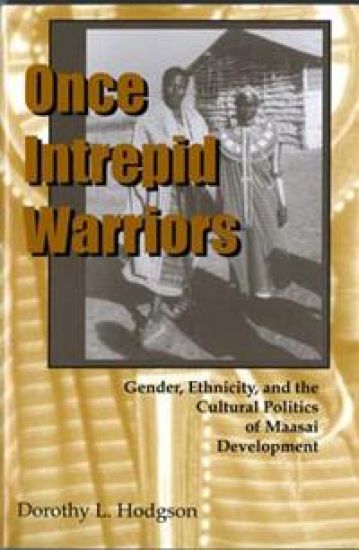
"Once Intrepid Warriors advances a brilliantly persuasive critique of development among the Maasai. . . . This historical ethnography is a tour de force, counter-balancing the analysis of cultural, political, and socio-economic transformation over the longue duree with intimate and memorable portraits of representative individuals." —Richard Werbner "In a series of chapters on the interrelationships of ethnicity, gender, and 'modernity,' Hodgson concludes that it is not the Maasai who have remained static, but rather the external images of them." —Choice ". . . meticulous and well-documented . . . a valuable resource. . . ." —Africa