Kirjojen hintavertailu. Mukana 12 390 323 kirjaa ja 12 kauppaa.

Kirjailija

Douglas Boyd

Kirjat ja teokset yhdessä paikassa: 32 kirjaa, julkaisuja vuosilta 2004-2026, suosituimpien joukossa Eleanor. Vertaile teosten hintoja ja tarkista saatavuus suomalaisista kirjakaupoista.

32 kirjaa

Kirjojen julkaisuhaarukka 2004-2026.

Plantagenet Princesses

Plantagenet Princesses

Douglas Boyd

Pen Sword History
2020
sidottu
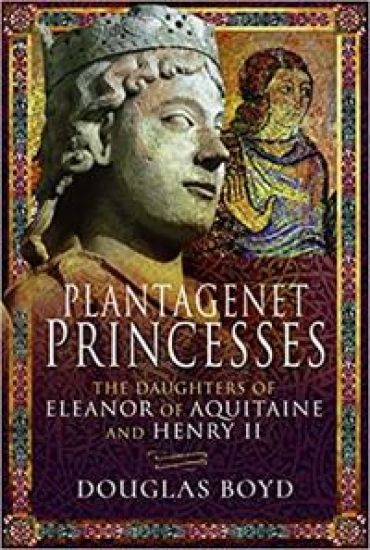
The names of few medieval monarchs and their queens are better known than Eleanor of Aquitaine, uniquely queen of France and queen of England, and her second husband Henry II. Although academically labelled medieval', their era was the violent transition from the Dark Ages, when countries' borders were defined with fire and sword. Henry grabbed the English throne thanks largely to Eleanor's dowry because she owned one third of France. Their daughters also lived extraordinary lives. If princes fought for their succession to crowns, the princesses were traded - usually by their mothers - to strangers for political power without the bloodshed. Years before what would today be marriageable age, royal girls were despatched to countries whose speech was unknown to them and there became the property of unknown men; their duty the bearing of sons to continue a dynasty and daughters who would be traded in their turn. Some became literal prisoners of their spouses; others outwitted would-be rapists and the Church to seize the reins of power when their husbands died. Eleanor's daughters Marie and Alix were abandoned in Paris when she divorced Louis VII of France. By Henry II, she bore Matilda, Alienor and Joanna. Between them, these extraordinary women and their daughters knew the extremes of power and pain. Joanna was imprisoned by William II of Sicily and worse treated by her brutal second husband in Toulouse. If Eleanor was libelled as a whore, Alienor's descendants include two saints, Louis of France and Fernando of Spain. And then there were the illegitimate daughters, whose lives read like novels
Normandy's Nightmare War

Normandy's Nightmare War

Douglas Boyd

Pen Sword History
2019
nidottu
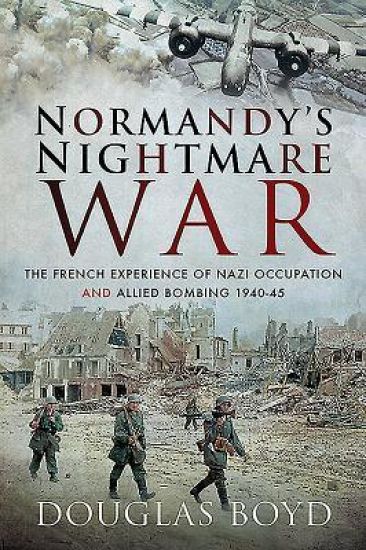
Famous for Calvados apple brandy and Camembert cheese, Normandy is a green and pleasant land now dotted with thousands of British-owned second homes. Its coastline is also dotted with thousands of indestructible reinforced-concrete bunkers and gun emplacements that formed part of the Atlantic Wall of Hitler's Fortress Europe. Tourists passing through the ferry ports like Boulogne, Cherbourg and Dunkirk may wonder why there are so few old buildings. Few know that the demolition which preceded the extensive urban renewal of the ancient town centres was effected by British bombs during four years of hell for the people living there. Before its belated liberation three ghastly months after D-Day, the sirens in Le Havre wailed 1,060 times to warn of approaching British and American bombers. After one single Allied raid, over 3,000 dead civilians were recovered from the city's ruins, without counting the thousands of injured, maimed and traumatised survivors. So, whom did the Normans regard as the enemy: the German occupiers who shot a few hundred civilians or the Allied airmen who killed as many neutral citizens of northern France as died in Britain from German bombs during the whole war? Told largely in the words of French, German and Allied eyewitnesses - including the moving last letters of executed hostages - this is the story of Normandy's nightmare war.
Moscow Rules

Moscow Rules

Douglas Boyd

The History Press Ltd
2018
nidottu
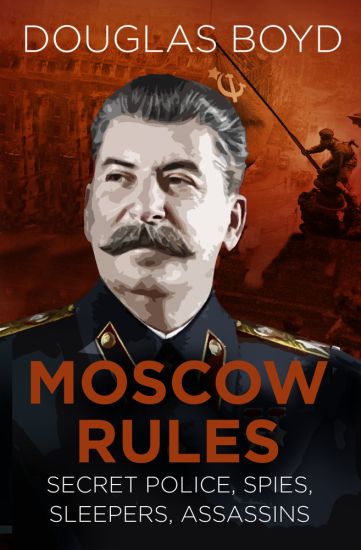
After the guns fell silent in May 1945, the USSR resumed its clandestine warfare against the western democracies. Stalin installed secret police services in the satellite countries of Central and Eastern Europe. Trained by his NKVD officers of the Polish UB, the Czech StB, the Hungarian AVO, Romania’s Securitate, Bulgaria’s KDS, Albania’s Sigurimi and the Stasi of the German Democratic Republic spied on and ruthlessly repressed their fellow citizens on the Soviet model. When the resultant hatred exploded in uprisings they were put down by brutality, bloodshed and Soviet tanks. Not so obvious was that these state terror organisations were also designed for military and commercial espionage in the West, to conceal the real case officers in Moscow. Specially trained operatives undertook ‘wet jobs’, including the assassinations. Perhaps the most menacing were the sleepers who who married and raised families in the west while waiting to strike against their host countries; many are still among us.In Moscow Rules Douglas Boyd explores the relationship between the KGB and its ghastly brood – a family from hell.
Red October

Red October

Douglas Boyd

The History Press Ltd
2017
sidottu
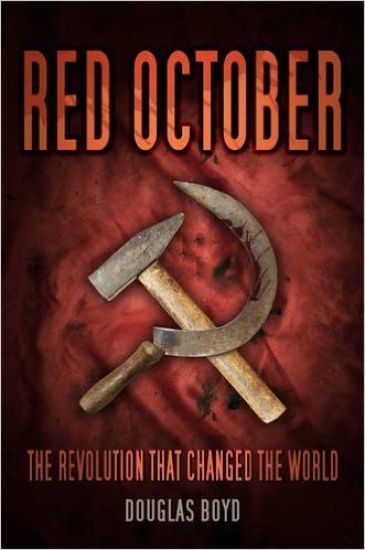
The October Revolution happened in November 1917. Later Soviet propaganda pretended for several decades that it was ‘the will of the people’, but in reality the brutal rebellion, which killed millions and raised the numerically tiny Bolshevik Party to power, was made possible by massive injections of German money laundered through a Swedish bank. The so-called ‘workers’ and peasants’ revolution’ had a cast of millions, of which the three stars were neither workers nor peasants. Nor were they Russian. Josef V. Djugashvili – Stalin – was a Georgian who never did speak perfect Russian; Leiba Bronstein – Trotsky – was a Jewish Ukrainian; Vladimir I. Ulyanov – Lenin – was a mixture of Tatar and other Asiatic bloodlines. Karl Marx had thought that the Communist revolution would happen in an industrialised country like Germany. Instead, German cash enabled Lenin, Trotsky, Stalin and Co. to destroy ineffective tsarist rule and declare war on the whole world. This is how they did it, told largely in the words of people who were there.
The Solitary Spy

The Solitary Spy

Douglas Boyd

The History Press Ltd
2017
sidottu
Of the 2.3 million National Servicemen conscripted during the Cold War, 4,200 attended the secret Joint Services School for Linguists, tasked with supplying much-needed Russian speakers to the three services. The majority were in RAF uniform, as the Warsaw Pact saw air forces become the greatest danger to the West. After training, they were sent to the front lines in Germany and elsewhere to snoop on Russian aircraft in real time. Posted to RAF Gatow in Berlin, ideally placed for signals interception, Douglas Boyd came to know Hitler’s devastated former capital, divided as it was into Soviet, French, US and British sectors. Pulling no punches, he describes the SIGINT work, his subsequent arrest by armed Soviet soldiers one night on the border, and how he was locked up without trial in solitary confinement in a Stasi prison. The Solitary Spy is a unique account of the terrifying experience of incarceration and interrogation in an East German political prison, from which Boyd eventually escaped one step ahead of the KGB.
Daughters of the KGB

Daughters of the KGB

Douglas Boyd

The History Press Ltd
2015
sidottu
After the guns fell silent in May 1945, the USSR resumed its clandestine warfare against the western democracies. Soviet dictator Josef Stalin installed secret police services in all the satellite countries of Central and Eastern Europe. Trained by his NKVD - a predecessor of the KGB - officers of the Polish UB, the Czech StB, the Hungarian AVO, Romania's Securitate, Bulgaria's KDS, Albania's Sigurimi and the Stasi of the German Democratic Republic (GDR) spied on and ruthlessly repressed their fellow citizens on the Soviet model. When the resultant hatred exploded in uprisings - in GDR 1953, Hungary 1956 and Czechoslovakia 1968 - they were put down by brutality, bloodshed and Soviet tanks. What was at first not so obvious was that these state terror organisations were also designed for military and commercial espionage in the West, to conceal the real case officers in Moscow. Specially trained operatives undertook mokrye dyela or 'wet jobs', including assassination of emigres and other anti-Soviet figures. Perhaps the most menacing were the sleepers who settled in the West, married and had children while waiting to strike against their host countries. Many of them are still among us.Here, historian and author Douglas Boyd explores for the first time the relationship between the KGB and its ghastly brood of 'daughters' - a true family from hell.
The Kremlin Conspiracy

The Kremlin Conspiracy

Douglas Boyd

The History Press Ltd
2014
nidottu
What did it mean when Vladimir Putin stepped down from president to prime minister of Russia in 2008 and bounced to the top again in 2013? The Putin-Medvedev clique of mega-rich ex-KGB men and lawyers call their state machine kontora – the firm – and run it as though they own all the shares. They command the largest armed forces in Europe, equipped with half the world’s nuclear warheads. Their air force regularly flies nuclear capable Tupolev Tu-95 strategic bombers into British airspace to analyse our radar defences and time in-the-air reaction. In a frightening foretaste of future warfare, the Kremlin launched a cyberattack on neighbouring Estonia in 2007 that crashed every computer and silenced every mobile phone, bringing the country to a complete halt. Was this just Tsar Vladimir bullying a small independent neighbour state that could not hit back – or a rehearsal for something far bigger? People call Putin’s power strategy ‘the new Cold War’. Author Douglas Boyd argues that it is the same one as before, fought with potent new weapons: the energy resources on which half of Europe now depends, and which can be turned off at Moscow’s whim. Recounted often in the words of participants, The Kremlin Conspiracy is the chilling story of 1,000 years of bloodshed that made the Russians the way they are. Today, Ukraine. Tomorrow? The past points the way, for the men running the Kremlin ‘firm’ are driven by the same motivation as Ivan the Terrible and Catherine the Great.
Lionheart

Lionheart

Douglas Boyd

The History Press Ltd
2014
sidottu
When people think of Richard the Lionheart they recall the scene at the end of every Robin Hood epic when he returns from the Crusades to punish his treacherous brother John and the wicked Sheriff of Nottingham. In reality Richard detested England and the English, was deeply troubled by his own sexuality and was noted for greed, not generosity, and for murder rather than mercy. In youth Richard showed no interest in girls; instead, a taste for cruelty and a rapacity for gold that would literally be the death of him. To save his own skin, he repeatedly abandoned his supporters to an evil fate, and his indifference to women saw the part of queen at his coronation played by his formidable mother, Queen Eleanor. His brief reign bankrupted England twice, destabilised the powerful empire his parents had put together and set the scene for his brother’s ruinous rule.So how has Richard come to be known as the noble Christian warrior associated with such bravery and patriotism? Lionheart reveals the scandalous truth about England’s hero king – a truth that is far different from the legend that has endured for eight centuries.
Blood in the Snow, Blood on the Grass

Blood in the Snow, Blood on the Grass

Douglas Boyd

The History Press Ltd
2012
sidottu
D-Day, 6 June 1944; a day that has gone down in history as one of the most crucial steps towards Allied victory of the Second World War. But what is known of the thousands of young Frenchmen and women who were formed into small, untrained armies and used as bait by the Allied powers to distract the German forces from the invasion beaches? These civilians were scattered through the French forests and hill country, and they believed that Allied forces would arrive to help them drive the hated Nazi occupiers out of France; but this support never arrived. Instead they were abandoned, to be hunted down by collaborationist French paramilitaries, Wehrmacht and Waffen-SS troops. Those that were lucky died quickly; the unlucky ones survived – they were brutally raped and tortured before being shot, or were deported to death camps in Germany. With rare, striking and often harrowing photographs of the people, places and events of this period, Boyd reveals the startling truth of the prologue to the D-Day landings, highlighting atrocities that should never be forgotten.
April Queen

April Queen

Douglas Boyd

The History Press Ltd
2011
nidottu
Eleanor of Aquitaine was the only person ever to sit on the thrones of both France and England. In this account of the turbulent adventures of the extraordinary mother of Richard the Lionheart and King John, author Douglas Boyd takes us into the heart and mind of the woman who changed the shape of Europe for 300 years by marrying Henry of Anjou to make him England's Henry II. Brought up in the comfort- and culture-loving Mediterranean civilisation of southern France, she was a European with a continent-wide vision and a peculiarly 'modern' woman who rejected the subordinate female role decreed by the Church. In this biography, using French, Old French, Latin and Occitan sources, Douglas Boyd lays bare Eleanor's relationship and vividly brings her world to life.
Eleanor, April Queen of Aquitaine

Eleanor, April Queen of Aquitaine

Douglas Boyd

Sutton Publishing Ltd
2004
sidottu
In this biography of Eleanor of Aquitaine, one of the most exciting women in European medieval history, Boyd takes the reader to the heart of this extraordinary woman. He reveals her as a peculiarly "modern" character - she rejects as a liberated woman the subordinate role decreed by the Chruch and Salic law; she refused to be a consenting victim of ethnic cleansing; and she promotes her vision of a continent wide dynasty - and sets her into the context of southern French civilization, with its love of comforts and pleasures in life. The book not only recreates the turbulent life of this woman, but takes the reader into the world she knew - her friendships, the food she ate, the clothes she wore, the sounds, sights and smells around her.