Kirjojen hintavertailu. Mukana 12 595 353 kirjaa ja 12 kauppaa.

Kirjailija

Douglas S Earl

Kirjat ja teokset yhdessä paikassa: 4 kirjaa, julkaisuja vuosilta 2010-2017, suosituimpien joukossa Reading Joshua as Christian Scripture. Vertaile teosten hintoja ja tarkista saatavuus suomalaisista kirjakaupoista.

Mukana myös kirjoitusasut: Douglas S. Earl

4 kirjaa

Kirjojen julkaisuhaarukka 2010-2017.

Reading Old Testament Narrative as Christian Scripture
Douglas Earl sets out a fresh perspective on understanding what is involved in reading Old Testament narrative as Christian Scripture. Earl considers various narratives as examples that model different interpretive challenges in the form of exegetical, ethical, historical, metaphysical, and theological difficulties. Using these examples, the significance of interpretive approaches focused on authorial intention, history of composition, canonical context, reception history, and reading context are considered in conjunction with spiritual, literary, structuralist, existential, historical-critical, and ethical-critical approaches. Christian interpretation of Scripture as Scripture is shown to be an inherently ad hoc task, understood as a rule-governed practice in Wittgenstein’s sense: an established goal-directed activity for which no method, hermeneutical principle, or critical perspective discovers ”meaning” or generates good interpretation. Good interpretation involves exploration of various construals of the “world of the text” using “hermeneutics of tradition” and “critique of ideology” (Ricoeur). The interpreter’s task is to discern faithful readings and develop their significance in a given intellectual or cultural context. The interpretation of Scripture and its appropriation is seen to involve wisdom in forming judgments on a case-by-case basis, learned through examples and experience, on what constitutes good interpretation and use. Earl shows how traditional hermeneutics and contemporary critical resources suggest that history, ethics, and theology can rarely be “read off” Old Testament narrative, but also how Christians can appropriate ethically and historically problematic books such as Joshua, faithfully adopt a “minimalist” approach to 1-2 Samuel, and embrace a Trinitarian reading of Genesis 1.
The Joshua Delusion?

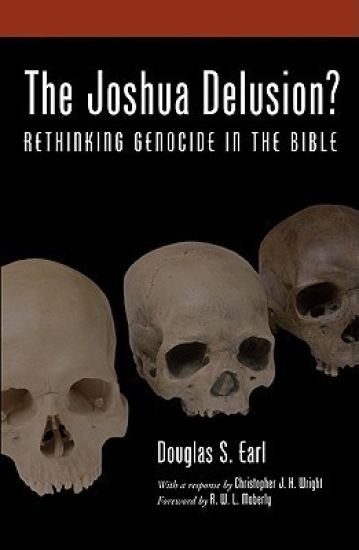
The Joshua Delusion?

Douglas S Earl; Walter Moberly; Christopher J H Wright

Wipf Stock Publishers
2011
nidottu
Description: Many Christians wrestle with biblical passages in which God commands the slaughter of the Canaanites-men, women, and children. The issue of the morality of the biblical God is one of the major challenges for faith today. How can such texts be Holy Scripture? In this bold and innovative book Douglas Earl grasps the bull by the horns and guides readers to new and unexpected ways of looking at the book of Joshua. Drawing on insights from the early church and from modern scholarship, Earl argues that we have mistakenly read Joshua as a straightforward historical account and have ended up with a genocidal God. In contrast, Earl offers a theological interpretation in which the mass killing of Canaanites is a deliberate use of myth to make important theological points that are still valid today. Christopher J. H. Wright then offers a thoughtful response to Earl's provocative views. The book closes with Earl's reply to Wright and readers are encouraged to continue the debate. Endorsements: "There is no doubt that the Bible-and the God of the Bible-are saturated with reams of violence . . . and nowhere more frontally than in the book of Joshua. Douglas Earl wades boldly into the problem of reading Joshua theologically. He brings to the task the rich resources of the Christian tradition and the best of current hermeneutical possibilities. The outcome is a rich, suggestive approach that invites deep rethinking of how we read such texts responsibly. His book is a welcome voice in an important, vexed, unfinished conversation." --Walter Brueggemann, Columbia Theological Seminary, USA "This sophisticated but plainly written study is eye-opening even for highly practiced readers and teachers of Scripture. Taking on one of the most difficult cases in the Bible, Earl offers guidance for discovering the truth of Scripture without sacrificing critical acumen on historical and ethical matters." --Ellen Davis, Duke Divinity School, USA "Douglas Earl aims to revive 'spiritual' or symbolic readings of Joshua, going back to Origen, but refined in the light of modern anthropological understandings of myth and symbol. This is a timely and illuminating book, written with the highest regard for Scripture, and I commend it warmly to all who are exercised by the problem of violence in the Old Testament." --Gordon McConville, University of Gloucestershire, UK About the Contributor(s): Douglas Earl did his PhD on the book of Joshua at the University of Durham. He is author of Reading Joshua as Christian Scripture. Christopher J. H. Wright is an Old Testament scholar and the Director of the Langham Partnership
Reading Joshua as Christian Scripture

Reading Joshua as Christian Scripture

Douglas S. Earl

Eisenbrauns
2010
pokkari
The book of Joshua has been received and used as Christian Scripture throughout Christian history. The challenge today, however, is how Christians should appropriately continue to read Joshua as Scripture, not least in the light of well-known historical and ethical difficulties with the narrative. In Reading Joshua as Christian Scripture, Douglas Earl draws on conceptual resources offered by recent anthropological approaches to myth and combines this with a close literary reading of the text, in order to argue that Joshua is misconstrued when it is treated as a historical account of conquest. Instead, in its ancient Israelite context Joshua functioned to reshape accepted norms of community identity, as reflected in the book of Deuteronomy, by forming a new “cultural memory.” Furthermore, Earl reconsiders the traditional notion of the “spiritual sense” of Scripture in terms of a rich account of symbol and also makes use of the narrative hermeneutics of Paul Ricoeur. The result is a fresh and unexpected reading of Joshua as Christian Scripture that develops the original function of the narrative in a way that resonates with classic premodern readings and is also challenging to contemporary Christian understandings of identity and faithfulness.