Kirjojen hintavertailu. Mukana 12 595 353 kirjaa ja 12 kauppaa.

Kirjailija

Duncan A. Buell

Kirjat ja teokset yhdessä paikassa: 4 kirjaa, julkaisuja vuosilta 1989-2026, suosituimpien joukossa Foundation Of Computation: Languages And Machines. Vertaile teosten hintoja ja tarkista saatavuus suomalaisista kirjakaupoista.

Mukana myös kirjoitusasut: Duncan A Buell

4 kirjaa

Kirjojen julkaisuhaarukka 1989-2026.

Foundation Of Computation: Languages And Machines

Foundation Of Computation: Languages And Machines

Stephen Anthony Fenner; Duncan A Buell

WORLD SCIENTIFIC PUBLISHING CO PTE LTD
2026
sidottu
This unique compendium presents the basics of the theory of computing at a level and in a manner that can be easily understood by computer science students in a large university. It offers the student a firm foundation in logical reasoning and covers many traditional topics in unconventional ways.The useful reference text benefits professionals, academics, researchers and undergraduate students in the area of theoretical computer science.
Data Structures Using Java

Data Structures Using Java

Duncan A. Buell

Jones and Bartlett Publishers, Inc
2011
nidottu
Written in an engaging and informal style, Data Structures Using Java facilitates a student's transition from simple programs in the first semester introductory programming course to more sophisticated, efficient, and effective programs in the second semester Data Structures course. Without delving too deeply into the details of Java, the author emphasizes the importance of effective organization and management of data and the importance of writing programs in a modern, object-oriented style. Designed to correlate with the curricular guidelines of the ACM/IEEE Computer Science Curriculum 2008, Data Structures Using Java introduces students to the more advanced concepts of writing programs but is still accessible to non-computer science majors. Believing that learning how to design and write programs requires hands-on application of concepts, the author includes labs throughtout the text for students to immediately apply and test the newly learned material. The accessible writing style and hands-on approach of Data Structures Using Java, will provide your students with the skills necessary to design and use algorithms and data structures in their programming careers in an uncluttered environment, and efficient manner. Key Features: -Content correlates to the learning objectives of the curricular guidelines of the 2008 ACM/IEEE Computer Science Curriculum. -Avoids much of the advanced theory to provide students with the practical skills required to write algorithms and create data structures, in a one-term CS2 course. -Ideal for students who want to enter the programming profession immediately -Includes lab exercises throughout for students to apply the newly learned concepts. Instructor Resources: -PowerPoint Lecture Outlines -Solutions to the chapter exercises -Test Bank -Source Code needed for the programming exercises.
Binary Quadratic Forms

Binary Quadratic Forms

Duncan A. Buell

Springer-Verlag New York Inc.
2011
nidottu
The first coherent exposition of the theory of binary quadratic forms was given by Gauss in the Disqnisitiones Arithmeticae. During the nine­ teenth century, as the theory of ideals and the rudiments of algebraic number theory were developed, it became clear that this theory of bi­ nary quadratic forms, so elementary and computationally explicit, was indeed just a special case of a much more elega,nt and abstract theory which, unfortunately, is not computationally explicit. In recent years the original theory has been laid aside. Gauss's proofs, which involved brute force computations that can be done in what is essentially a two­ dimensional vector space, have been dropped in favor of n-dimensional arguments which prove the general theorems of algebraic number the­ ory. In consequence, this elegant, yet pleasantly simple, theory has been neglected even as some of its results have become extremely useful in certain computations. I find this neglect unfortunate, because binary quadraticforms have two distinct attractions. First, the subject involves explicit computa­ tion and many of the computer programs can be quite simple. The use of computers in experimenting with examples is both meaningful and enjoyable; one can actually discover interesting results by com­ puting examples, noticing patterns in the "data," and then proving that the patterns result from the conclusion of some provable theorem.
Binary Quadratic Forms

Binary Quadratic Forms

Duncan A. Buell

Springer-Verlag New York Inc.
1989
sidottu
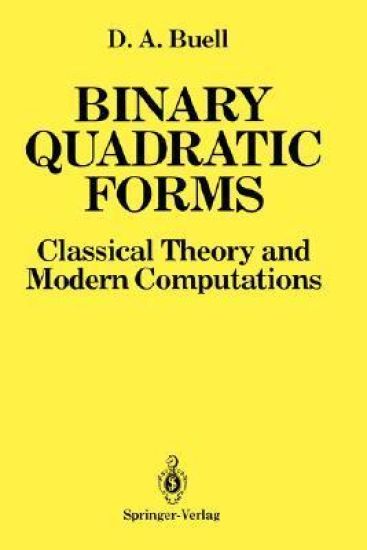
The first coherent exposition of the theory of binary quadratic forms was given by Gauss in the Disqnisitiones Arithmeticae. During the nine­ teenth century, as the theory of ideals and the rudiments of algebraic number theory were developed, it became clear that this theory of bi­ nary quadratic forms, so elementary and computationally explicit, was indeed just a special case of a much more elega,nt and abstract theory which, unfortunately, is not computationally explicit. In recent years the original theory has been laid aside. Gauss's proofs, which involved brute force computations that can be done in what is essentially a two­ dimensional vector space, have been dropped in favor of n-dimensional arguments which prove the general theorems of algebraic number the­ ory. In consequence, this elegant, yet pleasantly simple, theory has been neglected even as some of its results have become extremely useful in certain computations. I find this neglect unfortunate, because binary quadraticforms have two distinct attractions. First, the subject involves explicit computa­ tion and many of the computer programs can be quite simple. The use of computers in experimenting with examples is both meaningful and enjoyable; one can actually discover interesting results by com­ puting examples, noticing patterns in the "data," and then proving that the patterns result from the conclusion of some provable theorem.