Kirjojen hintavertailu. Mukana 12 390 323 kirjaa ja 12 kauppaa.

Kirjailija

Duncan Mills

Kirjat ja teokset yhdessä paikassa: 3 kirjaa, julkaisuja vuosilta 2004-2009, suosituimpien joukossa Signal Analysis. Vertaile teosten hintoja ja tarkista saatavuus suomalaisista kirjakaupoista.

3 kirjaa

Kirjojen julkaisuhaarukka 2004-2009.

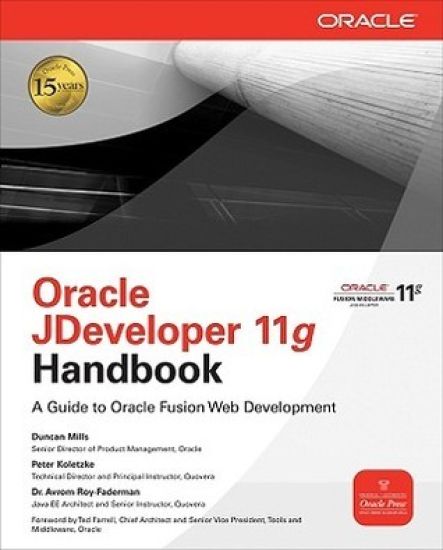
Oracle JDeveloper 11g Handbook

Oracle JDeveloper 11g Handbook

Duncan Mills; Peter Koletzke; Avrom Roy-Faderman

McGraw-Hill Professional
2009
nidottu
Publisher's Note: Products purchased from Third Party sellers are not guaranteed by the publisher for quality, authenticity, or access to any online entitlements included with the product.Written by the most knowledgeable Oracle JDeveloper author team in the worldThis Oracle Press guide shows how to build Web applications using the Fusion Middleware development tool, Oracle JDeveloper. The book discusses the latest technologies and explains how to develop code using multiple techniques.Oracle JDeveloper 11g Handbook: A Guide to Fusion Web Development covers the Oracle Application Development Framework and JavaServer Faces. Hands-on practice examples walk you through the creation of a complete sample application that employs highly-interactive user interface components and declarative development methods. You will learn the techniques required to implement Fusion-oriented software solutions in JDeveloper.
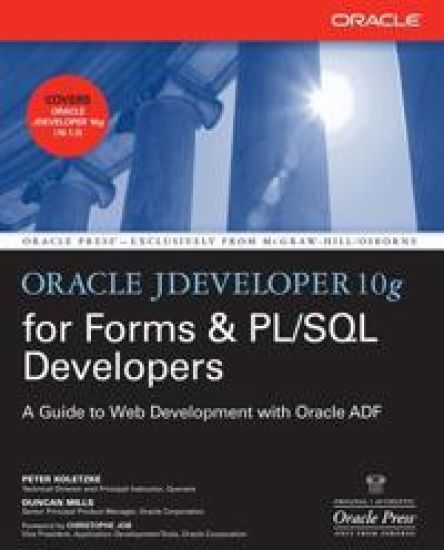
Oracle JDeveloper 10g for Forms & PL/SQL Developers: A Guide to Web Development with Oracle ADF
Publisher's Note: Products purchased from Third Party sellers are not guaranteed by the publisher for quality, authenticity, or access to any online entitlements included with the product.The most efficient way to learn J2EE programming techniquesTwo Oracle experts demonstrate techniques for working within J2EE and JDeveloper for the thousands of developers currently using Oracle Forms and the PL/SQL language. Oracle is shifting their focus towards Java technologies, so you will need to know how to use the Java-based J2EE and JDeveloper. The book includes explanations of the Application Development Framework (ADF). Throughout, high-level and low-level Forms concepts are related to Java concepts so that you can become comfortable with the new terminology.Covers the new components required when developing and deploying a J2EE applicationSpecial mentions in the text describe how JDeveloper techniques translate to PL/SQL or Oracle FormsCovers JDeveloper 10.1.3 and ADF FacesAll code and examples will be available online
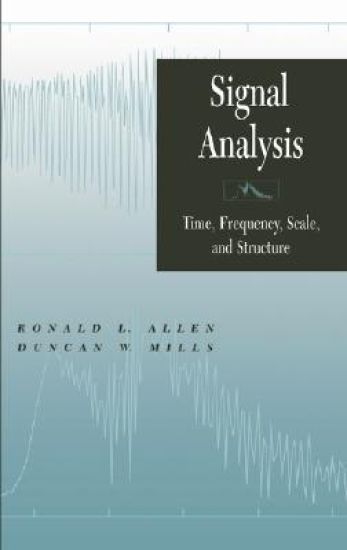
Signal Analysis

Signal Analysis

Ronald L. Allen; Duncan Mills

John Wiley Sons Inc
2004
sidottu
Signal analysis from concept to application Signal analysis, a method of arriving at a structural description of a signal so that later high-level algorithms can interpret its content, is a growing field with an increasing number of applications. Signal Analysis: Time, Frequency, Scale, and Structure opens a window into the practice of signal analysis by providing a gradual yet thorough introduction to the theory behind signal analysis as well as the abstract mathematics and functional analysis which may be new to many readers. Making the material accessible for readers of different levels of mathematical background, the authors clarify the basic concepts and types of signals and slowly build up to mastering the mathematics of Hilbert spaces, complex analysis, distributions, random signals, and analog Fourier transforms. Chapters cover: *Concepts of analog, discrete, and digital signals *Discrete systems and signal spaces, including linear and convolutional systems and lp signal spaces *Time domain signal analysis including segmentation and thresholding, filtering and enhancement, and edge and pattern detection *Continuous, discrete, and generalized Fourier transforms *The z-transform, time-frequency and time-scale signal transforms *Frequency domain and mixed-domain signal analysis Suitable as a professional reference, up-to-date review for practitioners, and a resource of signal analysis techniques, Signal Analysis: Time, Frequency, Scale, and Structure serves up a well-rounded, mathematical approach to problems in signal interpretation using the latest time, frequency, and mixed-domain methods.