Kirjojen hintavertailu. Mukana 12 390 323 kirjaa ja 12 kauppaa.

Kirjailija

Duncan Taylor

Kirjat ja teokset yhdessä paikassa: 3 kirjaa, julkaisuja vuosilta 2023-2024, suosituimpien joukossa Lest We Remember. Vertaile teosten hintoja ja tarkista saatavuus suomalaisista kirjakaupoista.

3 kirjaa

Kirjojen julkaisuhaarukka 2023-2024.

Lest We Remember

Lest We Remember

Duncan Taylor

Kropotkin Press
2024
nidottu
Is Britain ashamed of its past, and if not should it be? A dilapidated war memorial in Oxford city-centre seems a strange place to begin a search to the answer to these questions but this intriguing book does just that. It takes us from the mountains of Afghanistan to the tropics of Uganda to tell a tale of one city's often surprising links with the British Empire.Uncomfortable questions are raised with the focus as much on those commemorated on the memorial as on those who they came into contact with in the imperial realm. The author weaves a fascinating tale of individual experiences and their wider context which makes us think again about our past and how we remember it.Retracing the lives and events of those commemorated on the memorial this book draws on archival sources to trace two high Empire period military campaigns and the effect they had on the lives of those instigating them. It also turns the table and explores the impact on those who were caught up in the campaigns and the subsequent trajectories of their nations.It deals with wide themes of imperialism but does so by telling an all too human tale of the lives of the individuals caught in the historical stream.
Forensic DNA Trace Evidence Interpretation

Forensic DNA Trace Evidence Interpretation

Duncan Taylor; Bas Kokshoorn

TAYLOR FRANCIS LTD
2023
nidottu
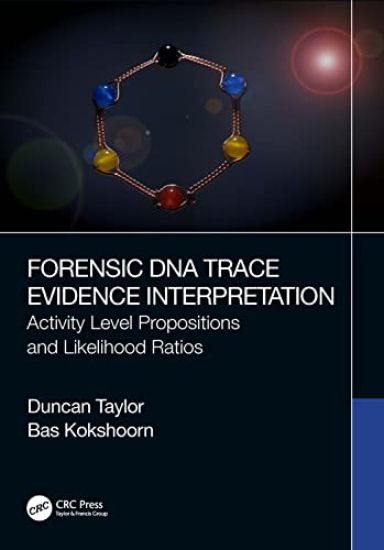
Forensic DNA Trace Evidence Interpretation: Activity Level Propositions and Likelihood Ratios provides all foundational information required for a reader to understand the practice of evaluating forensic biology evidence given activity level propositions and to implement the practice into active casework within a forensic institution. The book begins by explaining basic concepts and foundational theory, pulling together research and studies that have accumulated in forensic journal literature over the last 20 years. The book explains the laws of probability - showing how they can be used to derive, from first principles, the likelihood ratio - used throughout the book to express the strength of evidence for any evaluation. Concepts such as the hierarchy of propositions, the difference between experts working in an investigative or evaluative mode and the practice of case assessment and interpretation are explained to provide the reader with a broad grounding in the topics that are important to understanding evaluation of evidence. Activity level evaluations are discussed in relation to biological material transferred from one object to another, the ability for biological material to persist on an item for a period of time or through an event, the ability to recover the biological material from the object when sampled for forensic testing and the expectations of the prevalence of biological material on objects in our environment. These concepts of transfer, persistence, prevalence and recovery are discussed in detail in addition to the factors that affect each of them.The authors go on to explain the evaluation process: how to structure case information and formulate propositions. This includes how a likelihood ratio formula can be derived to evaluate the forensic findings, introducing Bayesian networks and explaining what they represent and how they can be used in evaluations and showing how evaluation can be tested for robustness. Using these tools, the authors also demonstrate the ways that the methods used in activity level evaluations are applied to questions about body fluids. There are also chapters dedicated to reporting of results and implementation of activity level evaluation in a working forensic laboratory. Throughout the book, four cases are used as examples to demonstrate how to relate the theory to practice and detail how laboratories can integrate and implement activity level evaluation into their active casework.
Forensic DNA Trace Evidence Interpretation

Forensic DNA Trace Evidence Interpretation

Duncan Taylor; Bas Kokshoorn

TAYLOR FRANCIS LTD
2023
sidottu
Forensic DNA Trace Evidence Interpretation: Activity Level Propositions and Likelihood Ratios provides all foundational information required for a reader to understand the practice of evaluating forensic biology evidence given activity level propositions and to implement the practice into active casework within a forensic institution. The book begins by explaining basic concepts and foundational theory, pulling together research and studies that have accumulated in forensic journal literature over the last 20 years. The book explains the laws of probability - showing how they can be used to derive, from first principles, the likelihood ratio - used throughout the book to express the strength of evidence for any evaluation. Concepts such as the hierarchy of propositions, the difference between experts working in an investigative or evaluative mode and the practice of case assessment and interpretation are explained to provide the reader with a broad grounding in the topics that are important to understanding evaluation of evidence. Activity level evaluations are discussed in relation to biological material transferred from one object to another, the ability for biological material to persist on an item for a period of time or through an event, the ability to recover the biological material from the object when sampled for forensic testing and the expectations of the prevalence of biological material on objects in our environment. These concepts of transfer, persistence, prevalence and recovery are discussed in detail in addition to the factors that affect each of them.The authors go on to explain the evaluation process: how to structure case information and formulate propositions. This includes how a likelihood ratio formula can be derived to evaluate the forensic findings, introducing Bayesian networks and explaining what they represent and how they can be used in evaluations and showing how evaluation can be tested for robustness. Using these tools, the authors also demonstrate the ways that the methods used in activity level evaluations are applied to questions about body fluids. There are also chapters dedicated to reporting of results and implementation of activity level evaluation in a working forensic laboratory. Throughout the book, four cases are used as examples to demonstrate how to relate the theory to practice and detail how laboratories can integrate and implement activity level evaluation into their active casework.